Sahil Sameer of OpenGrad on Building a Higher-Education Access Layer for Government Schools, AI-Led Career Mapping, and Tier-1 College Admissions at Scale
📝Interviews
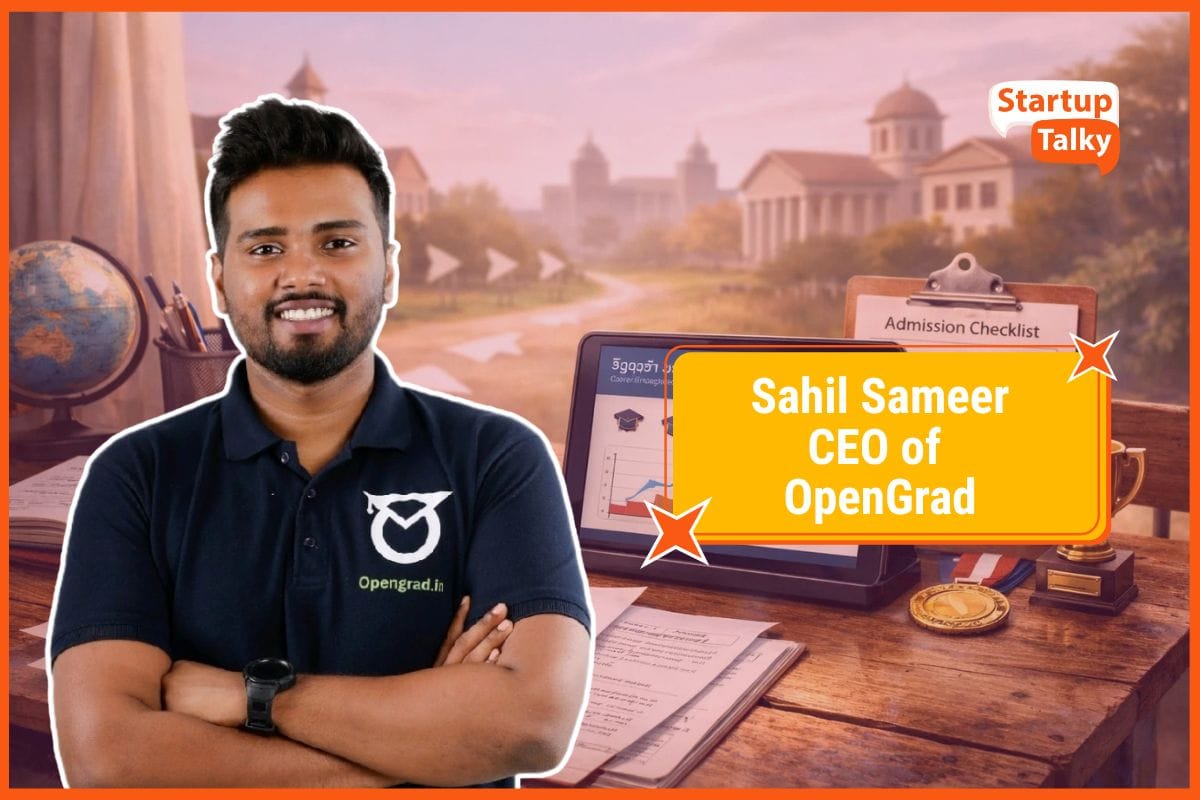
StartupTalky presents Recap'25, a series of exclusive interviews where we connect with founders and industry leaders to reflect on their journey in 2025 and discuss their vision for the future.
In this edition of Recap’25, StartupTalky speaks with Sahil Sameer, CEO of OpenGrad, who shares insights on addressing one of the most structural gaps in India’s public education system—bridging schooling outcomes with access to quality higher education. He reflects on how millions of government school students, particularly in rural and tribal regions, complete Class 12 without the guidance, preparation, or application support needed to enter top national and state-level colleges—where competitive entrance exams, coaching access, and informational advantages often determine mobility.
Sameer explains how OpenGrad is building the missing higher-education layer on top of government schools through district and state partnership models, fellowship-led implementation, and an AI-enabled platform designed for low-access contexts. The conversation explores OpenGrad’s work across Tamil Nadu and Chhattisgarh, its peer-led preparation model in Kerala, and how tools like Daksha—its voice-first, regional-language AI guidance platform—are helping students navigate exam pathways, preparation, and admissions end-to-end. He also shares key learnings from 2025 around scaling trust with governments and donors, building mission-aligned talent pipelines through fellows and alumni mentors, and OpenGrad’s long-term roadmap to embed a replicable higher-education access system within state education infrastructure.
StartupTalky: What is the core mission of OpenGrad, and how has its vision evolved over time?
Sahil Sameer: India’s public education system has made significant progress in improving school enrollment and board examination outcomes, but a critical gap remains in translating schooling into access to quality higher education. For students studying in government schools, especially in rural, tribal, and low-access regions, the education system largely ends at Class 12. Entry into good national and state-level colleges, which are key drivers of employment outcomes, exposure, and long-term social mobility is determined through competitive entrance examinations that lie entirely outside the scope of the public school system.
Government schools are structurally optimized for descriptive board exams, and teacher performance metrics are closely tied to pass percentages and completion rates. There is little institutional focus on higher-education pathways, entrance exams, application processes, or post-school transitions. Career counseling exists in theory, but counselor-to-student ratios in government systems often run into thousands per counselor, making meaningful guidance impossible. Even where counselors are present, they are rarely updated on rapidly changing entrance exam patterns, deadlines, or eligibility criteria. As a result, most students remain unaware of opportunities, miss critical application windows, or self-select out due to lack of confidence and exposure.
This gap is compounded by the fact that access to entrance exam preparation is overwhelmingly controlled by a private coaching industry. Quality preparation, mentoring, and guidance are concentrated in urban centers and priced far beyond the reach of most government school families. Students from more privileged backgrounds benefit not only from paid coaching, but also from relatable role models, alumni networks, and informal guidance that demystifies elite institutions. Government school students, many of whom are first-generation learners, lack these social and informational advantages, even when they have the academic potential to succeed.
The scale of this problem is significant. India sees over 10 million students complete higher secondary education every year, but only a small fraction gain entry into high-quality public institutions that disproportionately shape leadership, income, and opportunity. This is not merely an issue of employment; it is an issue of intergenerational mobility. Access to good colleges provides students with exposure, peer learning, confidence, and networks that influence life trajectories far beyond the first job. Without intervention, the public education system risks becoming a terminal pathway rather than a launchpad for social advancement.
OpenGrad exists to build the missing higher-education layer on top of the public school system. Our mission is to democratize access to top public colleges by ensuring that students from government schools are not excluded due to lack of guidance, preparation, or support. Addressing this problem aligns directly with our objective of converting years of schooling into meaningful outcomes by enabling informed career choices, structured entrance exam preparation, and end-to-end support through the college enrollment process.
StartupTalky: What are the key programs or initiatives through which you deliver impact today?
Sahil Sameer: State Government Partnership Model (Tamil Nadu): OpenGrad partners with the Tribal Welfare Department of Tamil Nadu across 130 government schools to deliver end-to-end career guidance and entrance exam preparation. In 2024–25, 1,100 students were supported, with 135 securing admissions to IITs, NITs, NLUs, and Central Universities. In the current year, OpenGrad is continuously supporting 6,000+ students across the state through career mapping, exam preparation, mentorship, and technology-enabled learning.
District Government Partnership Model (Chhattisgarh – Bijapur & MCB): OpenGrad works closely with district administrations in Manendragarh–Chirmiri–Bharatpur (MCB) and Bijapur to reach students in remote and low-access regions. During the 2024–25 pilot, 33 out of 50 students secured college admissions. In the current year, the program supports 500 students, with a strong focus on exam readiness, follow-through, and last-mile mentoring.
Community-Driven MBA Preparation Model (Kerala): OpenGrad runs a peer-led MBA preparation cohort in Kerala, anchored by a strong alumni mentor network. In 2023, 58% of the cohort (47 out of 80 students) secured admissions to IIMs. In 2024, 112 students converted IIM calls, with an even larger cohort being supported in the current year. A defining feature of this model is the virtuous cycle of alumni engagement, with successful aspirants returning as mentors for future cohorts.
Overall Impact & Measurement: Across programs, OpenGrad tracks key metrics including career pathway mapping, entrance exam enrollment, mock test performance, application completion, admissions secured, and post-admission retention. To date, OpenGrad has reached 10,000+ students and enabled 500+ Tier-1 college admissions, with a significant proportion of students appearing for entrance examinations in the current cycle.
StartupTalky: How has your focus area or sector changed in recent years, and how has your organization adapted to these shifts?
Sahil Sameer: Over recent years, the higher-education entrance ecosystem in India has become significantly more complex. The introduction of new national exams, frequent changes in exam patterns, and increasingly fragmented and technical notifications have made it extremely difficult for students—especially those from underprivileged backgrounds—to track eligibility, deadlines, and preparation pathways. This complexity has also increased the operational burden on organizations working at scale.
At the same time, the rapid adoption of AI-powered learning tools has created a widening gap between privileged students, who can easily access personalized preparation, and government-school students, who remain excluded from these advancements.
OpenGrad has adapted to these shifts in two key ways. First, we strengthened our Fellowship Program, placing trained fellows closer to students and institutions to provide hands-on support for exam navigation, registration, preparation planning, and follow-through. Second, we built Daksha, an AI-enabled learning and guidance platform designed specifically for low-access contexts. Daksha provides 24/7, regional-language, voice-first support, adaptive practice, and continuous tracking, ensuring that technological advancements benefit underserved students rather than deepen inequities.
Together, these adaptations allow OpenGrad to absorb system-level complexity while making the preparation journey simpler, more accessible, and more equitable for students.
StartupTalky: What impact metrics or indicators do you track to measure outcomes and effectiveness of your work?
Sahil Sameer: At the output level, OpenGrad tracks the number of students completing career mapping, enrolling in preparation programs, attempting mock tests, and submitting college applications. At the outcome level, indicators include improvement in mock test scores, percentage of students admitted to good state and national colleges, proportion of students joining mapped or preferred courses, and reduction in preparation-stage dropouts. At the impact level, indicators include college retention, employability proxies, income progression over time, and alumni participation as mentors.
Measurement and validation are conducted using platform analytics, assessment data, application and admission records, and cohort dashboards. Exam results and admissions are validated through official scorecards and allotment records, while longer-term outcomes are tracked through follow-ups and alumni engagement data.
StartupTalky: What were the biggest challenges your organization faced in the past year, and what key lessons emerged from navigating them?
Sahil Sameer: One of the biggest challenges OpenGrad faced in the past year was building trust as a relatively young organization while working with multiple stakeholders, including government departments, donors, and partner institutions. We addressed this by being extremely transparent—using technology, detailed reporting, and clear outcome tracking—along with guidance from a strong advisory board and support from leading incubator networks.
Another major challenge was rapid scaling while building a high-quality talent pool. We learned the importance of investing early in community-led capacity building. Engaged volunteers from top institutions gradually transitioned into fellows and full-time team members, helping us create a mission-aligned talent pipeline capable of sustaining growth.
These experiences reinforced that trust, transparency, and people are foundational to scaling impact responsibly.
StartupTalky: How do you ensure transparency, accountability, and trust among donors, partners, and beneficiaries?
Sahil Sameer: OpenGrad ensures transparency, accountability, and trust by operating a tech-first program model where all key activities and interactions are digitally tracked and recorded. Student enrollment, attendance, mentoring sessions, learning progress, mock tests, and exam applications are captured on centralized platforms, enabling real-time visibility for internal teams and partners.
Our outcomes are also clear and verifiable, as they are based on objective milestones such as exam registrations, participation, and college admissions. This makes impact measurement straightforward and reduces ambiguity around results.
In addition, structured dashboards and periodic reporting allow donors and government partners to independently track progress, while consistent documentation and data trails ensure accountability across programs and geographies.
StartupTalky: Looking ahead, what opportunities do you see for scaling impact, expanding reach, or deepening outcomes in the coming years, locally or globally?
Sahil Sameer: OpenGrad’s scale-up approach is intentionally designed to strengthen public education systems rather than operate parallel to them. Our focus is exclusively on government school cohorts, with the objective of building a replicable higher-education access layer that can be embedded within state education systems. Scale is therefore pursued through depth, system readiness, and institutional adoption, rather than rapid geographic expansion.
In the current phase, OpenGrad is operating a district-level model in Chhattisgarh and a state-level model in Tamil Nadu. Over the next year, the focus will be on consolidating these implementations by building robust technical systems, operational standard operating procedures (SOPs), and governance mechanisms. Tamil Nadu serves as the primary design and testing ground for technology, workflows, and delivery models due to its scale and infrastructure readiness. Learnings from Chhattisgarh provide insights into operating in lower-access and more constrained environments, strengthening the adaptability of the model.
Both the technical and non-technical components of OpenGrad’s model are designed to scale. On the technical side, the learning management system, AI-enabled career mapping tools, academic support agents, dashboards, and tracking systems are built as modular platforms. These systems can be adapted to new states with changes in language, entrance exam mix, academic calendars, and policy requirements, without rebuilding core architecture. The technology developed for Tamil Nadu will be reused and localized for new states, significantly reducing marginal costs and implementation time.
On the non-technical side, scalability is enabled through clearly defined processes and human roles. OpenGrad is codifying delivery workflows across career guidance, online training, exam registration, mentoring, and post-admission support into repeatable SOPs. Central to this is the Fellowship Program, which has been launched this year and will be expanded into a structured and aspirational fellowship. Fellows act as school-level champions responsible for coordinating career activities, enabling technology adoption, supporting students through applications, and serving as the interface between schools and OpenGrad’s central systems. As the program scales, Fellows become the backbone of execution, ensuring consistency while allowing contextual flexibility.
The scale-up roadmap follows a phased approach. During the 2026–27 academic year, OpenGrad will focus on strengthening systems, refining AI tools, improving operational efficiency, and expanding coverage within existing partner geographies. From the 2027–28 academic year, OpenGrad plans to onboard one additional state using the stabilized Tamil Nadu model. An additional state will be added in the subsequent academic year, ensuring that each expansion is supported by proven systems rather than ad-hoc execution.
At scale, the payer and the doer are clearly separated. Governments act as the primary payers, funding the intervention through state education or welfare budgets, often complemented by CSR or philanthropic capital during initial rollout phases. OpenGrad acts as the doer and implementation partner, responsible for program design, technology, training, delivery, and monitoring. Schools provide access and coordination, while Fellows and mentors execute on the ground using standardized systems.
This approach ensures that OpenGrad’s model scales sustainably, remains aligned with public education objectives, and builds long-term institutional capacity rather than temporary interventions.
StartupTalky: What role do technology and digital tools play in strengthening operations, monitoring impact, or community engagement?
Sahil Sameer: OpenGrad is a technology and AI-first organisation that leverages scalable, cost-effective digital systems to deliver education and employability support to underserved students across rural India.
A core innovation is our AI-powered Career Mapping Tool, which has been used by over 4,000 students to assess aptitude, interests, and skill gaps. The conversational system analyses learner inputs to generate personalised career pathways, skill recommendations, and progression plans, helping students make informed academic and career decisions in environments where traditional counselling access is limited. This AI-driven approach allows OpenGrad to deliver individualised guidance at scale without increasing operational costs.
Complementing this, our Attendance Mapping System supports over 7,000 students, enabling real-time monitoring and program optimisation. The Fellow Management Platform coordinates activities across 130 schools, supporting 35 fellows and facilitating structured collaboration with government stakeholders. Additionally, our Mentor–Mentee Scheduling Platform connects 300 mentors with 1,500 students, ensuring efficient mentor utilisation and consistent learner engagement.
StartupTalky: How do you plan to grow your programs and team sustainably while staying true to your mission?
Sahil Sameer: OpenGrad plans to grow sustainably by strengthening existing state and district partnerships before expanding to new geographies, ensuring quality and mission alignment. Our Fellowship Program serves as a long-term talent pipeline, bringing in committed graduates from top-tier institutions who gain deep on-ground experience and continue with the organization.
Sustainability is reinforced through a community loop, where students who benefit from the program return as mentors and volunteers, allowing impact to scale organically while preserving values, accountability, and institutional memory.
StartupTalky: One insight or piece of advice you would share with other non-profit leaders working in a similar space?
Sahil Sameer: The education and social impact sector is a long game, so patience and consistency matter more than quick wins. Build lean, test before scaling, and avoid overbuilding systems too early. It’s also important to explore hybrid or revenue-supported models, they help sustain quality, which beneficiaries may not always demand but always deserve.
Explore more Recap'25 interviews here.
Must have tools for startups - Recommended by StartupTalky
- Convert Visitors into Leads- SeizeLead
- Website Builder SquareSpace
- Run your business Smoothly Systeme.io
- Stock Images Shutterstock