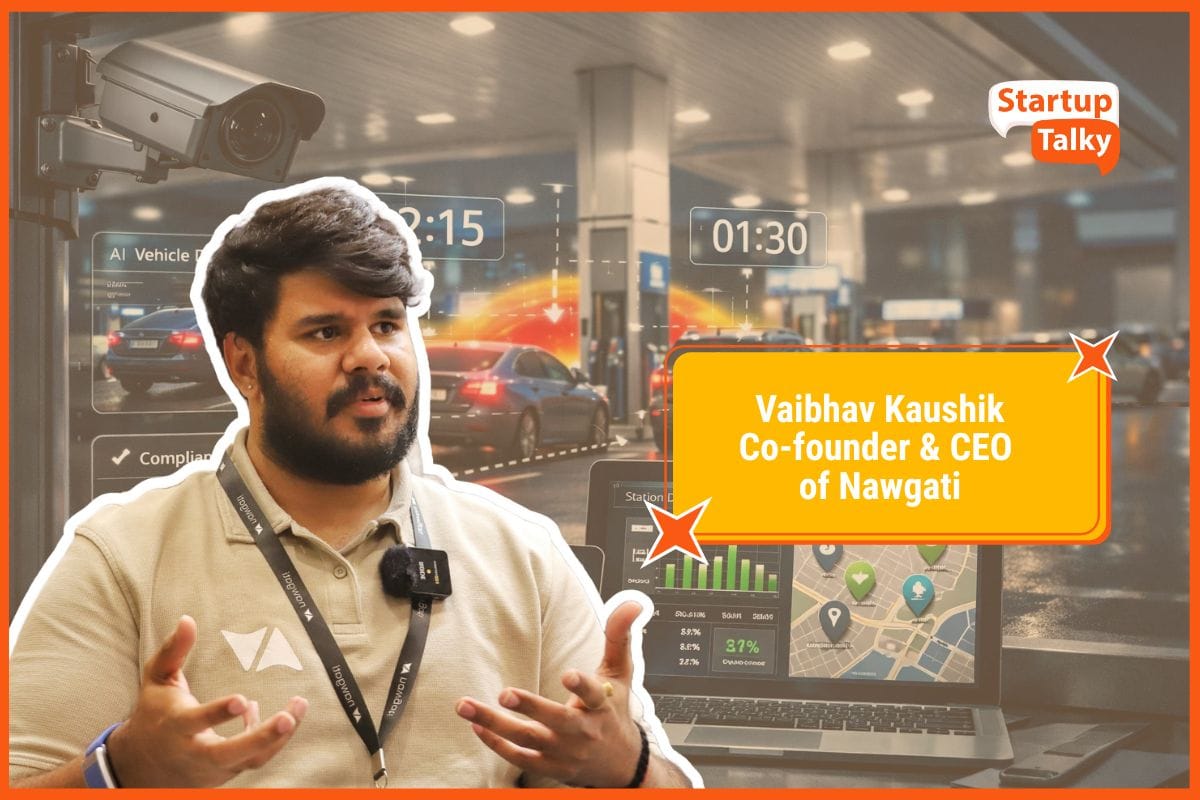
Vaibhav Kaushik of Nawgati on Fuel-Tech Infrastructure, Real-Time Station Intelligence, and AI-Driven Queue Management at Scale
📝Interviews
StartupTalky presents Recap'25, a series of exclusive interviews where we connect with founders and industry leaders to reflect on their journey in 2025 and discuss their vision for the future.
In this edition of Recap’25, StartupTalky speaks with Vaibhav Kaushik, Co-founder & CEO of Nawgati, who shares insights on building digital infrastructure for a traditionally manual and fragmented fuel retail ecosystem. He reflects on how long queues, unpredictable wait times, and lack of operational visibility at fuel stations create real economic and environmental costs—impacting not only everyday commuters, but also commercial drivers and fleet operators who depend on fast turnarounds to earn more.
Kaushik explains how Nawgati is evolving into a fuel-agnostic, data-driven platform serving consumers and fuel providers through two key products: the Nawgati Fueling App for real-time station discovery and wait-time visibility, and Aaveg, its B2B dashboard that delivers congestion analytics, compliance monitoring, and operational intelligence for station operators. The conversation explores how camera-based AI and predictive insights are enabling stations to improve throughput, reduce manual intervention, and deliver a more reliable fueling experience. He also shares key learnings from 2025, Nawgati’s traction with millions of organic app downloads, and the company’s roadmap for 2026, including expansion across petrol, diesel, CNG, and EV networks, deeper enterprise partnerships, and international rollout plans beginning with markets such as the UAE and Sri Lanka.
StartupTalky: What service does Nawgati provide? What was the motivation/vision with which you started?
Vaibhav Kaushik: With Nawgati, we’re building the digital infrastructure for fuel stations, OEMs, fleet operators, and the end consumer. We are India’s first fuel-tech platform built to modernise how people find and use fuel services, and how stations manage their operations. On the consumer side, we have our Nawgati Fueling App that helps drivers locate nearby petrol, diesel, CNG, and EV stations, view real-time wait times, and make data-driven decisions while on the move. On the business side, Aaveg is our B2B dashboard that gives station operators real-time insights into congestion, fuel availability, resource utilisation, and compliance metrics.
We began with a vision to solve a simple, yet real-world problem: long queues and wait times at fuel stations. It was back in 2019 when I used to travel a lot using Ola/Uber cabs for my internship, and during one of those commutes, I struck up a conversation with a driver while waiting for our turn to fuel up at a CNG station. He told me how much time they spend waiting in queues, time they could use to cover more trips in a day and earn more. While it felt like a simple problem to solve at the time, we realized the magnitude of the situation as we engaged with drivers and fuel providers. We realised the challenge was much bigger and systemic, as the stations lacked real-time visibility and tools to run efficiently, and consumers lacked reliable data while refuelling, which led to longer queues and waiting times, affecting not just the lifestyle but also contributing to environmental pollution.
StartupTalky: What new services have been added in the past year? What is/are the USP/s of your service?
Vaibhav Kaushik: In the past year, Nawgati has strengthened both consumer and B2B offerings. On the consumer side, we introduced support for Gujarati and Kannada, making the app accessible to more users across India. We also improved performance in low-network areas, ensuring that drivers can still access live station data even in remote regions. One of our popular additions has been ‘plan your trip’ with custom stops, allowing users to map their entire fuel journey with precision. For stations, we have upgraded Aaveg, which now delivers deeper analytics on resource utilisation, footprint management, and compliance monitoring. We’ve also worked on adding features like language support to enhance accessibility.
Our key USP is that we are not just building a one-sided solution; rather, we are creating an ecosystem that enables providers and consumers to engage effectively and efficiently: everyday drivers get reliable, live data to minimise wait times and plan journeys better. At the same time, station operators gain operational oversight previously unavailable in this sector. Moreover, while we started with one fuel type in mind, we’re now building a fuel-agnostic, data-driven platform that simplifies complexity and connects consumers, stations, fleet operators, and partners on one intelligent platform.
StartupTalky: How has the industry you are in changed in recent years, and how has Nawgati adapted to these changes?
Vaibhav Kaushik: From a static, slow, and disorganized service to a real-time, experience-driven, data-informed service, the traditionally run fuel industry has been steadily modernizing over the last few years. While the fuel industry in Tier 2 and 3 cities still operates in a disorganized manner, the story is different in Tier 1 cities, which move at a much faster pace. End users here expect transparency, instant insights, and predictable fueling experiences, and fuel stations are under pressure to meet that demand while handling congestion and complying with regulations with minimal downtime.
We’ve built AI and camera-based analytics from scratch to give station operators precise, actionable data on congestion, resource allocation, and customer flow, bringing automation and intelligence to a sector that had historically operated on manual observation.
So, in simple terms, we are an agile company, and to say we adapted to these changes would be an understatement. Over the last half a decade, we at Nawgati have evolved not just with the industry but with the changing consumer behaviour. From a simple queue management app to a complete fuel-tech ecosystem that supports real-time analytics, wait-time predictions, operational dashboards, and fuel-station management tools, we have paved the way to becoming India’s first and only fuel-tech ecosystem.
StartupTalky: What key metrics do you track to check the Nawgati's growth and performance?
Vaibhav Kaushik: We track growth through both consumer engagement and B2B adoption. On the consumer side, key metrics include app downloads, monthly active users, and app usage data indicating how reliably people depend on our real-time station insights. Nawgati’s app has already crossed 2.5 million organic downloads and continues to grow rapidly.
On the business side, we monitor the number of stations onboarded, the depth of usage of the Aaveg dashboard, reductions in congestion/wait times, improved fuel station traffic inflow, and increased operational efficiency metrics reported by station partners. We also look at partnerships with major gas providers, monthly subscription renewals, and geographic expansion into Tier-1 and Tier-2 cities as clear signs of traction. These metrics together show both market penetration and real operational value delivery. Moreover, as we expand globally, we are also focusing on product adoption and market acceptance as key growth factors.
StartupTalky: What were the most significant challenges Nawgati faced in the past year, and how did you overcome them?
Vaibhav Kaushik: One of our biggest challenges this year was scaling across diverse fuel networks while maintaining a consistent experience. Every region operates differently, with different traffic flows, different station layouts, and different levels of digital readiness. Bringing all of them onto a single unified platform required significant on-the-ground work, training, and product adaptation.
Another challenge was ensuring that real-time data stayed reliable in low-network or high-load conditions. Fuel stations are dynamic environments, and delays of even a few seconds can distort decision-making. We solved this by optimizing our data pipelines, improving offline resilience, and building smarter monitoring layers into Aaveg.
Lastly, rapid scale always tests internal processes. We focused heavily on strengthening our support systems, refining SOPs, and investing in team capability.
These challenges ultimately made the platform stronger and helped us build a more future-ready operational backbone for the industry.
StartupTalky: What are the different strategies you use for marketing? Tell us about any growth hack that you pulled off.
Vaibhav Kaushik: Marketing in our industry is less about noise and more about credibility. Our strategy has always been to let outcomes speak, such as reduced congestion, better throughput, and stronger compliance. Most of our growth has come from demonstrating results to one network and having that success travel through the ecosystem.
One growth hack that worked extremely well was using real-time station data as a storytelling tool. Instead of generic marketing, we showcased live improvements, queue drops, faster turnaround, and operational insights. This immediately resonated with operators because it wasn’t a pitch; it was their own data validating the product.
On the consumer side, we focused on regional language expansion, hyper-local awareness, and reliability in low-network areas. These small improvements significantly increased organic adoption because they solved real, everyday problems.
For us, marketing is simple: deliver value, show proof, and let the ecosystem amplify the story.
StartupTalky: What are the important tools and software you use to run your business smoothly?
Vaibhav Kaushik: At Nawgati, our operations depend heavily on tools that help us stay aligned, responsive, and data-driven. Internally, we rely on project management platforms for sprint planning, product tracking, and cross-team collaboration. Our engineering and data teams use monitoring and analytics tools to keep Aaveg stable, ensure uptime, and track real-time performance across thousands of fuel stations.
For customer support and operator engagement, we use communication and ticketing systems that allow us to respond quickly and track issues until resolution. This is important because fuel stations are high-dependency environments, and any disruption needs instant attention.
We also have internal dashboards built specifically for our team, giving us a live pulse of station operations, user behaviour, and performance metrics. These dashboards guide everything from product updates to on-ground deployments.
Overall, the combination of structured workflows, strong analytics, and custom in-house tools allows us to run a tight, efficient operation at scale.
StartupTalky: What opportunities do you see for future growth in your industry in India and the world? What kind of difference in market behavior have you seen between India and the world?
Vaibhav Kaushik: There is a massive global opportunity to digitise a traditionally manual sector like fuel retail. Most stations, whether in India or abroad, still operate with limited real-time visibility, which affects everything from congestion to compliance. This is where Aaveg, our operator-facing platform, becomes a critical part of the ecosystem. It brings accuracy, predictability, and live operational intelligence to forecourt operations, giving fuel station owners a level of control that simply didn’t exist before.
India’s opportunity, however, is even more exciting. Unlike mature markets, India is a mobile-first, multilingual, rapidly digitising environment. Consumers are actively seeking convenience, shorter wait times, and reliable information without having to step away from their route. Through the Nawgati app, we’re building a strong consumer layer that complements Aaveg, offering live congestion data, fastest route planning, and a more predictable fueling experience. This behaviour, which demonstrates high adoption and strong reliance on real-time data, is unique to India and accelerates our scale.
Globally, the behaviour is different. Infrastructure is strong, but the digital layer is fragmented or missing. To improve overall fuelling activity at the stations, operators abroad want standardised visibility and automated intelligence, and Aaveg fits that need directly.
The industry is clearly moving toward software-led fuel management, and both Aaveg and the Nawgati app position us at the centre of that shift.
StartupTalky: How are you using AI, whether in service delivery, internal processes, or customer experience, and what impact has it created?
Vaibhav Kaushik: AI is becoming the core engine behind how we scale Nawgati’s impact across fuel and mobility networks. Our platform Aaveg already monitors thousands of stations in real time, but the real shift is happening as we move from simple detection to true interpretation and decision-making. We’re now integrating advanced AI models that can read CCTV video inputs, understand real-world scenarios, and reason through them.
These systems can interpret behaviour, identify non-compliance, anticipate congestion, and recommend corrective actions instantly. Layered with agentic AI, this intelligence doesn’t just observe; it supports real-time decisions and on-ground actions, dramatically improving operational efficiency, safety, and service quality.
For fuel operators, this means fewer manual interventions, higher throughput, reduced pilferage, and stronger SOP adherence. For consumers, it translates to smarter stations that run predictably and consistently.
StartupTalky: How do you plan to expand the Customers, service offerings in the future?
Vaibhav Kaushik: Nawgati aims to be fuel-agnostic, integrating petrol, diesel, CNG, EV charging, and future mobility services into one platform. So, we plan to expand in three key directions: deepen enterprise partnerships with OEMs and fleet operators, scale consumer adoption across fuel types and regions, and introduce advanced products tailored for EV charging stations.
Geographically, we’re already exploring international expansion through partnerships, beginning with the UAE and Sri Lanka markets, to modernise global fuel retail operations. Further, offerings in the future will include richer analytics suites, predictive station performance tools, and APIs for ecosystem partners to build on top of Nawgati’s data infrastructure. At every step, the goal is to make fueling frictionless and efficient for customers and operators alike.
StartupTalky: One tip that you would like to share with another Service company founder?
Vaibhav Kaushik: A simple tip to any founder is to focus on solving a real, measurable problem and let that drive your product decisions. In service businesses, impact speaks louder than promises as the customers adopt solutions that clearly save them time, money, and effort.
So, build feedback loops early, iterate fast, and validate every assumption with real users. If you can make your offering indispensable in their daily workflow, growth becomes organic and sustainable.
Explore more Recap'25 interviews here.
Must have tools for startups - Recommended by StartupTalky
- Convert Visitors into Leads- SeizeLead
- Website Builder SquareSpace
- Run your business Smoothly Systeme.io
- Stock Images Shutterstock