

The Shift Towards Tech-Led Interiors: What Leading Design Firms Are Doing Differently
✍️ Opinions
This article has been contributed by Anita Yadagiri, Director – The Canvas, ANJ Group
Technology has moved to the heart of workspace design. Modern offices are expected to sense, adapt and respond to people in real time, making intelligence as critical as aesthetics. This shift is reshaping every design decision, from spatial planning to long-term performance. Leading designers are now treating technology as a core design language, one that defines the workplace as much as its architecture and materials.
The Rise of Data-First Design: When Workplaces Start Responding to People
For years, design began with intuition, what we believed a space should look and feel like. That mindset has changed dramatically. Today, the most forward-thinking interiors begin with data, not decor. When we understand how people move through a space, what environments energise them, what frustrates them, and where real collaboration happens, the workplace becomes a living organism that reflects the pulse of an organisation. Occupancy heatmaps, workflow analytics and spatial utilisation data now offer precise clues about what a workplace actually needs, instead of what trends dictate. The aim is to design workplaces that continue to evolve, where environments shift with teams, workstyles change and technology expands. Such an approach allows space to learn from its users rather than the other way around.
Productising Space Through Digital Twins: Designing Tomorrow Before We Build Today
A major transformation in our industry is the move from static floor plans to dynamic digital twins. Earlier, clients had to imagine what a space might feel like. Today, they can step into it, test it and even stress-test it before a single tile is placed. Digital twins allow us to model everything from daylight penetration, acoustics, air flow, energy loads, movement patterns and collaborative behaviour. This brings science into what was once largely intuition driven. The magic lies in the ability to simulate variations: What if a team grows by 40%? What if hybrid work increases meeting room demand? What if the organisation shifts to project-based clusters next year? With digital twins, these are no longer theoretical questions but testable models. This approach has changed how we design and build. It reduces rework, accelerates decision-making and gives clients unprecedented clarity. It allows us to treat the workspace not as a one-time project but as a system that can be updated, modulated, improved and scaled with the organisation.
Technology as the Spatial Spine: From AV/IT Integration to Hybrid Intelligence
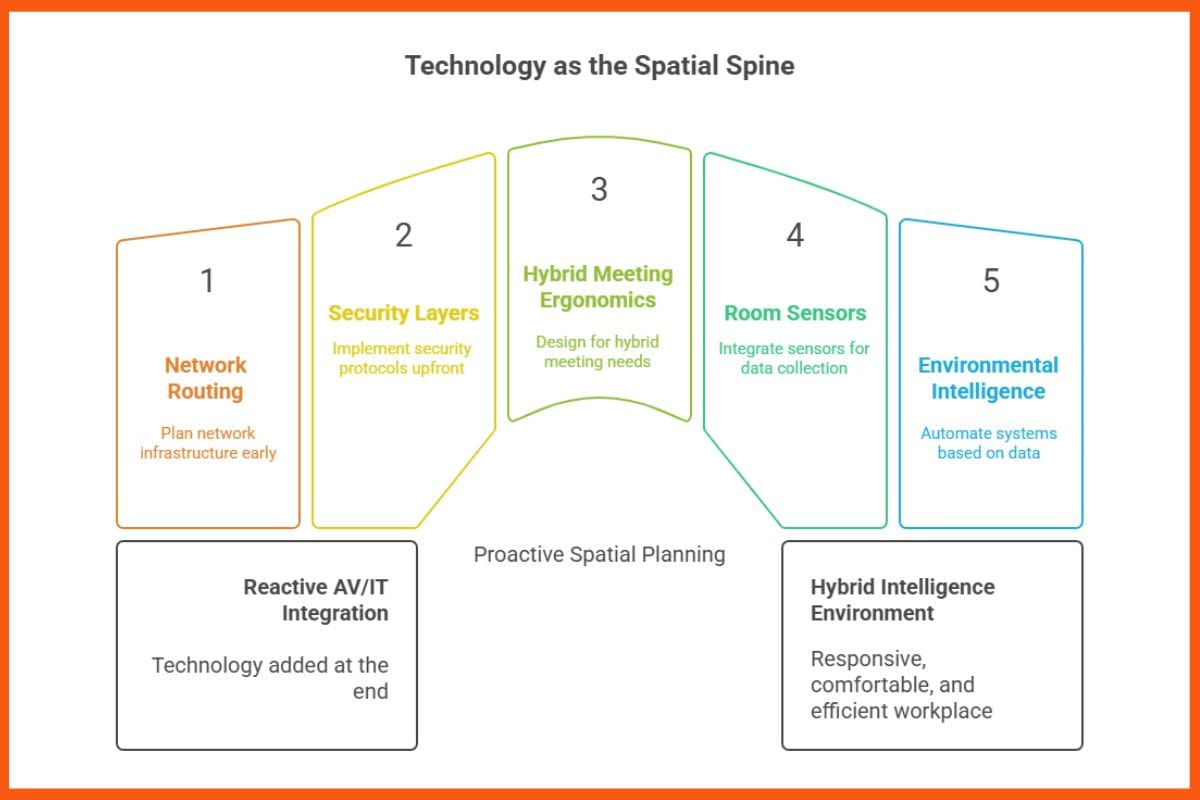
There was a time when AV and IT were added towards the end of a project with screens, cables, routers and sensors squeezed into whatever space was left. Today, technology has become a design spine. We now anchor spatial planning around AV and IT logic, with network routing, security layers, hybrid-meeting ergonomics, room sensors, environmental intelligence and automation systems informing the design language from day one. This shift has been essential because the workplace is digital, distributed and interconnected. Designing for hybrid work is only the starting point. The future lies in designing for hybrid intelligence. Smart scheduling systems, adaptive HVAC, predictive maintenance, mood-based lighting and real-time occupancy create environments that respond in the moment. These interventions reduce energy waste, improve comfort and support wellbeing.
High-Touch Meets High-Tech: Human Warmth in Digitally Intelligent Spaces
People crave warmth, nature, handcrafted textures, biophilic cues and a sense of belonging. This is why the future isn’t high-tech versus high touch but symbiosis of both. We are designing spaces where tactility coexists with intelligence, materiality supports digital precision and emotional resonance meets functional efficiency. A space might have adaptive lighting, but the glow still feels warm. It might have automated blinds, but the palette is inspired by nature. It might have integrated sensors, but the textures remain comforting and familiar. This approach makes technology humane. It reassures teams that the workplace supports them. Equally important is the environmental intelligence embedded into these systems. Sensors optimise fresh air cycles, track water usage, maintain indoor air quality and reduce energy loads. Smart materials support responsible use of resources. So, while the space feels natural and timeless, its performance is futuristic and sustainable.
The Workplace as a Living System: Co-Creation, Modularity and the New Designer
Modern workplace is a living and breathing ecosystem, shaped its workers. Design and build teams must embrace modularity, iteration and long-term technological integration. Panels, flooring systems, partitions, lighting grids and collaborative settings are now designed as modular products that can be moved, replaced or reconfigured with minimal disruption. This flexibility allows organisations to reinvent their workplace without starting from scratch. Immersive technologies, including, VR, AR, Unreal-engine walkthroughs and lighting/material simulators, are turning clients into co-creators. They can test design in real time. The design team now includes computational designers, BIM specialists, UX strategists, data scientists and sustainability experts working alongside architects and interior designers. This cross-functional integration is redefining how workplaces are imagined and delivered. The success of any tech-led interior depends on how it amplifies human experience, enabling them to work and grow with ease.
The shift towards tech-led interiors is an evolution that blends intelligence with empathy, precision with warmth and innovation with purpose. As workplaces continue to evolve, the firms that design them must evolve too, creating environments that are smarter and more humane.
 PV Vyshnavi