

Best Gym Management Software Platforms for Fitness Businesses: Features, Pricing, and Best Picks by Business Type
Collections 🗒️
Running a gym on spreadsheets no longer works. In today's time, the gap between fitness businesses using modern gym management software and those relying on manual systems has become a clear competitive divide. Members now expect mobile class booking, in-app progress tracking, and automated billing reminders, while gym owners need real-time visibility into revenue, attendance, and retention.
The market has evolved rapidly. The global fitness app market is projected to reach $15.6 billion by 2028, with gym management platforms at the core. AI-powered analytics, wearable integrations, and retention-focused automation are now standard. The challenge is no longer basic functionality, but choosing the right platform for your specific fitness business.
This guide analyses some of the leading gym management software platforms across pricing, features, and real-world fit to help gym owners, boutique studios, and fitness entrepreneurs make the right choice.
How We Evaluated These Gym Management Software Platforms
To make this comparison useful, we evaluated each platform against consistent criteria:
- Core functionality: Does it handle billing, scheduling, and member management without friction? These are non-negotiable.
- Ease of use and mobile experience: How quickly can staff learn the system? More importantly, how do members experience the app they will use daily?
- Pricing transparency: Some platforms publish clear pricing. Others require demos and sales calls. We note which is which.
- Niche specialization: A platform built for CrossFit differs substantially from one built for multi-sport facilities. We identify where each platform excels.
- Support and onboarding quality: Implementation matters. Research from Software Advice shows that onboarding time is one of the top three concerns for fitness business owners. A feature-rich platform that takes six weeks to configure may cost more in lost time than a simpler alternative.
- Integrations and ecosystem: Does the platform play well with payment processors, accounting software, and other tools you already use?
- User reviews and market credibility: Capterra ratings and G2 reviews provide a signal, though we weight them appropriately given that smaller platforms may have fewer reviews but still deliver quality.
A note on pricing: several platforms hide pricing behind demo requests. Where pricing is not publicly available, we indicate this clearly.
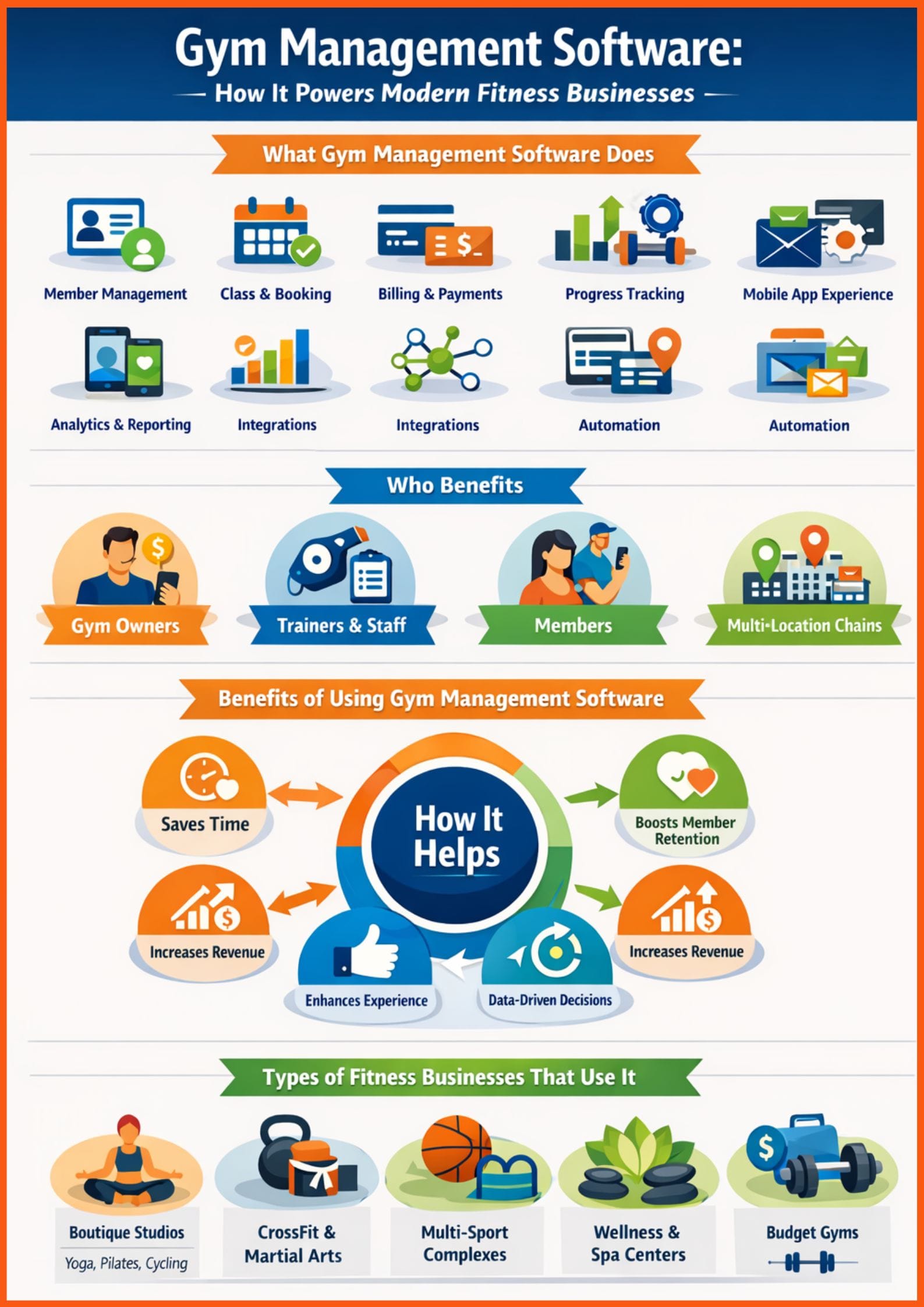
Quick Comparison: Top Gym Management Software Platforms
Before getting into detailed reviews, here is a summary comparison for quick reference:
| Platform | Best For | Starting Price | Capterra Rating | Key Strength |
|---|---|---|---|---|
| PushPress | CrossFit, martial arts | Free (2.19% + $0.30/txn) | 4.7/5 | Member engagement tools |
| Zen Planner | Boutique studios, martial arts | $99/month | 4.3/5 | Belt/rank tracking |
| Mindbody | Large wellness businesses | Custom quote | 4.0/5 | Consumer marketplace |
| Glofox | Boutique fitness studios | Custom quote | 4.4/5 | Branded mobile app |
| Virtuagym | Gyms with coaching focus | Custom quote | 3.8/5 | Nutrition integration |
| Coast | Equipment/facility management | Free / $20/user/mo | N/A | Operations focus |
| 1club.ai | Small-mid gyms (AI-native) | Free | 4.7/5 | Transparent pricing |
| EZFacility | Multi-sport complexes | Custom quote | 4.4/5 | Space scheduling |
| Club Automation | Scaling operations | Custom quote | N/A | Enterprise features |
| Recess | Budget-conscious gyms | Free | N/A | No booking caps |
List of Best Gym Management Software Platforms: In-depth Reviews
PushPress
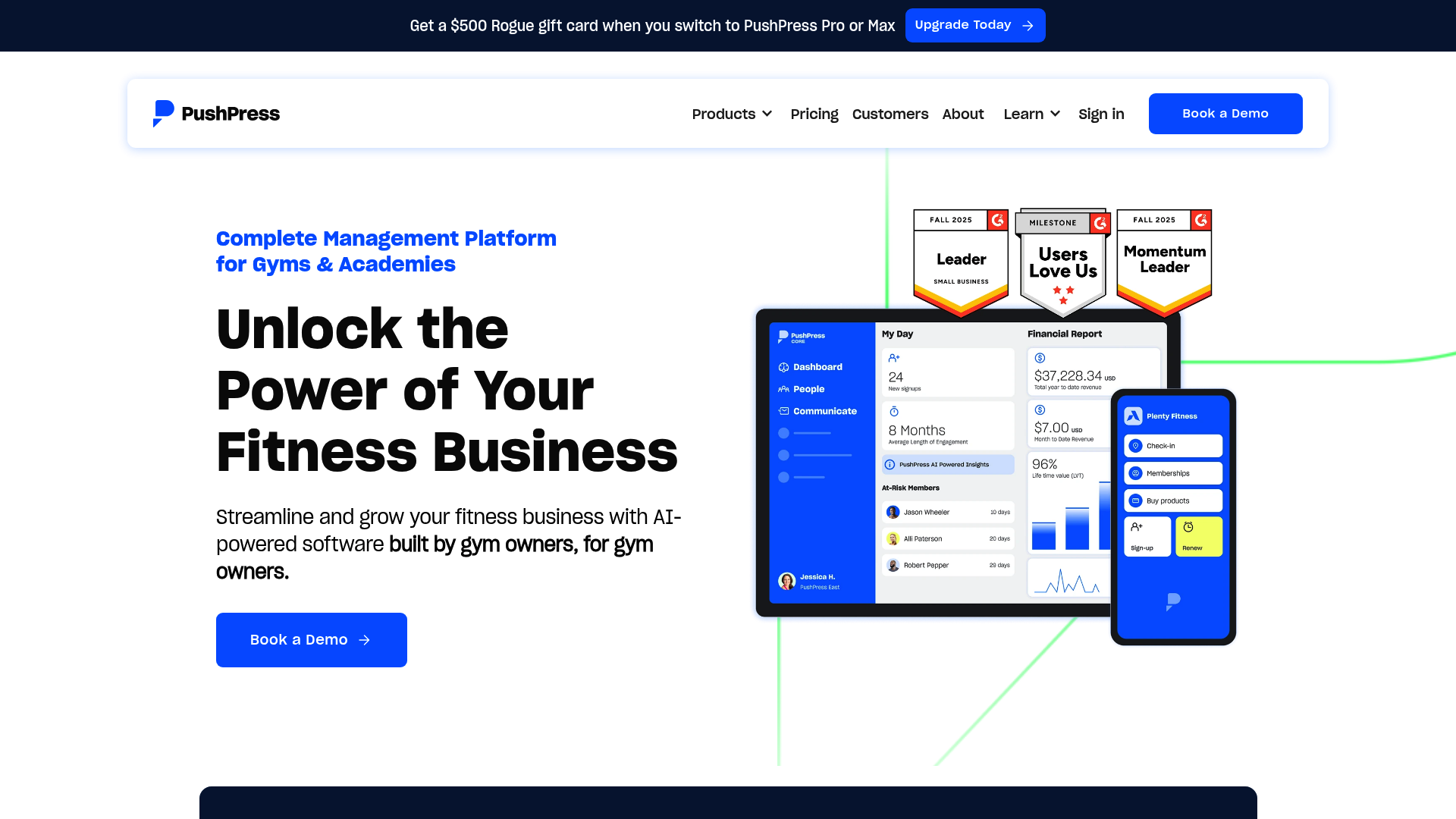
PushPress positions itself as "built by gym owners, for gym owners." The platform focuses heavily on member engagement and retention, with features specifically designed for CrossFit boxes and martial arts academies.
Product and functional capabilities
The member app stands out with PR (personal record) logging, workout tracking, and community "fist-bump" features that encourage member interaction. Amazon Fire Stick integration displays the Workout of the Day on gym screens, a feature unique to PushPress in this comparison. For martial arts academies, rank and belt tracking with automated promotion eligibility notifications simplifies a traditionally manual process.
Pricing
| Plan | Monthly Fee | Transaction Fee | Ideal For |
|---|---|---|---|
| Free | $0 | 2.19% + $0.30/txn | Testing, tiny gyms |
| Pro | $159/month | Reduced rate | Growing gyms |
| Max | Custom | Lowest rates | High-volume operations |
The transaction fees on the free plan add up quickly. A gym processing $10,000/month in memberships would pay roughly $249 in fees alone. The Pro tier makes financial sense once monthly payment volume exceeds a certain threshold.
Pros and cons
| Pros | Cons |
|---|---|
| Clean, intuitive interface | High fees on free plan |
| Strong member engagement features | Limited third-party integrations |
| Responsive support team | Basic customization options |
| Native WOD display integration | Enterprise features less developed |
Zen Planner
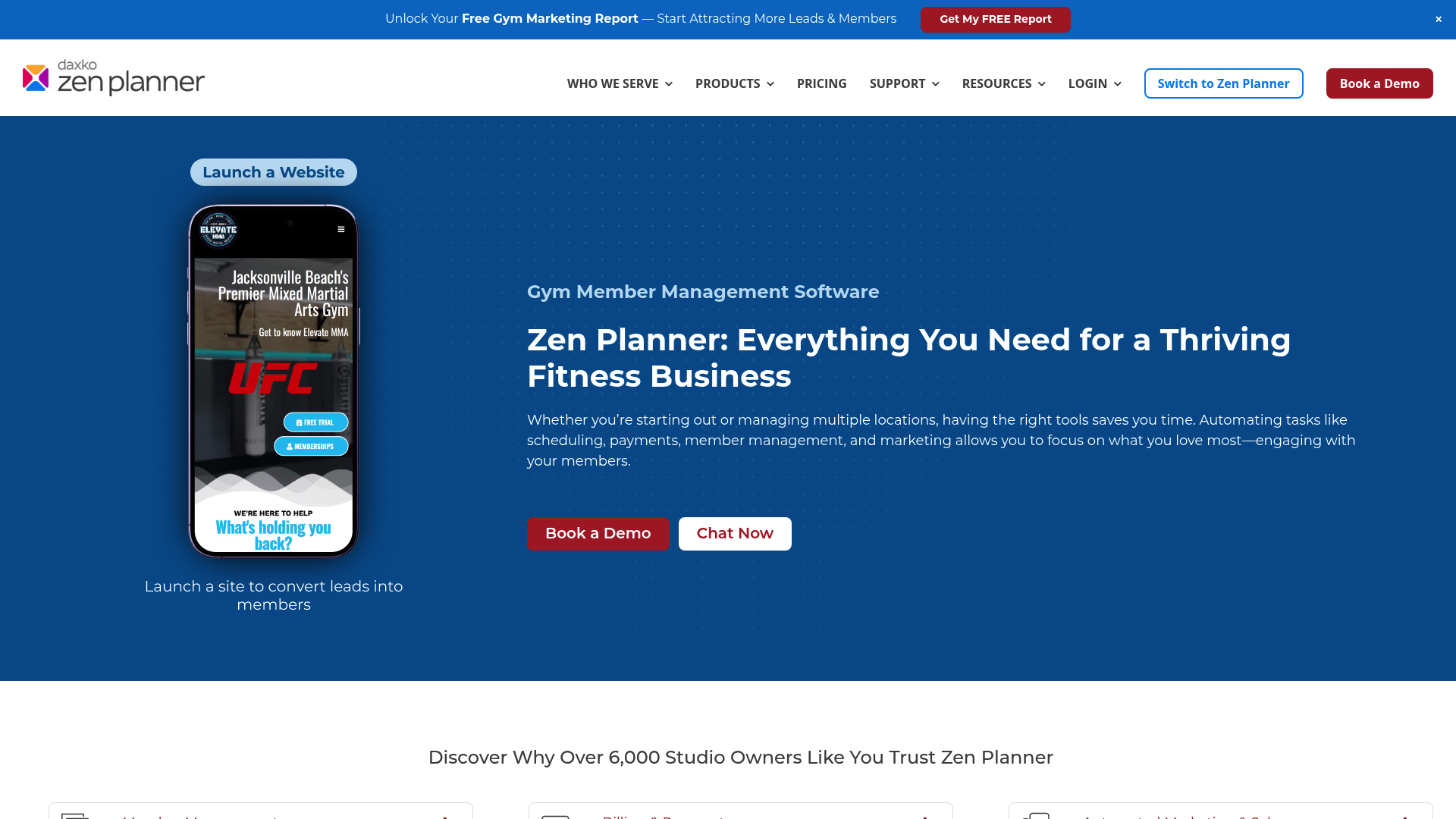
Zen Planner, owned by Daxko, has carved out a defensible position in the martial arts and boutique fitness segment. Its belt and rank tracking system is the most sophisticated in the market.
Product and functional capabilities
The platform excels at progression-based fitness businesses. Martial arts academies can configure specific belt color sequences, set time-in-rank requirements, and automatically flag members eligible for promotion testing. Family integrated billing consolidates multiple family members under a single payment account, a feature that simplifies operations for studios where parents and children train together.
Pricing
| Member Count | Monthly Price |
|---|---|
| Up to 45 | $99/month |
| 46-100 | Scaled pricing |
| 101-200 | Scaled pricing |
| 201+ | Custom quote |
Zen Planner uses flat monthly pricing without per-transaction fees, which benefits high-volume gyms. The pricing scales transparently with member count.
Pros and cons
| Pros | Cons |
|---|---|
| Best-in-class rank/belt tracking | Dated user interface |
| Family billing consolidation | Mobile app lags desktop |
| Powerful email automation | Premium features require add-ons |
| No transaction fees | Steeper learning curve |
 Pratyusha Srivastava
Mindbody
Mindbody is the enterprise standard for wellness businesses. It serves large operations that combine gym, spa, salon, and retail under one roof.
Product and functional capabilities
The platform's consumer-facing marketplace is its primary differentiator. Millions of consumers use the Mindbody app to discover and book fitness classes, giving businesses built-in member acquisition. Features include an AI virtual assistant for booking inquiries, dynamic pricing based on demand, ClassPass integration, and Mindbody Capital for business financing.
Pricing
Mindbody does not publish pricing. Enterprise positioning suggests monthly costs likely exceed $500 for most configurations, with pricing varying based on business size and feature requirements. Sales consultation required.
Pros and cons
| Pros | Cons |
|---|---|
| Marketplace drives member discovery | No public pricing |
| Most comprehensive feature set | Steep learning curve |
| Robust integration ecosystem | Slower support response times |
| Financing available through platform | Overkill for smaller gyms |
Glofox
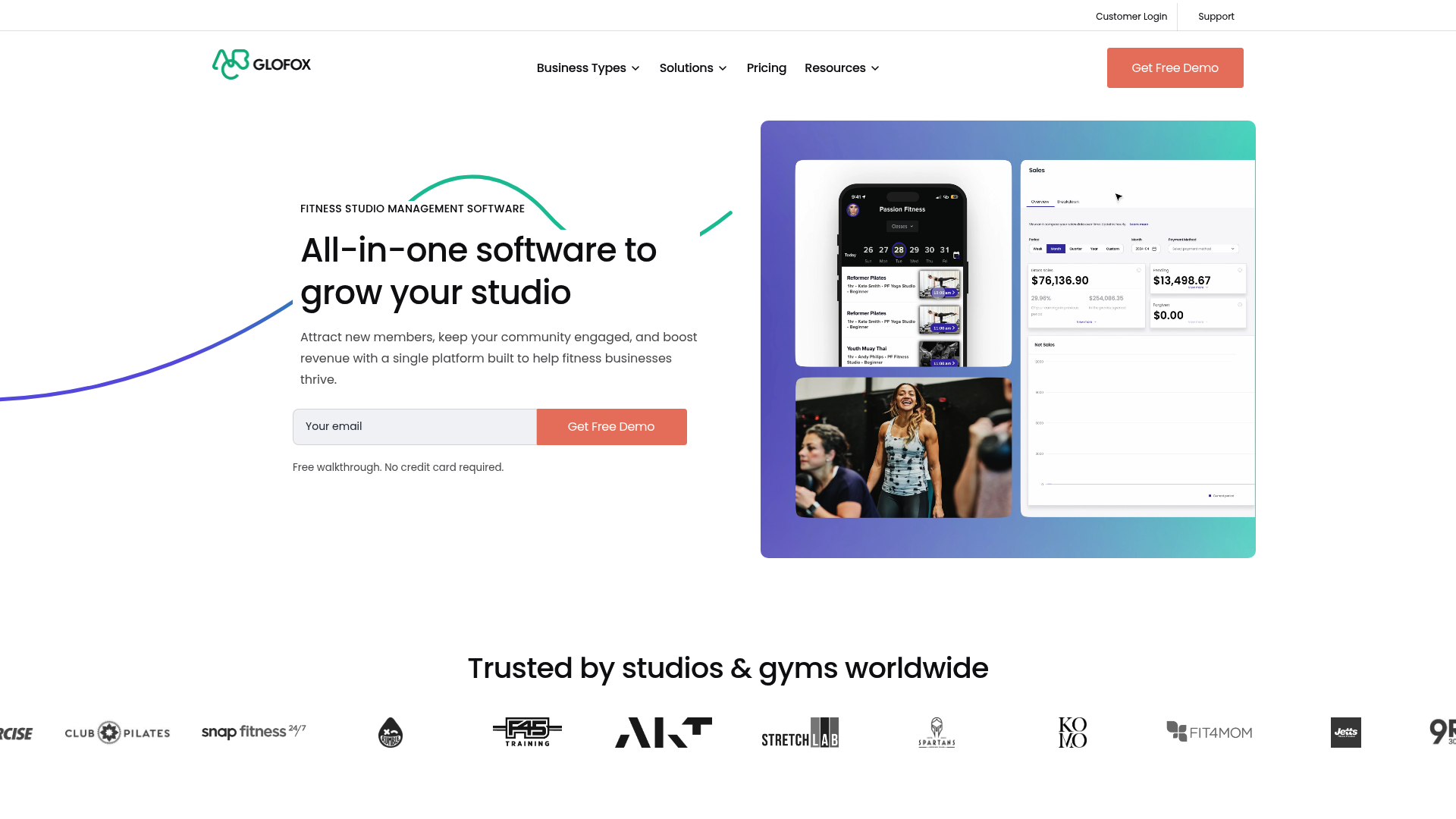
Glofox targets boutique fitness studios that prioritize brand identity and premium member experiences. The platform serves notable clients, including F45, Barry's, and Row House.
Product and functional capabilities
The custom-branded mobile app is the headline feature. Members interact with your studio's branded experience rather than a generic platform interface. Spot booking allows members to reserve specific equipment positions (bike #3, mat #7), reducing class-time conflicts. A built-in CRM handles lead conversion and member lifecycle management.
Pricing
| Tier | Details |
|---|---|
| Starter | Entry-level (contact sales) |
| Growth | Mid-market (contact sales) |
| Ultimate | Premium (contact sales) |
| Enterprise | Multi-location chains (custom) |
Glofox does not publish specific pricing. Market positioning suggests it sits at the higher end for boutique software.
Pros and cons
| Pros | Cons |
|---|---|
| Branded mobile app | Pricing not transparent |
| Spot booking for equipment | Bulk schedule changes difficult |
| Modern, sleek interface | Higher cost than competitors |
| Strong floor sales POS | Occasional reporting glitches |
Virtuagym
Virtuagym differentiates through coaching and nutrition integration. The platform serves over 10,000 fitness businesses across 80+ countries.
Product and functional capabilities
The nutrition coaching module stands alone in this comparison. Trainers can create and deliver personalized meal plans through the member app. Progress tracking covers hundreds of data points for body measurements, strength metrics, and nutrition adherence. Community challenges and reward systems drive member engagement through gamification.
Pricing
Virtuagym requires a demo for pricing. The modular architecture means costs vary significantly based on which features you activate (training plans, nutrition, community features).
Pros and cons
| Pros | Cons |
|---|---|
| Best nutrition integration | Core gym management less polished |
| Comprehensive progress tracking | Complex setup and configuration |
| Training plan delivery | Custom pricing only |
| Community gamification | Implementation-heavy |
Coast
Coast takes a different approach entirely. Rather than member management, it focuses on equipment maintenance and facility operations.
Product and functional capabilities
Work order management, preventive maintenance scheduling, and parts inventory tracking are the core features. The platform uses meter-based and time-based triggers for maintenance tasks. A "seen by" feature creates accountability by showing which team members have reviewed checklists and tasks. Slack-like team messaging keeps maintenance staff coordinated.
Pricing
| Plan | Cost | Key Features |
|---|---|---|
| Free | $0 | Limited work orders, basic asset tracking |
| Paid | $20/user/month | Full features, preventive maintenance |
The per-user model scales with team size. A five-person maintenance team costs $100/month.
Pros and cons
| Pros | Cons |
|---|---|
| Only platform focused on operations | Not a full gym management system |
| Mobile-first for on-site work | Limited member-facing features |
| Low cost per user | Best paired with another platform |
| Quick setup | Smaller integration ecosystem |
1club.ai
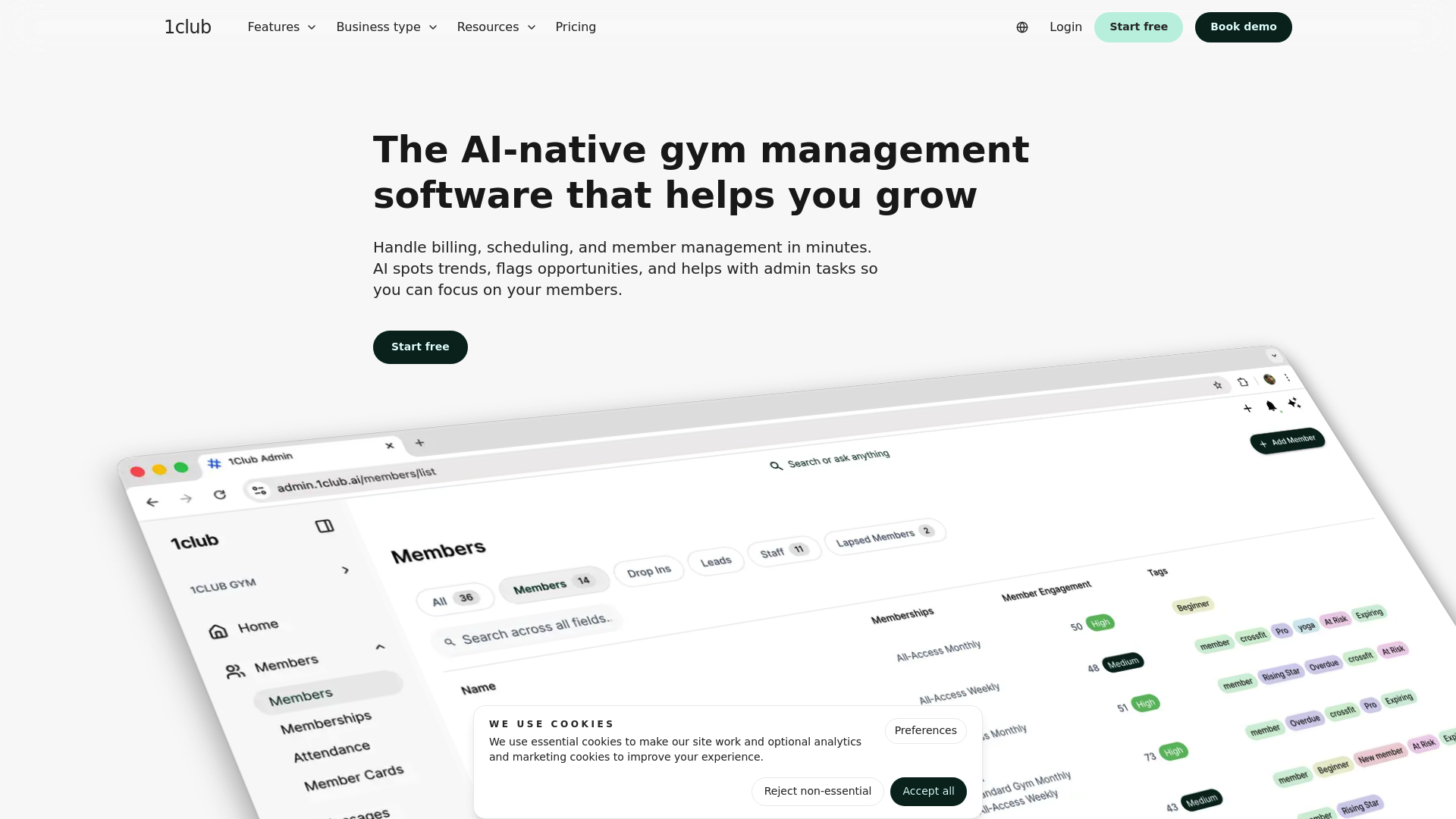
1club.ai represents the newer generation of gym software, built from the ground up with AI rather than bolting it onto legacy architecture.
Product and functional capabilities
AI-powered scheduling recommendations, analytics-driven insights, and modern UX define the platform. Multilingual support (English, Spanish, and others) serves diverse member bases. The interface prioritizes simplicity over feature density.
Pricing
| Plan | Monthly Price | Ideal For |
|---|---|---|
| Free | $0 | Tiny gyms, testing |
| Start | $39/month | Growing studios (<100 members) |
| Grow | $79/month | Mid-sized (100-300 members) |
| Scale | $199/month | Larger studios (300+) |
This is the most transparent pricing in the comparison. No hidden fees, no sales calls required, clear upgrade paths.
Pros and cons
| Pros | Cons |
|---|---|
| AI-native architecture | Newer, less established |
| Fully transparent pricing | Smaller user community |
| Modern, clean UX | Lacks niche specialization |
| Generous free tier | Limited case studies |
EZFacility
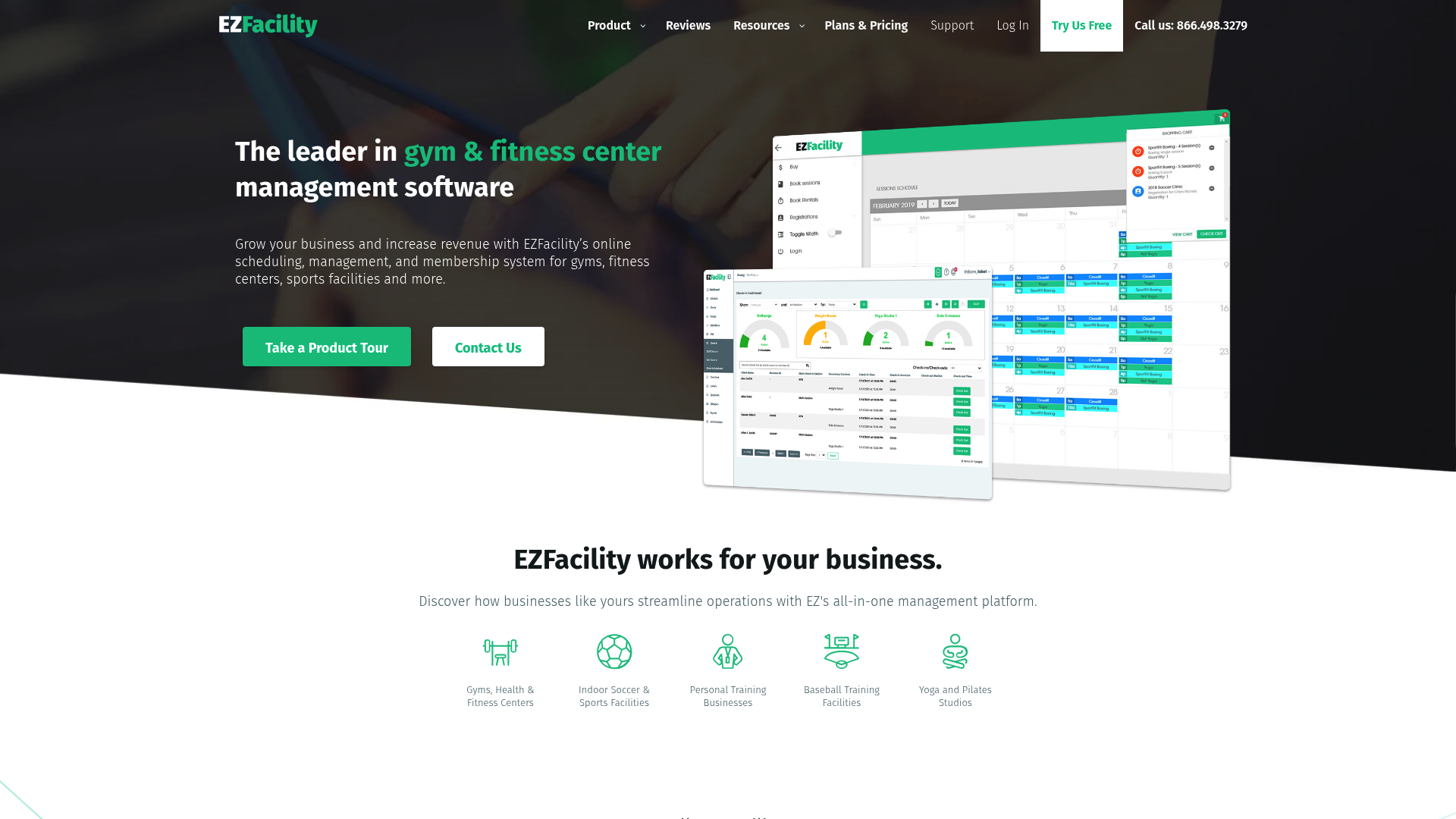
EZFacility is purpose-built for multi-sport complexes and facilities with diverse scheduling needs.
Product and functional capabilities
Space and court scheduling is the core strength. Recreation centers managing tennis courts, basketball courts, meeting rooms, and fitness areas need this level of scheduling sophistication. League management with tournament brackets and scoring systems handles competitive programming. Self-service check-in kiosks manage high-traffic entry points.
Pricing
EZFacility uses custom quotes based on facility size and complexity. Enterprise positioning suggests pricing in the $300-1000+/month range, depending on configuration.
Pros and cons
| Pros | Cons |
|---|---|
| Best space/court scheduling | Weak mobile app |
| Built-in league management | Lengthy onboarding process |
| Tournament scoring systems | Too complex for simple gyms |
| Multi-activity support | Custom pricing only |
Club Automation
Club Automation, also part of the Daxko family, serves as the enterprise scaling solution for growing fitness operations.
Product and functional capabilities
Advanced analytics dashboards provide executive-level visibility into business performance. The integrated CRM manages the member lifecycle from lead to long-term retention. Secure billing infrastructure meets enterprise compliance requirements. Integration with the broader Daxko ecosystem (including Zen Planner) allows businesses to scale across different platform tiers.
Pricing
Custom quotes only. Enterprise positioning suggests minimum monthly costs of $500+ with pricing scaling based on locations and members.
Pros and cons
| Pros | Cons |
|---|---|
| Built for scaling operations | Overkill for single locations |
| Advanced analytics | No public pricing |
| Daxko ecosystem integration | Complex implementation |
| Enterprise-grade security | Higher cost barrier |
Vivek Dev Jacob
Recess
Recess takes the freemium model to its logical conclusion: everything is free, funded through payment processing.
Product and functional capabilities
Unlike "free" tiers that cap bookings or limit features, Recess includes unlimited scheduling, full member management, custom branding, email/SMS campaigns, CRM tools, and attendance tracking at no monthly cost. The platform monetizes through payment processing fees when members pay for memberships and services.
Pricing
| Plan | Cost | What You Get |
|---|---|---|
| Recess | $0 | Everything, no caps or limits |
The business model is transparent: Recess earns revenue from payment processing, eliminating monthly fees entirely.
Pros and cons
| Pros | Cons |
|---|---|
| Actually free, no booking caps | Newer, less established |
| Full feature set included | Not enterprise-grade |
| Custom branded app | Dependent on their payment processing |
| No contract lock-in | Limited advanced features |
Category Recommendations: Best Gym Management Software Platform by Business Type
Choosing based on business type rather than feature count leads to better outcomes. Here are our recommendations by segment:
- Best overall for most gyms: PushPress balances ease of use, member engagement features, and reasonable pricing. The free tier lets you test before committing.
- Best for single-location boutique studios: Glofox delivers premium member experiences through branded apps and spot booking. The cost is higher, but so is the brand impression.
- Best for CrossFit boxes and functional training: PushPress again, with its WOD display integration, PR tracking, and community features designed for CrossFit culture.
- Best for martial arts academies: Zen Planner has the most sophisticated belt tracking and promotion eligibility automation. Nothing else comes close for this use case.
- Best for multi-location chains: Club Automation or Mindbody provides enterprise features and centralized management across locations.
- Best budget option: Recess offers the most generous free tier, with 1club.ai as a close second for those wanting tiered upgrade paths.
- Best for AI-forward operations: 1club.ai built AI into the foundation rather than adding it as an afterthought.
- Best for facilities with equipment focus: Coast is the only platform emphasizing maintenance and operations. Pair it with another platform for member management.
How to Choose the Right Gym Management Software Platform
Start with your business type
The platform that works for a yoga studio does not necessarily work for a multi-sport recreation center. Match the platform to your segment:
| Business Type | Primary Recommendation | Secondary Option |
|---|---|---|
| CrossFit/Functional | PushPress | Recess |
| Martial Arts | Zen Planner | PushPress |
| Boutique Studio | Glofox | 1club.ai |
| Multi-Sport Facility | EZFacility | Mindbody |
| Budget-Conscious | Recess | 1club.ai |
| Enterprise/Chain | Club Automation | Mindbody |
Consider the total cost of ownership
A monthly subscription is only part of the cost:
- Transaction fees (2-3.5% typical) compound quickly on high-volume gyms. According to payment processing industry standards, a gym processing $30,000/month at 2.5% pays $750 in fees alone.
- Add-on costs for premium features catch some buyers off guard. Verify what is included in base pricing versus what requires upgrades.
- Migration and onboarding time have real costs. Staff hours spent learning a new system and migrating member data are not free.
Common mistakes to avoid
- Choosing based on feature count rather than fit. A platform with 50 features you will never use adds complexity without value.
- Ignoring transaction fees on "free" plans. Calculate your monthly payment volume and model the true cost.
- Underestimating staff training time. A sophisticated platform requires sophisticated training. Factor this into your decision.
- Not testing the mobile app. Your members will interact with the app daily. If it feels clunky, so does your gym's brand.
Questions to ask vendors
Before committing, ask:
- What is the total cost, including transaction fees, at my expected payment volume?
- How long does typical onboarding take, and what support is included?
- Can I see and test the member-facing mobile app before signing?
- What happens to my data if I need to switch platforms later?
- What integrations are available for accounting and payment tools I already use?
Start Building Your Fitness Business With the Right Tool
The gym management software market has matured considerably. No single platform is objectively "best" because different business types have fundamentally different needs. A martial arts academy requires belt tracking. A multi-sport complex requires court scheduling. A boutique cycling studio requires spot booking.
Our recommendation: shortlist 2-3 platforms that match your business segment, then trial each one. Most offer free tiers or demo periods. The investment of a few hours of testing will save months of frustration from choosing the wrong platform.
For founders and entrepreneurs building fitness businesses, the right management platform is foundational infrastructure. Get this decision right early, and scaling becomes much simpler.
FAQs
What is the best free gym management software?
PushPress and 1club.ai both offer free plans. PushPress charges 2.19% + $0.30 per transaction on the free tier, which adds up quickly for established gyms but works for testing or tiny operations. 1club.ai offers a genuinely free plan with no booking caps, making it better for budget-conscious gyms that need basic functionality without transaction fees.
Which gym management software is best for CrossFit boxes?
PushPress is purpose-built for CrossFit gyms with features like PR tracking, WOD display integration via Amazon Fire Stick, and community engagement tools like member fist-bumps. Zen Planner is also popular in the CrossFit community, particularly for gyms that also run martial arts programs and need belt/rank tracking.
How much does gym management software typically cost?
Pricing varies widely. Entry-level platforms like Zen Planner start at $99/month. Mid-tier platforms typically charge $150-$300/month. Enterprise platforms like Mindbody, Glofox, and EZFacility use custom pricing (usually $300-$1,000+/month depending on size). Transaction fees range from 1.9% to 2.9% plus a per-transaction fee, though some platforms include payment processing in their monthly price.
What features should I prioritize when choosing gym management software?
Start with the basics: automated billing, class scheduling, and member check-in. Then evaluate mobile experience (both for staff and members), ease of use during onboarding, and specialty features for your gym type (belt tracking for martial arts, PR logging for CrossFit, nutrition coaching for personal training studios). Integration with existing tools (accounting software, payment processors) matters more than you think.