
Meesho Business Model | How Does Meesho Make Money
Discover the Meesho business model, revenue model, financial performance, SWOT analysis, funding, competitive advantages, future growth plans, and how India's leading value-commerce platform makes money in 2026.


Online purchasing is ruling the market now. With a bundle of eCommerce websites coming into prominence with their wide range of products across niches, along with affordable and convenient services for users that can be trusted, purchasing online has become very much a reality.
The fact that online shopping websites and eCommerce stores have been changing the lives of buyers and sellers ever since they emerged cannot be argued. However, it is also important to note here that these websites present enormous opportunities for people who want to be resellers and arrange a decent margin for themselves.
Meesho has transformed from a social reselling startup into one of India's largest eCommerce marketplaces. With millions of buyers, thousands of sellers, and a zero-commission model, it has changed how small businesses sell online.
In this article, we will explore the Meesho business model, understand how Meesho makes money, and examine the business strategy that has helped it become one of India’s most trusted and widely used eCommerce platforms.
Meesho at a Glance
| Founded | 2015 |
|---|---|
| Founders | Vidit Aatrey & Sanjeev Barnwal |
| Headquarters | Bengaluru, India |
| Industry | E-commerce |
| Business Model | B2C, D2C Marketplace |
| Revenue FY26 | INR 12,055 Crore |
| Net Loss FY26 | INR 166 Crore |
| Commission | 0% for Sellers |
| Annual Transacting Users | 264 Million+ |
| Annual Orders | 2.67 Billion+ |
About the Meesho Business - An Overview
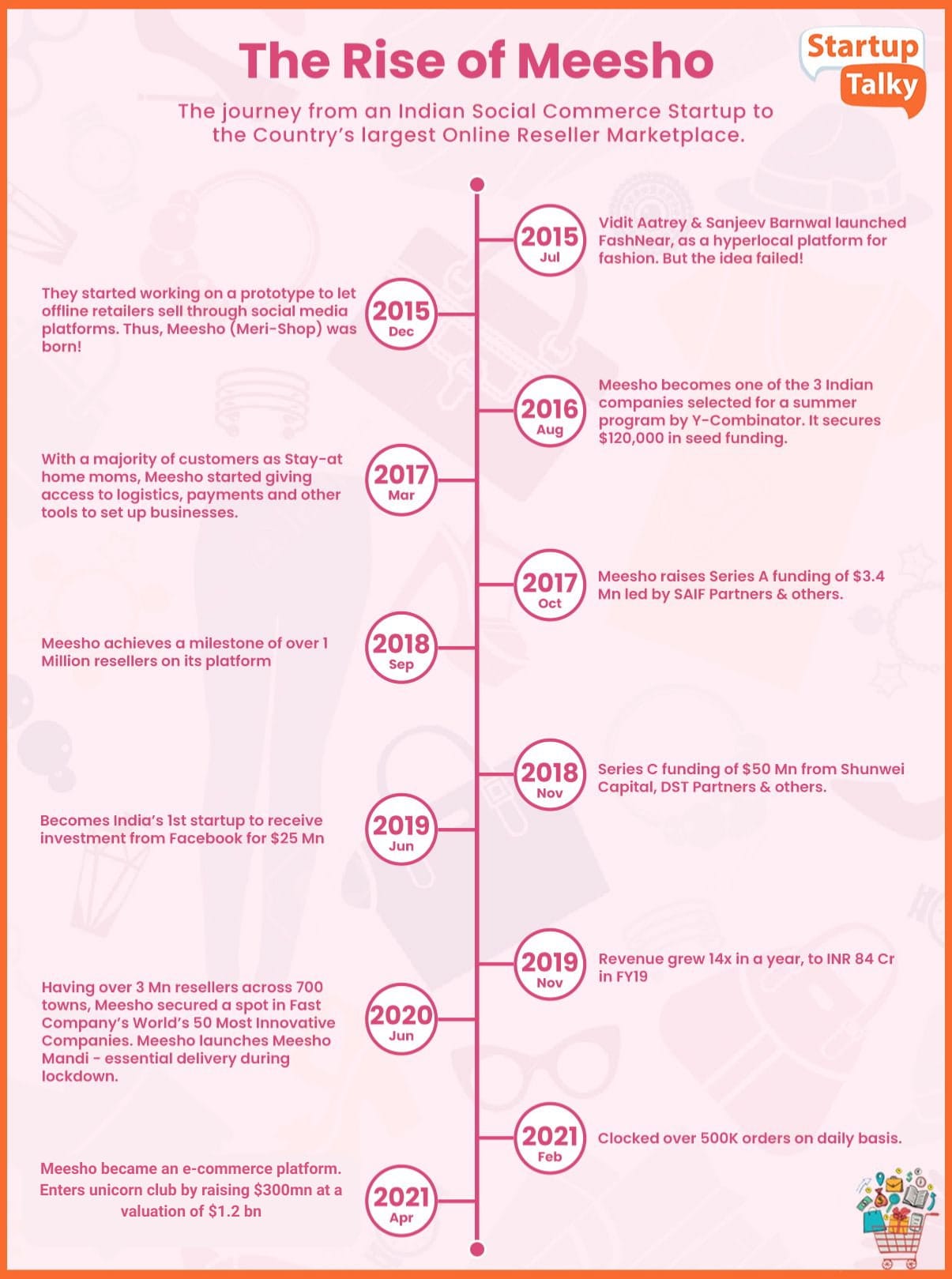
Meesho Journey
Why Meesho Became Successful
Meesho Business Model
Meesho Revenue Model | How Does Meesho Make Money?
Competitive Advantages of Meesho
Meesho Financials
Meesho SWOT Analysis
Meesho - Funding and Valuation
Meesho - How to make Money from it?
Meesho - Future Goals and Hindrances
About the Meesho Business - An Overview
Founded by batchmates and IIT Delhi graduates Vidit Aatrey and Sanjeev Barnwal in 2015, Meesho started as a mobile-first social e-commerce platform for resellers that include housewives, domestic elders, and others who are fond of using social media channels like WhatsApp, Facebook, Instagram, and others to sell merchandise within their non-public community, typically recognised as social circles. However, in 2021, Meesho transitioned into a horizontal e-commerce marketplace platform focusing on creating opportunities for Indian businesses to sell products directly to customers through the Meesho ecosystem.
Originally started as Meesho, the name of the company is inspired by “Meri Shop”, translated to "my shop" in English and the thought that it would serve as a shop for everyone in the country.
Meesho has become India's largest e-commerce platform by Annual Transacting Users (ATUs) and placed orders. During FY26, the platform served 264 million annual transacting users, a 33% year-on-year increase, while the total number of orders reached 2.67 billion, up 45% from the previous year. The company also expanded its seller ecosystem to approximately 961,000 annual transacting sellers, reflecting an 87% YoY growth. Strong customer engagement and higher purchase frequency helped Meesho achieve a Net Merchandise Value (NMV) of INR 41,560 crore, a 39% year-on-year increase, further strengthening its position in India's value-commerce market.
Right at the onset, Meesho drew massive investments from the likes of Facebook (now Meta), Naspers, DST Global, RPS Ventures, and Shunwei Capital. In its early years, Meesho positioned itself as a social commerce platform, empowering individuals, especially homemakers and small entrepreneurs, to become resellers. It was often cited as "India's #1 Reselling App, trusted by 1 Crore+ resellers" during this period.
However, the company has since evolved and is now a "one-stop destination for women's clothing and accessories," which also offers an exclusive range of men's fashion, along with offering the unique opportunity to become sellers. Meesho's business strategy focuses on e-commerce, empowering sellers, offering a wide range of products, and providing services like logistics and payment processing to drive growth.
Today, Meesho's business strategy focuses on direct-to-consumer (D2C) e-commerce, empowering sellers, offering a wide selection of affordable products, and providing services like logistics and payment processing to drive inclusive online retail growth.
Meesho Journey
| Year | Milestone |
|---|---|
| 2015 | Meesho was founded by Vidit Aatrey and Sanjeev Barnwal. |
| 2016 | Selected by Y Combinator and secured seed funding. |
| 2019 | Facebook (Meta) invested in Meesho, accelerating its growth. |
| 2021 | Became a unicorn after raising $300 million led by SoftBank. |
| 2021 | Transitioned from a social commerce platform to a horizontal e-commerce marketplace. |
| 2024 | FY24 operating revenue crossed ₹7,615 crore and annual orders exceeded 1.3 billion. |
| 2024 | Launched Valmo, its in-house logistics marketplace. |
| 2025 | Raised $260 million through a secondary funding round. |
| 2025 | Meesho IPO opened from December 3–5, 2025, and the company was listed on the NSE and BSE on December 10, 2025. |
| 2026 | Expanded AI-powered shopping features, strengthened logistics, and focused on improving profitability as a publicly listed company. |
Why Meesho Became Successful
Several factors have contributed to Meesho's rapid growth:
- Zero-commission model for sellers
- Affordable products for price-conscious customers
- Strong presence in Tier-2, Tier-3, and Tier-4 cities
- Easy onboarding for MSMEs
- AI-powered product recommendations
- Reliable logistics network
- Mobile-first shopping experience
- Strong investor backing
- Focus on value-driven shopping
 Sarika Anand
Meesho Business Model
Meesho primarily operates as an e-commerce platform, thereby following a D2C model. It is focused on enabling over 10 crore small businesses, including individual entrepreneurs, to succeed online. Meesho's business model operates just like the business model of any other e-commerce service provider. With the majority of Meesho’s target market relying on Tier 2, 3, and 4 cities, the company claims to have a presence in 1000+ cities, which facilitates sellers to begin promoting with a 0% commission model.
0% Commission for Sellers
Meesho now follows a zero-commission model for sellers across all product categories, aiming to democratize e-commerce and support small businesses. This aligns with its focus on enabling inclusive and affordable e-commerce for both sellers and consumers, particularly in Tier-II and Tier-III cities.
Meesho is an online shopping platform that helps small businesses and individual sellers reach customers across India, especially in smaller cities and towns. Buyers browse and purchase products directly from these sellers through the Meesho app or website. Meesho supports the process by handling payments, delivery, and customer service. The company earns money mainly by offering advertising options to sellers who want to promote their products and by providing extra services like logistics support. Customers pay separate shipping charges, which vary based on where they live and the product size.
Kanimozhi Sivakumar
Meesho Revenue Model | How Does Meesho Make Money?
There are lakhs of products to pick from, and as a seller, you don’t have to fear the logistics, payments, and delivery of a product that you sell. Meesho works in the industrial enterprise version, which is comparable to other e-commerce companies. Let’s break down Meesho’s sales streams and how they generate revenue, outlining their revenue model.
Logistics Services
Meesho generates revenue by providing logistics and fulfilment services to sellers through its own logistics marketplace. In 2024, Meesho launched Valmo, a logistics arm that improves delivery efficiency, supports local entrepreneurship, and contributes to Meesho’s overall revenue.
Seller Advertisements
With a growing number of sellers on the platform, Meesho generates revenue by offering promoted listings and advertising slots. Sellers pay to have their products featured more prominently within the app or on the website, increasing their visibility and sales potential.
Meesho Mall
Meesho introduced Meesho Mall, a dedicated section on its platform for branded products, allowing national and regional brands to sell directly to consumers. This initiative has expanded Meesho's offerings across various categories, including personal care, footwear, electronics, and more.
Some notable brands available on Meesho Mall include Mamaearth, Himalaya, Dabur, Titan, Denver, Bajaj, Joy, Lotus Herbals, Biotique, Bata, Paragon, Relaxo, and Liberty. Meesho charges a platform fee ranging from 2% to 5% for transactions in this section, contributing to its revenue.
Seller Financing
Meesho offers a financing service called Meesho Instant Cash, providing short-term loans to sellers. This service helps sellers manage their cash flow and grow their businesses. While the primary goal is to support sellers, Meesho may earn interest or fees from these financial services.
AI and Data Intelligence
Meesho utilises artificial intelligence (AI) and machine learning to analyse user behaviour, preferences, and transaction data. By providing personalised shopping experiences and optimising product recommendations, Meesho enhances user engagement and satisfaction. While not a direct revenue stream, these AI-driven services contribute to increased sales and customer retention, indirectly boosting revenue.
These revenue streams collectively support Meesho's business model, focusing on providing affordable and accessible e-commerce solutions to small businesses and consumers, particularly in Tier-2 and Tier-3 cities across India.
Competitive Advantages of Meesho
1. Zero-Commission Model
Meesho does not charge sellers any commission on product sales, making it one of the most seller-friendly e-commerce platforms in India. This helps MSMEs and small businesses maximize their profits while encouraging more entrepreneurs to join the platform.
2. Strong Focus on Tier-2, Tier-3, and Tier-4 Cities
Unlike many competitors, Meesho has built its business around customers in smaller towns and cities. By offering affordable products and regional accessibility, it has successfully tapped into India's fast-growing value-commerce market.
3. Affordable Pricing Strategy
Meesho is known for providing budget-friendly products across categories such as fashion, home essentials, beauty, and electronics. Its value-for-money approach attracts price-conscious shoppers and drives high order volumes.
4. Large Seller Network
Meesho has built one of India's largest online seller ecosystems, with hundreds of thousands of active sellers. The platform enables manufacturers, wholesalers, and small businesses to reach millions of customers across the country.
5. AI-Powered Recommendations
Meesho uses artificial intelligence and machine learning to personalize product recommendations, improve search results, and enhance customer engagement. AI also helps sellers optimize product visibility and improve conversions.
6. Robust Logistics Infrastructure
Through its logistics marketplace, Valmo, and third-party delivery partners, Meesho offers efficient order fulfilment across India. This strong logistics network supports faster deliveries while helping sellers manage shipping with ease.
7. Mobile-First Platform
Meesho was designed as a mobile-first e-commerce platform, making online shopping simple and accessible through smartphones. Its lightweight app, intuitive interface, and localized experience have helped it reach millions of users, especially in emerging markets.
Meesho Financials
| Meesho Financials | Q4 FY25 | Q4 FY26 |
|---|---|---|
| Operating Revenue | INR 2,400 crore | INR 3,531 crore |
| Total Expenses | INR 2,637 crore | INR 3,807 crore |
| Profit/Loss | INR –1,391 crore | INR –166 crore |
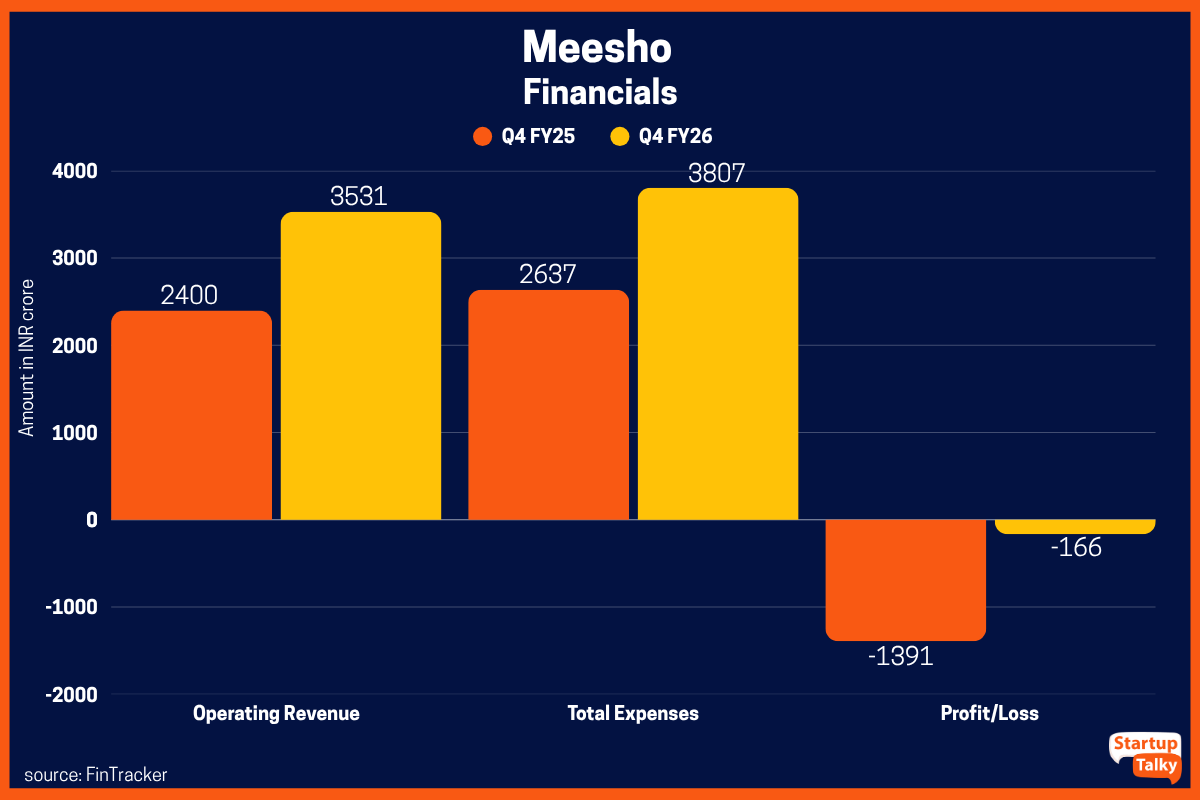
In Q4 FY26, Meesho reported operating revenue of ₹3,531 crore, a significant increase from INR 2,400 crore in Q4 FY25, reflecting strong business growth. Total expenses also rose from INR 2,637 crore to INR 3,807 crore during the same period as the company continued investing in logistics, technology, and expansion. Despite the higher expenses, Meesho significantly improved its financial performance by reducing its net loss from INR 1,391 crore in Q4 FY25 to INR 166 crore in Q4 FY26, indicating steady progress toward profitability.
While Meesho invests significantly in supporting last-mile delivery for its sellers, the company does not charge any commission on sales, following a zero-commission model. Instead, Meesho generates revenue through delivery charges paid by customers and fees from sellers who opt for advertising and promotional services on the platform.
Meesho SWOT Analysis
| Strengths | Weaknesses |
|---|---|
| Zero-commission model attracts millions of small sellers and MSMEs. | Profitability remains a challenge despite reducing losses. |
| Strong presence in Tier-2, Tier-3, and Tier-4 cities with a loyal value-conscious customer base. | Heavy dependence on low-margin, price-sensitive customers. |
| AI-powered product recommendations, personalization, and conversational commerce improve customer experience. | High logistics and fulfilment costs continue to impact margins. |
| Extensive seller network, integrated logistics (Valmo), and strong investor backing support long-term growth. | Limited international presence compared to global e-commerce competitors. |
| Large user base and growing advertising business create multiple revenue opportunities. | Brand perception is still centered on budget shopping rather than premium products. |
| Opportunities | Threats |
|---|---|
| Expansion into AI-driven shopping, voice commerce, and personalized product discovery. | Intense competition from Amazon, Flipkart, Shopsy, ONDC, and emerging quick-commerce platforms. |
| Growth of India's digital economy and increasing internet adoption in smaller cities. | Regulatory changes in India's e-commerce and data privacy landscape could affect operations. |
| Expansion of seller financing, advertising, and fintech services for merchants. | Rising customer acquisition, logistics, and fulfilment costs may pressure profitability. |
| New categories such as grocery, financial services, and private labels can diversify revenue. | Counterfeit products, return fraud, and quality-control issues can impact customer trust. |
| Continued improvements in logistics through Valmo and AI automation can improve operational efficiency. | Price wars and aggressive discounting by competitors could reduce market share and margins. |
Meesho - Funding and Valuation
Meesho is backed by top investors including Y Combinator, Facebook, Naspers, Sequoia Capital, Shunwei Capital, Westbridge Capital, and SAIF Partners.
Meesho became a unicorn in early 2021 after raising around $300 million in a funding round led by SoftBank, which valued the company at over $1 billion.
| Date | Stage | Amount | Investors/Shareholders |
|---|---|---|---|
| January 27, 2025 | Secondary Market | $260 million | - |
| May 6, 2024 | Venture Round | $275 million | - |
| October 13, 2023 | Secondary Market | $52.5 million | Westbridge Capital |
| October 21, 2021 | Debt Financing | - | Trifecta Capital Advisors |
| September 30, 2021 | Series F | $570 million | B Capital and Fidelity Management |
| April 5, 2021 | Series E | $300 million | Softbank Vision Fund |
| August 12, 2019 | Series D | $125 million | Prosus and Naspers |
| June 14, 2019 | Corporate round | $25 million | |
| November 5, 2018 | Series C | $50 million | DST Partners, RPS Ventures, Shunwei Capital |
| June 7, 2018 | Series B | $11.5 million | Sequoia Capital |
| October 12, 2017 | Series A | $3.4 million | Elevation Capital |
| August 18, 2016 | Seed Round | $120K | Y Combinator |
| March 1, 2016 | Angel Round | $180K | Investopad, Venture Highway, Rajul Garg |
| Jan 15, 2016 | Seed Round | - | - |
 Muskaan Kapoor
How To Make Money from Meesho?
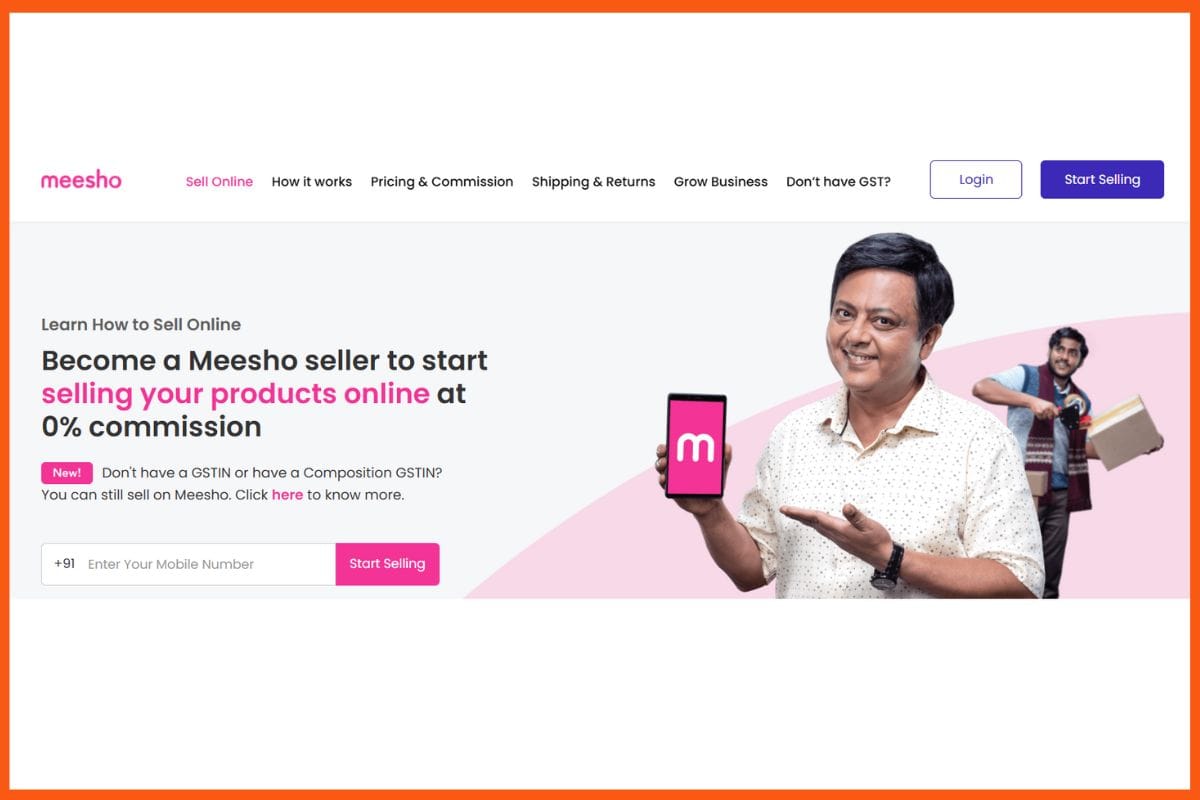
As India’s true e-commerce marketplace, Meesho offers a straightforward platform for individuals and small businesses to sell products online across the country. To get started, you simply register as a seller on Meesho’s platform by providing basic business details. Once registered, you can list your products with images, descriptions, and prices on the app without worrying about inventory or logistics management, as Meesho takes care of order processing, payments, and delivery.
Sellers on Meesho benefit from a large customer base spanning Tier 2, 3, and 4 cities, enabling wider reach than traditional sales channels. You can manage orders in real-time through the seller dashboard, track shipments, and receive payments directly. Additionally, Meesho provides sellers with tools to promote products and increase visibility through advertising options. This model empowers small entrepreneurs to scale their businesses with minimal upfront investment while earning profits through sales on the platform.
Alan Joseph
Meesho - Future Goals and Hindrances
Meesho Future Growth Plans (2026)
1. Expand AI-Powered Shopping
Meesho plans to use AI for personalized recommendations, conversational shopping, and better customer support to improve the shopping experience.
2. Strengthen Logistics
The company will continue expanding its Valmo logistics network to enable faster deliveries and lower fulfilment costs.
3. Improve Profitability
Meesho aims to reduce losses by improving operational efficiency, increasing advertising revenue, and optimizing logistics.
4. Grow the Seller Ecosystem
The platform plans to onboard more MSMEs and small businesses while offering better seller tools, financing, and analytics.
5. Expand Product Categories
Meesho is expected to strengthen existing categories and explore new segments to increase customer engagement and repeat purchases.
6. Focus on Tier-2 and Tier-3 Markets
The company will continue expanding in smaller cities by offering affordable products and a mobile-first shopping experience.
As Meesho moves forward, it faces various challenges, including:
- Competition: Meesho is facing competition from various e-commerce platforms such as Flipkart, Shopsy, and Amazon.
- Regulation: The Indian government is currently considering regulations that could potentially impact the e-commerce industry.
- Fraud: Some sellers have been caught selling fraudulent products, which Meesho is currently addressing.
Conclusion
Meesho has evolved from a social reselling platform into one of India's leading eCommerce marketplaces. Its zero-commission model, affordable pricing, and focus on small businesses have helped it build a massive user base across the country. While profitability and competition remain challenges, continued investments in technology, logistics, and seller empowerment position Meesho for long-term growth.
FAQs
How does Meesho make money?
Meesho makes money mainly through advertising fees from sellers, delivery charges paid by customers, and logistics services. It follows a zero-commission model for the sellers.
What does Meesho do?
Meesho app is a mobile-first eCommerce platform for sellers consisting of individual entrepreneurs, MSMEs, SMBs, retailers, manufacturers, among others who sell a vast range of products to customers in the country
Who is the founder of Meesho?
Vidit Aatrey and Sanjeev Barnwal are the founders of Meesho.
What is Meesho launch date?
Meesho was launched in December 2015.
Is Meesho B2B or B2C?
Meesho primarily operates as a B2C platform, connecting sellers directly to consumers.
What is Meesho business model?
Meesho is an e-commerce platform that follows a D2C and B2C business model. It enables individual sellers and small businesses to sell products directly to consumers across India. With 0% commission, intuitive tools, and smart discovery features, Meesho makes online selling simple, even for first-time digital entrepreneurs
How Meesho works?
Meesho allows sellers to bring their business online and sell products directly to customers. The sellers share product links, and when people buy, Meesho handles the delivery and payment.
How can I earn from Meesho?
You can earn from Meesho by registering as a seller, listing your products, and selling to customers across India. Meesho handles logistics, payments, and delivery, allowing you to focus on sales and profits.
How meesho earns money with 0 commission?
Meesho follows a zero-commission model, meaning it does not charge any commission fee from sellers for listing or selling products on its platform, making it easier and more affordable for small businesses to grow online.