

Top AI Trend Forecasting Tools for 2026 (Sales, Finance, Fashion & Market Intelligence)
Collections 🗒️
AI tools help predict trends before they reach their maximum public awareness level. The tools analyze social media content together with sales information and news articles to discover which topics interest people. The tools employ machine learning techniques to identify immediate shifts in consumer preferences and market demand and cultural evolution. The system transforms extensive data streams into understandable signals which predict upcoming events. The insights from the system help marketers and creators and businesses maintain their advantage through forward planning. The system provides simple dashboard displays which show essential patterns that enable small teams to make rapid decisions.
Why AI Trend Forecasting Tools Are Essential in 2026
AI forecasting tools help businesses:
- Predict future consumer demand
- Reduce inventory risks
- Optimize pricing strategies
- Detect emerging market trends early
- Improve financial planning accuracy
AI Forecasting Tools Comparison Table
| Tool | Key Strengths | Main Limitations |
|---|---|---|
| Anaplan |
• Advanced AI demand forecasting with PlanIQ • Scenario planning & what-if analysis • Real-time dashboards and forecasting |
• High cost • Not suited for small teams |
| Trendalytics |
• Deep social/TikTok trend insights • Product-attribute trend detection • Visual trend lifecycle tracking |
• Limited B2B and non-consumer use • Advanced features on higher tiers |
| Cube |
• Ideal for FP&A teams using spreadsheets • Unified, trusted financial model • Natural language forecasting |
• Performance issues at times • Not ideal for very small teams |
| IBM Planning Analytics |
• Automated model selection and tuning • Multi-variable forecasting • Strong enterprise AI |
• Complex to implement • Resource-intensive for large models |
| Jedox |
• Easy-to-use with guided AI tools • Strong enterprise planning abilities • Handles complex models well |
• Best value for comprehensive planning only • Not ideal for small businesses |
| Forecast.app |
• Focused restaurant demand forecasting • Near real-time guest traffic prediction • Reduces overstaffing and waste |
• Limited to restaurant industry • Requires workforce/inventory integrations |
| Crayon |
• Real-time competitor monitoring • Noise filtering via AI • CRM integrations for sales teams |
• Learning curve for new users • Best suited for active sales/product teams |
| Talkwalker |
• Accurate social/media trend forecasting • Sentiment & conversation tracking • Consumer intelligence tools |
• Costly for small teams • Some performance limitations |
| Exploding Topics |
• Early trend detection before peaks • Easy to use • Large topic coverage & niche filters |
• Limited depth in some niches • Forecast accuracy varies |
| Stylumia |
• Specialized fashion demand forecasting • Real-time shopper behavior analysis • Regional trend insights |
• Not suitable outside fashion • Enterprise implementation challenges |
Anaplan
Anaplan uses built-in AI and machine learning to find patterns in both historical business data and current operational data. It generates projections for sales and finance and supply chain operations and workforce management. The system combines time-based trends with real drivers like promotions and seasonal changes and market fluctuations. This enables teams to detect demand patterns at an early stage while making future forecasts. Users can run simple “what-if” tests to see how choices may affect results. The system provides real-time system updates through its dashboard and ongoing forecasting system.
Pros
- AI layers PlanIQ and Intelligence to provide detailed trend and demand forecasting.
- Enables users to create multiple scenarios which they can evaluate
- Business users can create forecasts without coding skills
Cons
- Not suited for small teams
- The total cost to operate this system exceeds the expenses required for basic AI tools
Pricing
Request for pricing (RFP)
Best for: Large enterprises needing advanced financial and operational forecasting.
 Vivek Dev Jacob
Trendalytics
The AI tool Trendalytics enables brands to discover trends during their initial development stages. The program uses data from search engines and social media platforms and online stores to demonstrate which styles and products are currently gaining popularity. The system uses its real-time dashboards to categorize trends into four groups which are accelerating, growing, peaking, and declining. The system enables teams to schedule their product launches and purchasing activities according to optimal timing. The system operates at large scale to monitor brand activities and price changes and discount offerings and inventory levels and TikTok engagement.
Pros
- Provides deep TikTok and social insights
- Uses comprehensive product-attribute data, including color, material, fit, pattern, and ingredients.
- Visual trend lifecycle helps in understanding current trends.
Cons
- Less useful applications for B2B and non-consumer products.
- Advanced features on high-tier plans
Pricing
Request for pricing (RFP)
Best for: Fashion, beauty, and D2C consumer brands.
Cube
Cube is an AI tool for finance teams. It helps FP&A teams track revenue, costs, and cash flow in one location. The system creates a unified, dependable model by connecting spreadsheets, ERPs, and BI tools. Built-in AI agents help with forecasting and variance checks, and trend analysis. The platform transforms disorganized data into understandable insights that users can apply to their planning needs. The system enables users to inquire about information using ordinary words while providing them with precise forecasts at the cell level. Cube requires minimal adjustments to integrate into existing workflows.
Pros
- Perfect solution for FP&A teams who depend on spreadsheets
- The system establishes trustworthiness through its semantic layer
- The process of consolidation and reporting decreases time requirements
Cons
- Performance issues
- The basic forecasting requirements of very small teams face difficulties with the pricing
Pricing
| Plan | Pricing |
|---|---|
| Starter | $40/developer/month |
| Premium | $80/developer/month |
| Enterprise | Custom pricing |
Best for: Mid-sized finance teams and FP&A departments.
Rishi Mundra
IBM Planning Analytics
IBM Planning Analytics uses its built-in AI system to analyze business data. The system detects patterns that include seasonal variations and unusual data points. The system creates understandable financial plans and budget estimates from these findings. The system can generate forecasts that require both simple and advanced time-series data. The system can analyze both historical records and current operational information. The results go directly to finance departments, sales teams, and workforce planning activities. This enables teams to respond quickly while maintaining proper coordination. The tool provides insights that people can easily understand.
Pros
- AI works in the most seamless manner
- enables non-data scientists to conduct automated model selection and tuning processes
- The forecasting system uses multiple variables to predict outcomes
Cons
- The setup and governance of large multi-cube models create challenging difficulties.
- The system requires substantial resources during major implementations
Pricing
Request for pricing (RFP)
Best for: Large enterprises with complex planning needs.
Jedox
The AI system of Jedox transforms historical and current data into straight forecast predictions. The system detects patterns and seasonal variations and identifies fresh changes across finance and sales, and operational activities. Teams can create continuous forecasting models and conduct what-if analysis and use essential business drivers for their planning activities. This capability enables them to adapt quickly to shifting market conditions. Users can operate the built-in tools without any difficulty. Anyone can establish models through the combination of guided wizards and AI-powered planning, which requires no data science expertise.
Pros
- Easy-to-use interface
- The software provides an ideal solution for enterprise planning
- The system enables users to create complex models that handle multiple entities
Cons
- The planning system provides its best value when used for comprehensive planning activities,
- Not suited for smaller teams/businesses
Pricing
Request for pricing (RFP)
Best for: Enterprise performance management.
Vivek Dev Jacob
Forecast.app
The AI tool Forecast.app serves restaurant chains to predict their guest arrivals throughout all dining times at every restaurant location, which operates on a daily basis. This system provides staff and food preparation teams with better planning tools through its guest prediction system. The tool uses past data together with weather patterns, local events, and seasonal trends to make its predictions. The system provides updates to its forecasts at near-real-time intervals. The system enables managers to make quick adjustments for rising or falling demand situations. Forecast.app examines guest covers instead of focusing on sales figures.
Pros
- Concentrates on predicting restaurant customer traffic instead of delivering general forecasting
- Helps businesses decrease their excessive staffing and resource waste
- Allows operational teams without data skills to use the system effectively.
Cons
- Does not serve multiple industry needs
- Requires complete workforce management and inventory management systems
Pricing
Request for pricing (RFP)
Best for: Multi-location restaurant chains.
Crayon
Crayon uses AI to track competitors and market changes in real time. It scans websites, news, social media, pricing updates, and product launches. Then it removes noise and shows only what matters. The system delivers vital information through alerts which track both major developments and emerging patterns. The system creates brief summary reports while it detects exceptional changes and organizes information through search-friendly tags. The sales team uses this information to develop more effective battlecards while they enhance their win–loss assessment process. Crayon links with customer relationship management systems and team collaboration platforms to deliver insights.
Pros
- Seamless competition forecasting
- The AI system uses filters to eliminate noise while it identifies essential insights.
- Seamless integrations to CRMs.
Cons
- Learning curve for new users.
- The system works best for organizations that have active sales teams and product development teams because other users will not use all its features.
Pricing
Request for pricing (RFP)
Best for: Sales enablement and product marketing teams.
Talkwalker
Talkwalker uses artificial intelligence systems to monitor social media platforms and news websites and online forums, and user review sites in order to identify and analyze emerging trends. The system detects increases in conversation volume while it demonstrates critical themes and tracks shifts in audience sentiment. The platform enables teams to track trend development through its visual representations and time measurement tools while they use the system to forecast engagement levels up to 90 days into the future. The system enables users to search through millions of posts to discover the initial indicator's highest point.
Pros
- The AI system offers accurate predictions for 90-day periods
- The platform includes automatic trend applications that detect rising, stable, and declining topics
- Advanced consumer intelligence tools that enable users to obtain insights about competition.
Cons
- The small teams and early-stage brands will find the pricing structure to be too expensive
- Performance issues
Pricing
Request for pricing (RFP)
Best for: Large brands and marketing agencies.
Exploding Topics
The AI tool Exploding Topics identifies trends which have not yet reached their peak. The system analyzes web page content using machine learning to track the development of topics across different time periods. The system uses machine learning to identify initial signs of demand while it filters out temporary trends. The process includes human verification work, which helps maintain the usefulness and understanding of results. Users can search by niche, see 12-month forecasts, and sort more than 750,000 topics by future growth. Content planning and product development require this information because it helps founders and marketers.
Pros
- The software provides users with a straightforward experience.
- Enabling them to identify emerging trends that can be applied to multiple business sectors.
- Best fit for content development, search engine optimization, financial analysis, and product investigation.
Cons
- limited coverage for certain niche markets that contain fewer in-depth trend analysis.
- Accuracy level issues
Pricing
Request for pricing (RFP)
Best for: Founders, marketers, SEO teams.
Stylumia
Stylumia serves as an AI solution that fashion brands use to enhance their operations. The system uses shopper behavior data and market trends to forecast future sales potential. The demand engine operates by monitoring fashion trends, color choices, and product price changes throughout the day. The system enables brands to identify their most successful products while discovering which items experience declining sales. This process enables teams to create superior products while selecting appropriate inventory levels and establishing effective pricing strategies. The system demonstrates which products succeed in each market, enabling brands to modify their regional product distribution.
Pros
- Specialized fashion algorithms, which work with consumer data from the fashion industry.
- The system shows better forecasting outcomes and product sales results
- enables organizations to implement its consumer intelligence tools without any IT requirements
Cons
- .performance decreases when applied to other product categories.
- The process of implementing enterprise systems and managing organizational changes
Pricing
Request for pricing (RFP)
Best for: Fashion retailers and apparel brands.
Conclusion
The current branding process requires businesses to use AI-powered trend forecasting tools for both their development and their expansion needs. The system generates future consumer preferences based on current data while creating transparent displays of last year's consumer behavior. The teams use these abilities to reduce unnecessary spending and stop unexpected inventory problems while launching new products with increased assurance. The technology enables businesses to detect emerging trends before they become popular among general consumers, which allows them to establish market leadership instead of following competitors. The system creates a hidden advantage for all organizational choices.
FAQs
What is an AI forecasting tool?
An AI forecasting tool uses machine learning and historical data to predict future trends, demand, sales, or market behavior. These tools help businesses make data-driven decisions and reduce uncertainty.
Which AI forecasting tool is best for enterprise planning?
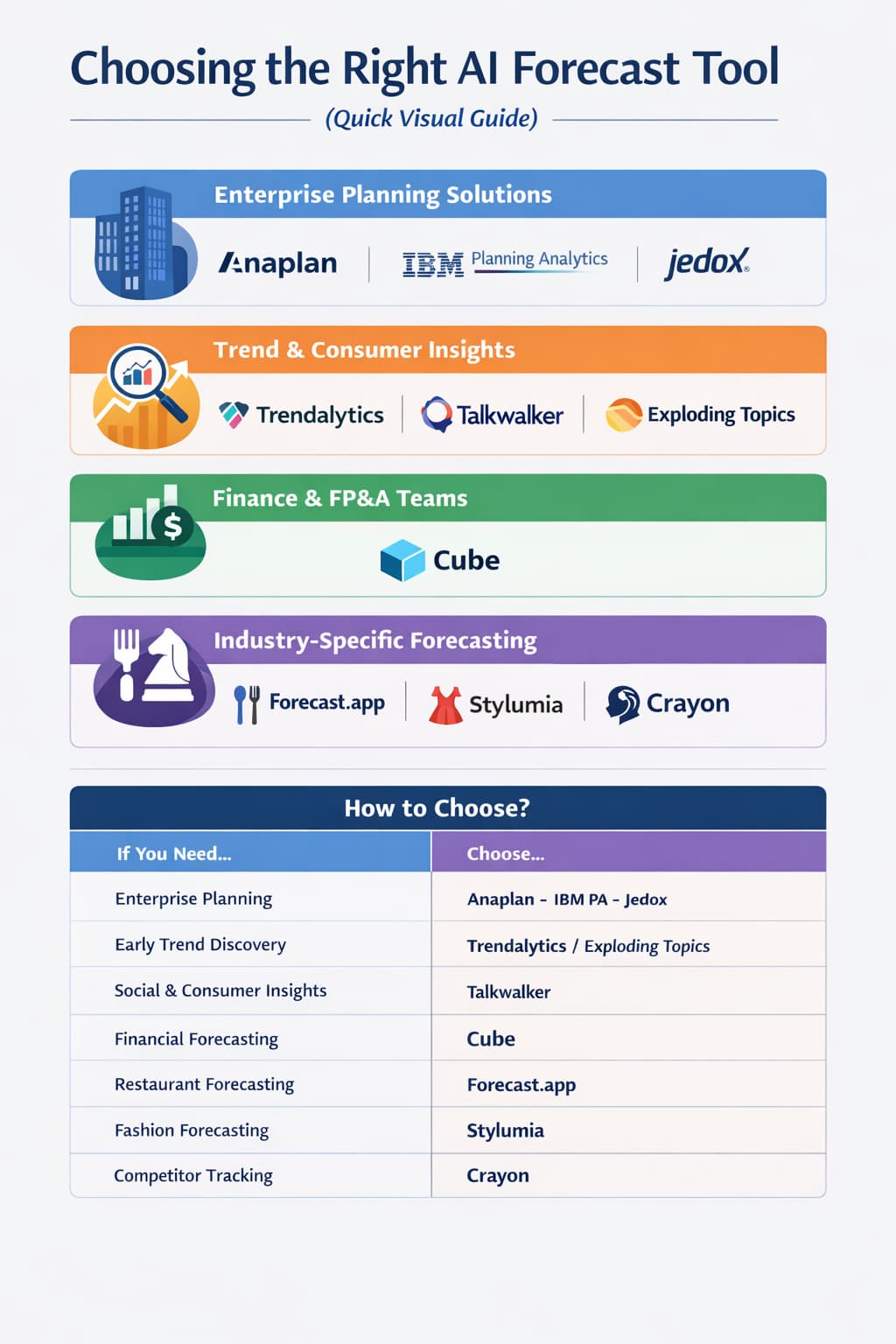
For enterprise planning, tools like Anaplan, IBM Planning Analytics, and Jedox are strong options. They support large-scale financial modeling, scenario planning, and multi-department forecasting.
What is the best AI tool for trend discovery?
Trendalytics and Exploding Topics are ideal for early trend detection, while Talkwalker is better for social media and consumer sentiment forecasting.
Are AI forecasting tools suitable for small businesses?
Some tools are enterprise-focused and expensive. However, platforms like Cube or Exploding Topics may be more suitable for small and mid-sized teams depending on the use case.