
Chandraghanta’s Courage: How Women Entrepreneurs Turn Challenges into Opportunities
Courage is not the absence of fear. It's staying calm enough to act anyway.
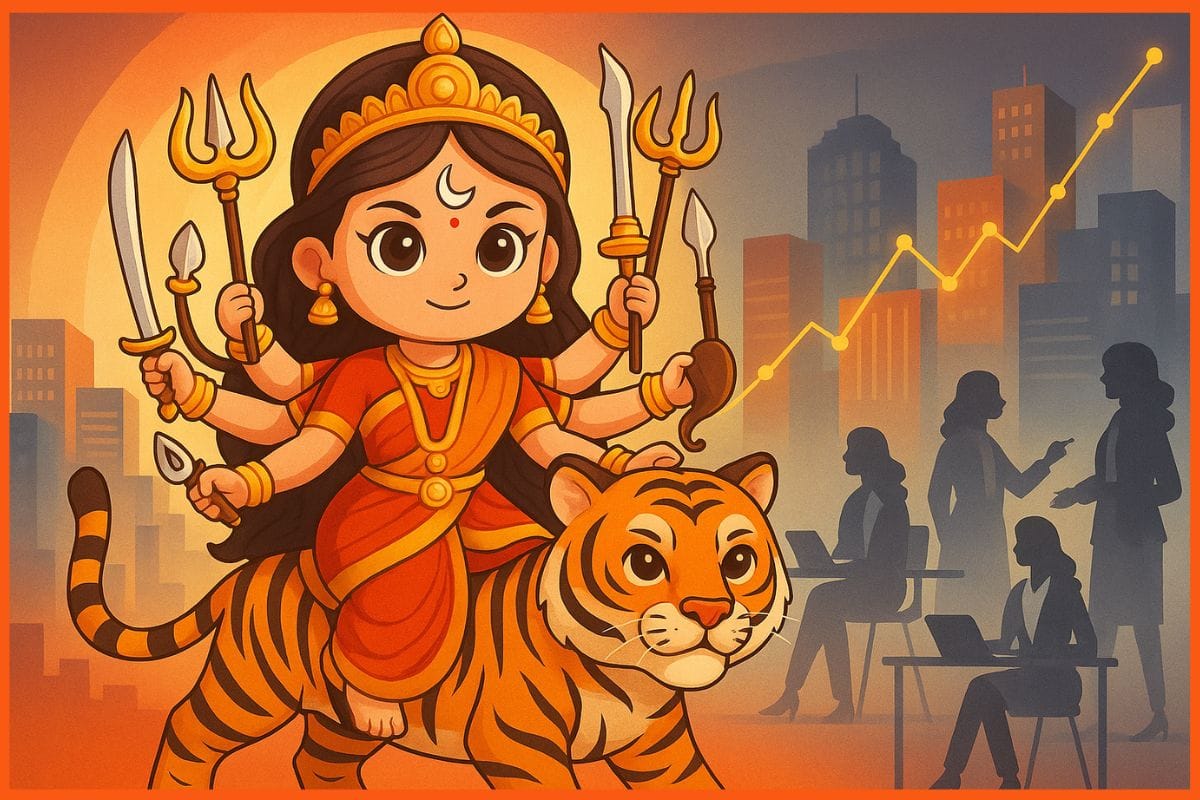
Today is the third day of Navratri, and it belongs to Goddess Chandraghanta. Her name comes from the half-moon, shaped like a bell (ghanta), that she wears on her forehead. She rides a tiger and carries weapons in her many hands, always ready for battle. Yet she is calm. It is said that the sound of her bell alone is enough to drive away fear and evil.
That mix of calm and courage is something every founder needs. Sooner or later, every business reaches a moment where the safe choice and the right choice point in different directions. Someone has to decide. And the decision is rarely easy.
So we asked our founders about that moment. When did your business need real courage? What did you do, and what happened next?
Their answers are six very different bets: on price, on the planet, on breaking a tradition, on inclusivity, on a new recipe and on giving things away for free.
A bet on price
We begin with a decision that many people told Nupoor Mohan would not work.
Therapy in India is often expensive, and that keeps most people away. When Nupoor built The Full Circle, she had to choose: charge what the market expected, or charge what people could actually afford.
Nupoor Mohan, Founder & CEO, The Full Circle
Pricing therapy at Rs 999 a session was our riskiest bet. Many people told me it would not be sustainable, and that good care had to cost more. I believed that if therapy stayed a luxury, most Indians would never walk through the door. So we built the model around access, kept the team lean, and invested in the right professionals. Since then, we have delivered over 2,000 sessions to clients in more than 30 cities across India, as well as the UK and the USA.
 Muskaan Kapoor
A bet on the future
Nupoor bet on what people could afford. Seema Bansal bet on where her whole industry was heading.
After nearly two decades in packaging, she could have kept doing what already worked. Instead, DCGpac put serious money into something the market was still warming up to.
Seema Bansal, Co-Founder & Executive Director, DCGpac
One of the important choices we made along the way was to go all in on sustainable manufacturing when the market was still developing. In January 2026 we opened our first Smart Manufacturing Plant in Noida. This plant is focused on making compostable packaging. Putting money into a place like this needed strong belief because sustainability is not something that can be seen as just a passing fad. It needs buildings, tools and time. We decided to put our money into this because we thought the industry was heading toward more responsible options. Now that choice shows our eagerness to take part in long-term chances even if the road is not clear.
A bet against tradition
Seema bet against the way her industry had always worked. Nidhi Sabbarwal took on something even older: habits passed down through generations.
Charcoal incense has been part of Indian homes for as long as anyone can remember. Kalyanamm asked people to change it.
Nidhi Sabbarwal, Founder, Kalyanamm Holy Waste Recycling Pvt. Ltd.
Chandraghanta inspires bravery and diligence, qualities I rely on and use when faced with challenges. When approaching a traditional market where charcoal was standard for incense, it took bravery; it was no easy task to get consumers to abandon routines that had lasted generations. Diligence included tracking consumer trends, being aware of changes in the industry, and pursuing environmentally sustainable practices.
I think that every challenge is an opportunity to reaffirm why we began: to make rituals healthier and more sustainable. Encountering challenges with courage and practising with discipline, we turn every setback into a learning opportunity. I feel we have transformed challenges into opportunities for growth and impact.
A bet on everybody
Nidhi stood up to tradition. Tejasvi Madan stood up to an industry that often didn't take her seriously.
Tejasvi Madan, Founder & CEO, Beyond Bound
Being a woman founder in a largely male-dominated industry isn't easy. At times, it feels like you are asked to prove yourself twice over. Chandraghanta's courage reminds me that belief in oneself has to come first. Whether it was deciding to take risks with unconventional designs or standing firm on size inclusivity, every bold move has shaped BeyondBound into what it is today. Obstacles don't disappear, but courage transforms them into stepping stones.
A bet on yourself
Some bets take factories and big decisions. Anupriya Keshri's took something smaller, but just as brave: being honest about what she didn't know.
During Ganesh Chaturthi, a big order came her way. There was just one problem.
Anupriya Keshri, Founder, TUMMZY
During Ganesh Chaturthi, a contact reached out through a reference asking for a bulk order of four modak varieties for her clients. The catch? I had never made a single modak in my entire life. Making them without maida or refined sugar felt daunting, and I wanted to give it a try, as this was also an offering for Ganpati Bappa. Taking a deep breath, I was honest with her: "I have never made modaks, but I will make samples first." I poured my heart, focus, and prayers into those samples. She loved them, and the order was confirmed. The best part came later when a key recipient's husband—who rarely compliments food—tasted them and asked where they were from, calling them exceptional. Taking that leap under pressure proved that when your intentions are pure, courage always sees you through.
Muskaan Kapoor
A bet on giving it away
We save the boldest idea for last, because it sounds backwards at first.
Subarna Mukherjee's riskiest move wasn't winning a client or launching a product. It was deciding to share her company's most valuable asset, its data, with everyone, including competitors.
Subarna Mukherjee, Founder & Global CEO, Shop Culture
Our riskiest bet wasn't a client. It was changing what we called ourselves. Agencies sell hours; we decided to sell insight. So we published Our Reports, built on our own portfolio data, and repositioned Shop Culture as a commerce accelerator firm. The fear was obvious: what if nobody cared, or a competitor used our numbers against us? We published anyway. The counterintuitive bit is that in services, giving away your data is how you prove you're worth paying for. The bell rings loudest when you ring it first.
What their courage has in common
Six founders, six bets: a lower price, a new factory, a break from tradition, a stand on size inclusivity, an honest "I've never done this," and data shared with the world.
None of these were loud, dramatic moves. But each one carried a real risk, whether that was losing money, losing time, losing customers, losing face or losing an edge to a competitor. And in every case, the founder stayed calm, thought it through and went ahead anyway.
That is Chandraghanta's kind of courage. Not reckless, not fearless, but steady. She doesn't wait for the battle to come to her. She rings the bell first.
If there's a decision you've been putting off because it feels risky, maybe today is the day to ring your bell.