Dove Marketing Strategy: How It Stands Out Among Its Competitors
Explore Dove’s marketing strategy in 2026, including its Real Beauty campaign, target audience, digital marketing, social media strategy, influencer marketing, product innovation and latest AI-focused marketing initiatives.


Dove is an American personal care brand owned by Unilever, which has gone above and beyond the traditional purpose of selling beauty and body care products to its customers.
The company has now become a household name because of successful marketing campaigns that are devoted to women of different ages, sizes and ethnicities. Dove’s products are marketed to help individuals find their internal beauty, something that soap cannot wash away.
Dove has established a distinctive brand identity by offering a diverse range of products and executing an impactful marketing approach that sets it apart from the crowded beauty industry.
The company believes in manufacturing quality products that are cleansing and feminine, the characteristics women look for in a product. The goal of the company is to build positive self-esteem and inspire women and young girls to reach their potential.
The brand values of Dove are self-love, empowerment, and beauty, which it achieves by creating campaigns such as the self-esteem project and the Real Beauty campaigns. By implementing effective marketing campaigns, Dove has successfully established a distinct reputation and differentiated itself from the competition while simultaneously increasing brand awareness.
According to Dove, the campaigns started a global conversation about the need for a wider definition of beauty after the study proved the hypothesis that the definition of beauty had become limiting and unattainable.
In recent years, companies have come up with new ways of marketing and emotive advertising campaigns, and Dove has used this in its marketing strategy to connect with their brand on a personal level.
By introducing campaigns and projects, the company has a chance to make a range of powerful videos and images based on research projects with the aim of making women feel good about themselves. All brands should have a story to tell or convey values in their branding which can be attributed to real life.
In 2026, Dove's marketing strategy has taken another important turn. The brand is now addressing the impact of AI-generated beauty standards and digital manipulation, while reaffirming its commitment to showing real women as they are.
In this blog, we will take an in-depth look at the marketing strategy of Dove, how it has evolved, and how it sets the brand apart from its competitors in the beauty industry.
About Dove
Dove Target Audience
Dove Marketing Strategy
Popular Marketing Campaigns of Dove
About Dove
Dove at a Glance
| Particular | Details |
|---|---|
| Brand | Dove |
| Parent company | Unilever |
| Category | Personal care and beauty |
| Origin | United States |
| Major product categories | Skin cleansing, body care, hair care, deodorants, baby care and men's grooming |
| Famous campaign | Campaign for Real Beauty |
| Major brand positioning | Real beauty, care, confidence and inclusion |
| Major recent focus | Authenticity, AI-era beauty standards, self-esteem and digital representation |
Dove is a personal care brand from the United States of America and belongs to Unilever. The company was invented by an American chemist named Vincent Lamberti. The soaps of the brand have been the trademark product of Dove, which was originally from the United Kingdom.
Dove manufactures its products in Argentina, Australia, Bangladesh, Bulgaria, Brazil, Canada, China, Egypt, Germany, India, Indonesia, Iran, Israel, Ireland, Japan, Mexico, Netherlands, Pakistan, Philippines, Poland, South Arica, South Korea, Thailand, Turkey, Russia and the United States.
Dove provides a comprehensive array of products for men, women, and babies and distributes them in over 150 countries. The iconic logo of Dove features a silhouette of a bird. The brand was established in the 1960s with the launch of the Dove Bar and Dove Beauty Bar. The uniqueness of Dove's products, specifically its claim of offering a soap that not only cleanses but also moisturizes the skin, garnered significant attention and set the brand apart from others in the market.
In the 1970s however, Dove started extending its product line after it gained a lot of popularity for being the mildest soap that is gentle for the skin. Soon enough, the brand products were highly recommended by physicians.
The initial marketing years were different as the advertisements focused on delivering authentic soaps that, unlike other soaps, moisturized skin rather than just washing it. The company then started creating advertisements that featured their customers and common women instead of models.
By the 90s, the company had grown to $200 million, and currently, the company was valued at approximately $5.4 billion in 2024. Its products are sold in nearly 150 countries. The company attributed its success to building a good reputation among women of various countries with the smart and emotional tactics used in its marketing strategies.
Dove Target Audience
Dove's Target Audience in 2026
| Audience | What Dove offers |
|---|---|
| Young women | Body confidence, self-expression and personal care |
| Adult women | Skin, hair and body care products |
| Gen Z consumers | Authenticity, inclusive representation and digital-first campaigns |
| Men | Dove Men+Care personal care and grooming products |
| Parents | Baby Dove and family-oriented care products |
| Families | Everyday personal care products |
| Consumers seeking gentle care | Cleansing and moisturising products |
| Socially conscious consumers | Purpose-led campaigns and representation |
The brand has launched many campaigns over the last decade to help educate and change people’s perceptions of women’s beauty. So, Dove’s products try to influence people both physically and emotionally with the positive characteristics of being friendly and outgoing. This is why the main target market or the audience of Dove is comprised of 18 to 35-year-old women who value natural beauty. This target audience is also highly engaged women who are active on digital and social media.
The target market of Dove also comes from the middle and upper class and are those who want to take extra care of their bodies. Women also prefer to buy products that have minimal to no chemical effects on their hair or bodies, and Dove fits that description.
Dove achieves tremendous reach towards the target customers via the empathetic marketing strategy. With the help of campaigns, Dove addresses the larger issues among different age groups of women and raises the brand's position in the buyer's eyes.
Additionally, Dove has also expanded its product offerings to cater to men and babies, broadening its target audience to include families and individuals looking for personal care products that cater to their specific needs.
Dove Marketing Strategy
Dove has more pros than cons when it comes to its product line. The pros of its products for women are its primary ingredients which are synthetic surfactants along with palm kernel and other vegetable oil and salts derived from animal fats.
While freshness and moisturizing properties are an added advantage of Dove products for women, its venture into Baby Dove has been an excellent marketing strategy. Dove's branding strategy focuses on real beauty and self-confidence, using authentic messaging and real people instead of models to promote body positivity and self-esteem. Dove branding strategy focuses on real beauty, body positivity, inclusivity, and authentic storytelling to build a strong emotional connection with consumers.
As one of Unilever’s most iconic brands, Dove needs constant effective marketing campaigns to stay in the beauty industry, which is already highly competitive. By using out-of-the-box campaigns and innovative advertisements in its marketing strategies since the 90s, Dove has been able to retain its market position very well.
Dove's Marketing in the AI Era
One of the most important developments in Dove's marketing strategy is its response to generative AI.
Dove says that 1 in 3 women feel pressure to alter their appearance because of what they see online, even when they know the images are fake or AI-generated.
The brand has therefore positioned AI as a new challenge to its Real Beauty philosophy.
The Code
Dove's The Code campaign explores how AI can influence society's definition of beauty.
The campaign asks what kind of beauty people want AI systems to learn and reproduce.
Dove has also created a Real Beauty Prompt Playbook aimed at encouraging more inclusive representations when people use generative AI tools.
This is significant because Dove's marketing strategy is no longer only about changing advertising.
It is also about influencing the digital environments where consumers discover and interpret beauty.
Here's a look at the creative and effective Dove Marketing Strategies:
- AI-Era Authenticity: Beauty advertising is entering a period where AI can create highly realistic people, faces and bodies. Dove has positioned authenticity as a response to this change. The brand's updated pledge states that it will continue featuring real women and will not use AI to create or distort women's images.
- Unique and Interesting Ways of Advertising: Dove has a very unique tactic when it comes to commercials. It does not use tried and tested methods of advertising by using well-known celebrities and models, Dove uses real people or its loyal customers for the commercials. This helped the company to build its brand image, reach out to its customers, and form a connection with its audience.
Dove 7 Day Test - Dove Marketing Strategy
- Emotional Appeals and Social Causes: Dove's marketing strategy often centers around emotional appeals and social causes, such as body positivity and inclusivity, rather than just product benefits and performance. This approach has helped the brand build a strong emotional connection with its target audience and establish a positive brand image. Over time, companies have started giving importance to people's attitudes, especially towards the consumption patterns of their target audience. Dove’s promotion strategy centers around emotional storytelling, social campaigns, and partnerships with experts to engage audiences and promote messages of self-care and real beauty.
- User-Generated Content: Dove has increasingly embraced authentic, unfiltered content.
A recent example is #ShareTheFirst, a creator-led initiative built around unfiltered user-generated content and the pressure created by digital perfection. Unilever identified this as Dove's first creator-led initiative in its 2025 annual report.
This represents an important shift in digital marketing.
Instead of producing every piece of content internally, brands can encourage consumers and creators to participate in the brand story. - Social Commerce: The relationship between content and shopping is becoming shorter. Consumers can discover a product through a creator video, social post or campaign and move directly towards purchase.
For Dove, this means product benefits can be integrated into storytelling instead of being promoted separately. - Market Products That Are Healthy for the Customers: The main benefit of Dove’s products is that it is healthy and gentle for the skin. Dove offers a wide range of products that are meant to moisturize and not just to clean the skin, but good quality products are not enough as you also need to have good marketing. Dove understands how customers do not relate to unattainable standards being put out on advertisements these days, which is why the advertisements of Dove always have common people embracing their natural beauty and encouraging others to use the products as it improves not just skin but one’s self-esteem.
- Dove Makes Sure It Supports Women's Empowerment: The main aim of Dove's marketing strategy is to promote real beauty among women to represent women of different colours, countries, ages, etc. This is why the company comes up with many marketing campaigns that try to break the beauty stereotypes that are portrayed in the media and create a more inclusive version of beauty in the media. Dove believes in promoting beauty in its purest form to show that everyone is beautiful without makeup or picture-perfect bodies. This has become a compelling social mission of Dove to build women’s self-esteem ever since. This approach has been effective in building trust and credibility with its target audience, as well as in appealing to a wider demographic.
- Dove Digital Marketing Strategy and Social Media Marketing: Dove has leveraged digital and social media platforms to reach its target audience, engage with them, and build brand awareness. The brand's campaigns on social media often go viral, generating significant exposure and driving sales.
- Unique Product Offerings: Dove has offered a range of unique and innovative products that cater to specific skin care needs, such as its "Dove DermaCare" line for women with curly hair, setting it apart from its competitors.
- Cultural and Social Relevance: Dove's campaigns often connect with issues already being discussed by consumers. This makes the brand part of a larger conversation rather than just another advertiser. The strategy is particularly relevant in social media, where consumers expect brands to participate in conversations and produce content that feels culturally relevant.
These creative and effective marketing strategies have helped Dove establish a strong brand image and drive sales, making it a leading brand in the personal care industry.
Dove Marketing Strategy: Key Approaches in 2026
| Strategy | Traditional Dove Approach | 2026 Evolution |
|---|---|---|
| Real beauty | Real women instead of idealised models | Real women + protection from AI distortion |
| Emotional marketing | Body confidence and self-esteem | Digital wellbeing and beauty pressure |
| Social media | Campaign distribution | Creator-led and UGC-driven storytelling |
| Advertising | TV, print and outdoor | Integrated digital, social, creators and commerce |
| Purpose | Women's empowerment | Empowerment + responsible representation in AI |
| Product marketing | Moisturising and cleansing benefits | Science, innovation and premium personal care |
| Content | Brand-produced campaigns | Brand + creators + consumers |
| Technology | Digital advertising | AI-aware content and digital experiences |
Dove Marketing Mix
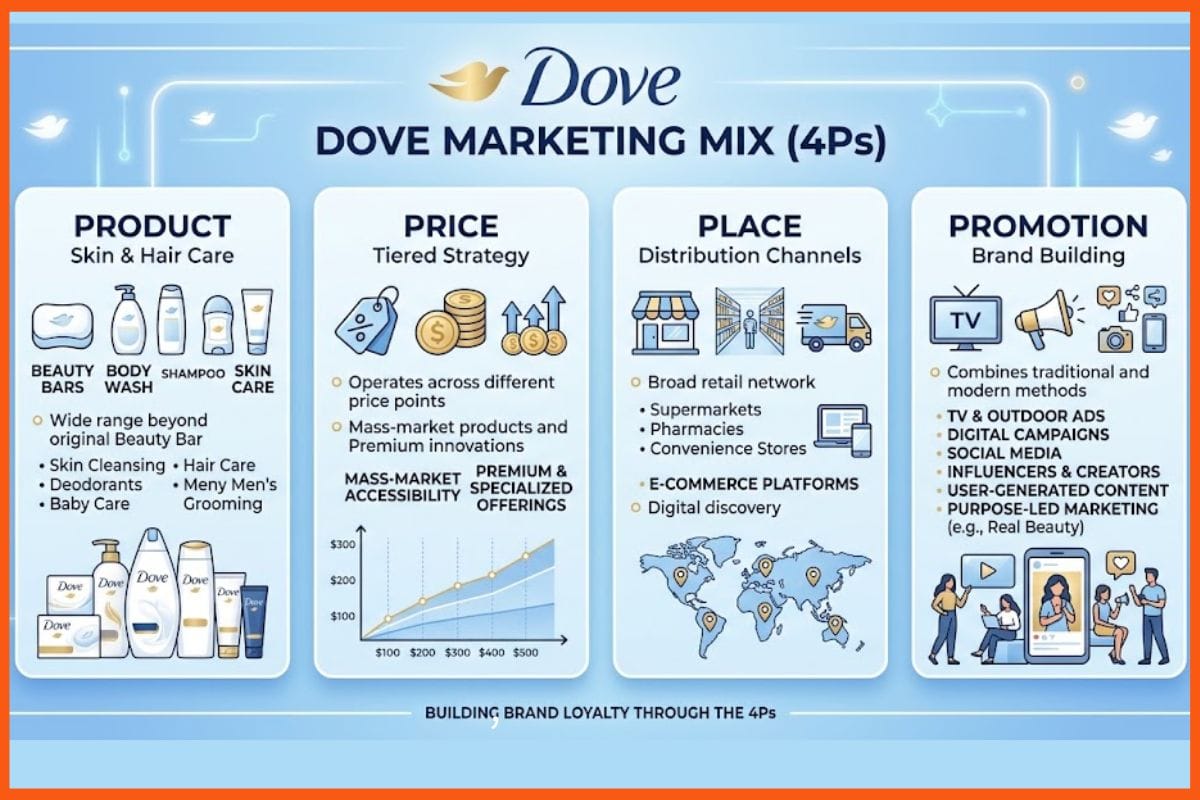
Dove's marketing strategy can also be understood through the traditional 4Ps of marketing: Product, Price, Place and Promotion.
| Marketing Mix | Dove's Approach |
|---|---|
| Product | Beauty bars, body wash, hair care, skin care, deodorants, baby care and men's grooming |
| Price | Mass-market products alongside premium and specialised offerings |
| Place | Supermarkets, pharmacies, convenience stores, e-commerce platforms and other retail channels |
| Promotion | TV, digital advertising, social media, influencers, creators, campaigns, OOH and purpose-led marketing |
Product
Dove has expanded considerably beyond its original Beauty Bar.
Its current portfolio includes products across skin cleansing, hair care, body care, deodorants, baby care and men's grooming.
Price
Dove operates across different price points depending on the category and product range.
Premium innovations allow the brand to capture consumers looking for more specialised personal care experiences.
Place
Dove products are distributed through a broad retail network and e-commerce channels.
Digital commerce has also created additional opportunities for product discovery and direct purchase.
Promotion
Promotion remains one of Dove's biggest strengths.
The brand combines traditional advertising with:
- Social media
- Influencer and creator marketing
- User-generated content
- Digital campaigns
- Television
- Outdoor advertising
- Brand collaborations
- Educational initiatives
Popular Marketing Campaigns of Dove
Dove has managed to create a unique and record-breaking campaign that has won the hearts of its customers over and over again. The company has been able to accomplish its success by investing in thoughtful, emotion-driven, empathic and sophisticated marketing strategies. Because of this, Dove has transformed from making campaigns that were activity-based to stunt marketing or large content creation.
The campaigns of Dove have always been conventional and thought-provoking. The campaigns below continue to reinforce Dove's brand positioning while providing more advertisements that the audience can interact with and relate to.
These are some of Dove’s most notable marketing campaigns that helped the company to stay on top of the beauty industry for years:
Choose Beautiful Campaign
Dove started the #ChooseBeautiful Campaign, whose main focus was to help women embrace their own natural beauty and unique selves. In order to make a video on this concept, the company reached out to women from five different cities (Shanghai, Delhi, London, Sao Paulo, and San Francisco) around the world and tried researching the different cultures and how it influences the choices women made when it came to buying products to their bodies.
In this campaign, a survey was held where it had two signboards depicting “Average” and “Beautiful” put on gateways of shopping centres to see how women of these cities consider themselves.
Dove Choose Beautiful Campaign
The campaign showed some women confidently entering through the “Beautiful” door while most others entered through the “Average” door. In the end, the women were interviewed on why they thought they were average when asked again whether they would choose “beautiful”. The women confidently moved through the “Beautiful” door with a smile.
The Real Beauty Campaign
Dove launched the iconic Real Beauty Campaign in 2004 that aimed to change, educate and inspire women on the actual definition of beauty and to make them feel comfortable in their own skin.
The pictures of regular women instead of the professional models were put up on billboard advertisements with messages inviting viewers to vote on whether a woman was “Fat or Fab” or “Withered or Wonderful” with the results to be displayed on the billboards.

Another experiment that was part of this campaign was in 2013 where FBI-trained Forensic artist Gil Zamora came for the campaign of Dove’s Real Beauty sketches where he made two sketches of each woman, one as described by the woman herself and another described by another person.
When he revealed two sketches, it was shown that the one described by another person was happier and fresher, which made the women emotional and conscious about the fact that they were more beautiful than they saw themselves as.
The result of the experiment showcased how more than 80% of the women were not comfortable with their bodies. The video of this experiment got more than 50 million views within 12 days.
Sales for Dove jumped from $2.5 to $4 billion within the ten years of its release. The Real Beauty campaign also won two ad awards to this date which is because it portrayed how women have to deal with unrealistic beauty standards while addressing the insecurities that women had to face. It brought a higher purpose to the brand and resonated with customers on several levels.
The Ad Makeover Campaign
Dove created an ad makeover campaign with interactive elements so women can change the way advertisements portray beauty. Users can regard negative things about ads such as weight loss or cosmetic surgery with positive messages designed by Dove.
Dove went one step further by searching for ads that had words with negative connotations such as Plastic surgery, Holiday, I hate my body, Bikini, Gym, or Diet.
Then Dove gave these ads a makeover by just replacing these words with good and positive ones, so none of the ads with these words can be shown. These advertisements went viral on Facebook as they spread the message of self-love.
Dove Ad
Over the span of a few years, over 171 million positive banners were displaced and reached 5.5 million unique women users. Over 70% of the women responded that they felt more beautiful through the campaign.
The #ShowUs Campaign
In the #Showus campaign, Dove partnered with Getty images in 2019 to create the world's largest photo library which was to be created by women who wanted to change the stereotypes of beauty and show women on what real beauty was.
Dove #ShowUs Campaign
This campaign features more than 500 images of 179 women from various countries and was also photographed by 116 female and non-binary photographs. This project was the winner at the 2019 Cannes Silver Glass: The Lion For Change as it allowed everyone to use the images and join the movement of empowering women.
#DetoxYourFeed

The campaign aims to educate young people about the impact of social media on self-esteem. With many spending a significant amount of time online and being exposed to unrealistic beauty standards, the initiative provides videos and educational resources to help boost self-confidence and reduce anxiety and stress caused by social media.
A short video was also created to guide parents and caregivers on how to talk to their children about the negative effects of social media. Additionally, a virtual event featuring a psychotherapist was held to discuss this important issue.
Key Takeaways From Dove's Marketing Strategy
Dove's marketing strategy provides several lessons for other brands:
| Marketing Lesson | What Dove Demonstrates |
|---|---|
| Build a clear identity | Keep a recognisable brand message |
| Tell stories | Use emotions instead of only product features |
| Be consistent | Build a purpose over many years |
| Know your audience | Address genuine consumer concerns |
| Use real people | Make advertising relatable |
| Encourage participation | Use UGC and interactive campaigns |
| Adapt to technology | Address new platforms and AI |
| Combine purpose with products | Connect brand values with product innovation |
| Stay culturally relevant | Participate in conversations consumers care about |
Conclusion
Dove has managed to remain at the top of the beauty industry by coming up with unique, emotional, empathetic marketing strategies. Through thoughtful campaigns, Dove has managed to make a change by making women feel confident and comfortable in their own skin and has successfully made women around the world feel beautiful in the way they are.
By truly understanding and capturing consumer concerns and executing campaigns with distinguished content, unlike other beauty companies Dove is able to maintain a representative for “real beauty” and empower women worldwide.
At the same time, Unilever's 2025 reporting shows Dove continuing to invest in product innovation, premiumisation, creator-led initiatives and faster digital content production.
The larger lesson from Dove's marketing strategy is that a brand can build long-term recognition by connecting product, purpose, storytelling and changing consumer behaviour.
FAQs
What is Dove target market?
The main target audience of Dove is comprised of 18 to 35 years old women that value natural beauty.
What is the history of Dove's marketing strategy?
Dove's marketing strategy has evolved over the years, with a focus on promoting positive body image and self-esteem for women. The brand's "Real Beauty" campaign, launched in 2004, marked a significant shift in this direction.
Who is the manufacturer of Dove?
Unilever is a British multinational company that owns the beauty brand Dove.
What makes Dove unique?
Dove does not use celebrities in its campaigns it uses real people which makes it stand out among other beauty brands.
What are some of the key elements of Dove's marketing strategy?
Dove's marketing strategy emphasizes emotional appeals, social causes, and empowering messages aimed at women. The brand often uses real women of diverse ages, sizes, and ethnicities in its advertising to promote body positivity.
How are dove beauty products different from other companies?
Dove products are different as they also moisturize the skin than just washing it.
How has Dove's marketing strategy changed over time?
Dove's marketing strategy has become increasingly inclusive and socially conscious over the years. The brand has expanded its focus beyond just body image to address issues like aging, skin care, and underrepresented communities.
What is the mission of Dove campaigns?
Dove's campaign aim in bringing out the self-esteem in women, to feel beautiful in their own skin and to break stereotypes.
How does Dove's marketing strategy compare to those of its competitors?
Dove's marketing strategy stands out among its competitors by focusing on social causes, emotional appeals, and inclusivity. While other personal care brands may prioritize product benefits and performance, Dove's marketing emphasizes the emotional and social impact of its products.
What is Dove real beauty campaign target audience?
The Dove Real Beauty campaign target audience primarily includes women of different ages, body types, skin tones, and backgrounds, with a focus on challenging unrealistic beauty standards and promoting self-confidence and natural beauty.
Is Dove an American company?
No. Dove is not an American company. Dove is a British-origin personal care brand owned by Unilever.
Who are Dove competitors?
Dove faces competition from major personal care brands such as Nivea, Olay, Lux, Pears, Vaseline, L’Oréal Paris, and Johnson’s. These brands compete with Dove across categories such as skincare, body wash, soaps, haircare, deodorants, and body lotions.