
Katyayani's Strength: Women Founders on Their Hardest Days
Every founder has a day she doesn't like to talk about.
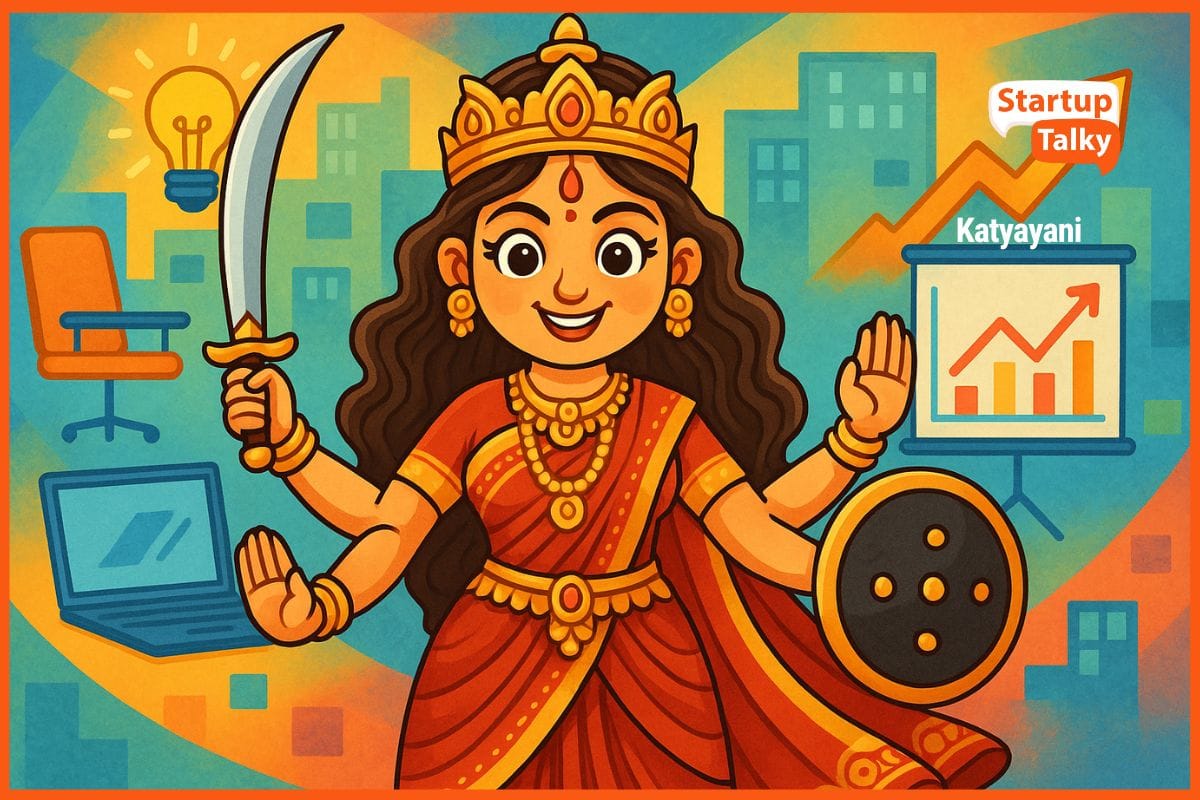
Today is the sixth day of Navratri, and it belongs to Goddess Katyayani, the warrior form of Maa Durga. Born in the home of the sage Katyayan, she is the goddess who rode out on a lion and defeated the demon Mahishasura when no one else could. She stands for courage in the middle of the fight, not before or after it.
For founders, those fights don't always look like battles. Sometimes it's a platform policy change. Sometimes it's a supplier walking away. Sometimes it's your own body. But they all ask the same question: will you keep going?
So we asked our founders: What is the hardest setback you've faced? How did you get through it? And what did it change about how you lead?
These are the most personal answers in the whole series. Thank you to every founder who shared them.
When the crisis isn't your fault
We begin with a setback that came out of nowhere.
Subarna Mukherjee's company, Shop Culture, helps brands sell on marketplaces like Amazon. This means a single decision by someone else can undo months of her team's work.
Subarna Mukherjee, Founder & Global CEO, Shop Culture
In marketplaces, your biggest risk is someone else's policy update. We once watched a client's account suspension wipe out months of work on a weekend. Nothing we did caused it, and nothing we did could quickly fix it. My first instinct was to fight the platform. My better instinct was to fix what we controlled: diversify channels, document everything, communicate daily with the client, and create hybrid models. It taught me that a leader's job in a crisis is to shrink the panic to its actual size. Calm is contagious. So is chaos.
 Muskaan Kapoor
When everything falls apart at once
Subarna's setback came from outside. For Tejasvi Madan, it came from every direction at the same time.
Tejasvi Madan, Founder & CEO, Beyond Bound
There have been moments when giving up felt tempting, when suppliers pulled out, when designs failed, when the uncertainty seemed too heavy. But Katyayani's determination reminded me of why I started. Knowing my "why" has kept me steady. It's this resilience, this refusal to let go of the vision, that has allowed Beyond Bound to keep moving forward even in stormy times.
When people call your idea niche
Tejasvi held on to her "why." Nidhi Sabbarwal held on to an idea that many people simply didn't take seriously.
Nidhi Sabbarwal, Founder, Kalyanamm Holy Waste Recycling Pvt. Ltd.
Katyayani's grit and perseverance are traits I have clung to closely throughout my entrepreneurial career. The incense business is traditionally oriented, and promoting environment-friendly, low-smoke variants was challenging. There were moments when people dismissed the idea as niche, but perseverance ensured that I kept innovating in natural incense, essential oils, and biodegradable packaging. Adversities are inevitable, but through resilience you can survive, and through determination you can succeed.
When things don't go to plan
Nidhi kept building through doubt. Archana Khosla Burman, co-founder of the apparel brand ZONE, has learned to look at setbacks in a different way: as lessons, not verdicts.
Archana Khosla Burman, Co-Founder, ZONE
Every founder faces situations where things do not go according to plan. One of the most important lessons I have learned is that failures are not final verdicts but opportunities to learn. Rather than dwelling on what went wrong, I focus on understanding what happened, identifying the lessons and using those insights to make better decisions moving forward.
Muskaan Kapoor
When you can't carry it all
Archana treats setbacks as lessons. Nupoor Mohan learned that sometimes the bravest thing is to admit you can't do everything.
She runs three businesses. At one point, all of them needed her at once.
Nupoor Mohan, Founder & CEO, The Full Circle
Running three businesses means there have been stretches when everything needed me at the same time, and one of them came just as The Full Circle was finding its feet. What got me through was being honest with my team about what I could and could not carry, and asking for help instead of pretending. It changed how I lead. I no longer see vulnerability as a weakness in a founder. It would be strange to build a company that tells people to ask for help, led by a founder who never does.
When the path is never clear
Nupoor's lesson was about honesty. Seema Bansal's, after nearly twenty years of running DCGpac, is about perspective.
Seema Bansal, Co-Founder & Executive Director, DCGpac
Entrepreneurship has taught me that setbacks are not isolated events; they test your ability to keep moving when the outcome is uncertain. Building a business from 2006 onwards meant navigating changing markets, customer expectations and the constant pressure of scaling. Some of the moments were decisions where there was no obvious right answer. I learned to separate a setback from the larger vision. That changed my leadership style: I became more focused on facts, adaptability and long-term thinking. Resilience, for me, is not about avoiding difficult moments but becoming better equipped to handle the next one.
When the money and people aren't there yet
Seema learned to separate a setback from the bigger vision. Suryasikha Satpathy's hardest years were about two very practical problems: money and people.
Suryasikha Satpathy, Founder & Director, BPE (Best Power Equipments India Pvt. Ltd.)
The hardest phase was managing the financial requirements of larger projects in our early years, while also building a strong service team. Since our products require after-sales service and we were operating across India, finding the right people to provide reliable service across locations was a significant challenge. For larger projects, we also needed to make advance payments to exporters when importing products, and we did not have sufficient assets in our initial years to support these requirements easily. However, we overcame these challenges within the first five years. It taught me that building a business requires not just financial management, but also the right team, consistent effort and the ability to overcome challenges early on.
Muskaan Kapoor
When faith carries you through
We end with the story we promised on Day 1.
When we first met Anupriya Keshri, she had just left a 15-year career and was in hospital after two surgeries on her finger. Months later, the wound still hadn't healed. Then came Navratri.
Anupriya Keshri, Founder, TUMMZY
Leaving my career brought financial strain, compounded by finger surgery that left my ring finger shorter. Months passed, but the wound stayed open, leaving bone exposed. Before Navratri in October 2025, still unhealed, I pledged a 9-day fruit fast and did Devi Seva at the Chhatarpur shrine in Delhi. I kept up my sadhana and prayers continuously. During those nine days, we even received Tummzy's official FSSAI license! On the tenth day, when I unwrapped the bandage, I broke down crying: fresh skin had fully grown over the exposed bone. That moment changed how I lead forever. It showed me that true strength isn't about physical force, it's about holding onto faith, surrendering to grace, and standing firm through adversity.
What their resilience has in common
Eight founders, eight hard moments: a client's account wiped out overnight, suppliers walking away, an idea dismissed as niche, plans that didn't work out, three businesses pulling at once, years of decisions with no clear answer, big projects with no money to fund them, and a wound that wouldn't heal.
None of them pretended these moments were easy. What they share is what they did next. They stayed calm, held on to why they started, asked for help when they needed it, and kept moving.
That is Katyayani's strength. Not the absence of struggle, but the decision to stand and face it.
If you're in the middle of your own hard season right now, you are in good company.