

From Filters to Feelings: Rethinking Matchmaking with Anuradha Gupta
📰 NewsIn a world of swipe culture and checklists, Anuradha Gupta is building a more intentional approach to love. Through Vows for Eternity, she helps individuals move beyond filters to find partnerships rooted in clarity, compatibility, and shared purpose.
The global matchmaking and online dating industry is undergoing a significant transformation, driven by shifting cultural norms, digital adoption, and evolving expectations around relationships. The global online dating market is projected to surpass $12 billion by 2030, while the Indian matchmaking market continues to grow steadily with increasing demand for personalized, high-intent, and culturally nuanced services. Among South Asians worldwide, there is a growing preference for bespoke matchmaking platforms that understand the intersection of tradition and modern identity.
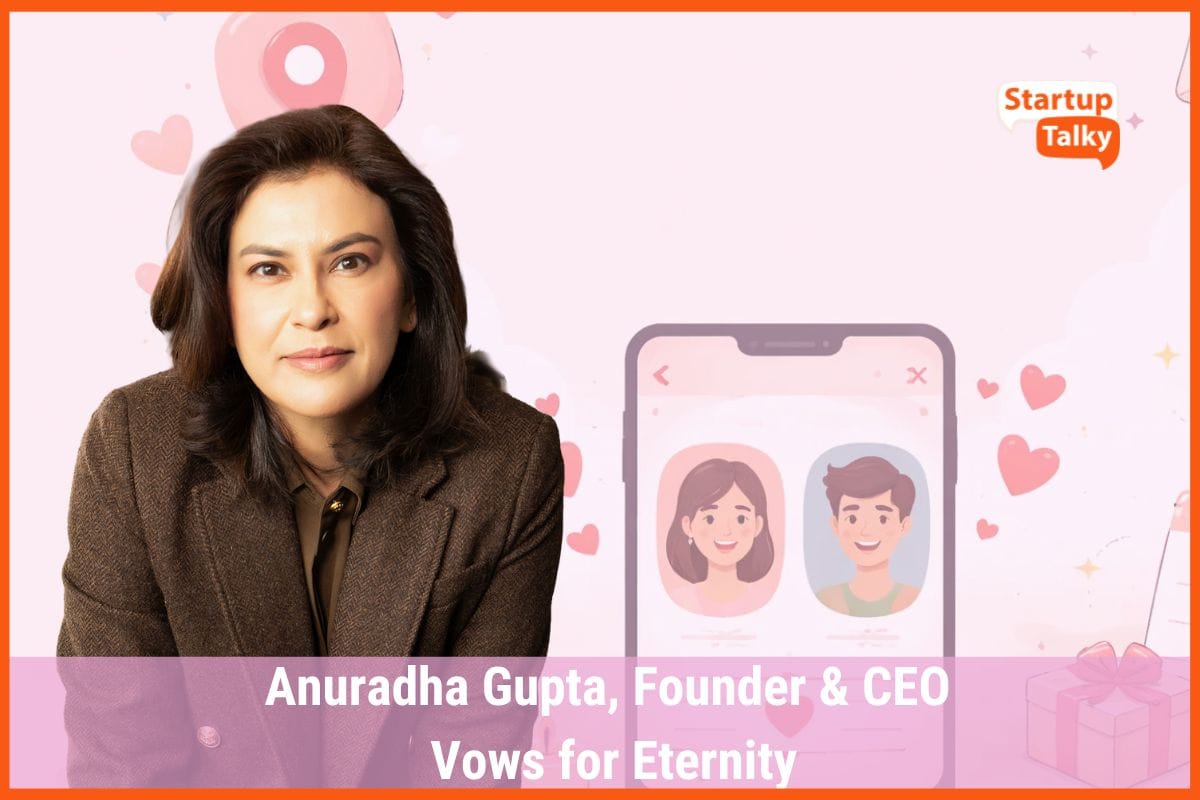
In this evolving landscape, Anuradha Gupta, Founder and CEO of Vows for Eternity, is redefining matchmaking through depth over data, helping individuals navigate love, identity, and partnership with clarity. As part of our International Women’s Day series, we spotlight her work at the intersection of culture and modern relationships.
Global Roots, Personal Truths: Redefining Matchmaking Beyond Filters
StartupTalky: Anuradha, you have lived and worked across four continents while staying rooted in South Asian values. How has this global-yet-grounded perspective shaped the way Vows for Eternity approaches matchmaking?
Anuradha Gupta: Living across cultures teaches you that people define love, family, independence, and identity very differently. But beneath all of that variation, the longing is identical. People want to be understood and loved.
It has also shown me how marriage itself is changing. What people expect from it, what they are willing to give to it, what they refuse to accept within it.
Traditional platforms are built on the assumption that identity can be filtered. That assumption does not hold. Especially not for globally exposed South Asians who are simultaneously navigating multiple value systems, managing family expectations in one hemisphere and personal aspirations in another, and trying to make sense of who they are amid all of it.
So at Vows for Eternity, we start with a different question entirely. Not “What are your interests and hobbies?” but “How do you see marriage?” And the answer is almost always where the real conversation begins.
Breaking the Timeline: Creating Space for Women Beyond Marriage Pressure
StartupTalky: Many South Asian women face intense pressure to marry by a certain age or in a certain way. How does Vows for Eternity create a space where women can explore compatibility without urgency or external judgment?
Anuradha Gupta: The pressure South Asian women face around marriage is real. But the part nobody talks about is what happens after years of absorbing it. It stops being external. It becomes internal. And that is far harder to undo than a pushy relative or a family deadline.
I have sat across from women who are accomplished, clear-headed, and genuinely ready for a partnership, and yet some part of them is still operating from a place of quiet panic. Not because anyone is pressuring them in that moment, but because the pressure has already done its work.
It has shaped what they think they deserve, how much time they believe they have, and how quickly they feel they need to decide.
That is what we are really working against. Not the family WhatsApp group. But the voice inside.
Before we discuss compatibility, we'll address that. Who are you today, separate from the timeline you were handed? What kind of partnership would genuinely add to your life, rather than resolve an anxiety?
When a woman can answer those questions from a place of stillness rather than urgency, everything changes. She makes better decisions. She asks better questions. She holds out for what she actually needs.
Marriage is not compulsory. And precisely because it is not, it deserves to be chosen and not settled for.
Redefining Balance: Ambition, Motherhood, and the Myth of Choice
StartupTalky: Building a global matchmaking company while raising twins is no small feat. What does balance actually look like for you day-to-day, and what would you say to women who feel they must choose between career ambition and family?
Anuradha Gupta: My day looks nothing like balance in the traditional sense. I am up before the house wakes, mentally in three time zones by 9 am, and somehow expected to know where the sports kit is. There are board calls that run late, and school plays I refuse to miss.
What keeps it from feeling like chaos is not a system. It is knowing, very clearly, what I will not trade.
The question assumes there is a choice to be made. I want to push back on that framing.
The idea that ambitious women must choose between career and family is one of the most damaging narratives we have inherited. It sets up a false binary and then makes women feel guilty whichever side they land on. I do not think the tension is between ambition and family. I think the tension is between ambition and the absence of the right conditions to hold both.
Those conditions are built, not found. They depend on who you choose as a partner, how you structure your support, what you are willing to ask for, and what you accept without guilt. There are seasons when work demands more. There are seasons when family does. What makes that sustainable is not perfect time management. It is having built a life with enough honesty and flexibility to move between those seasons without losing yourself in either.
And then there is the quieter discipline that few people talk about. Knowing what to let go of. Not every disagreement is worth your energy. Not every imperfection in your home, your schedule, or your relationships needs to be resolved. When you are holding a lot, you quickly become very clear about what actually matters. You stop fighting battles that were never going to move anything important. You hold tightly to the things that do.
Beyond Checklists: Helping Women Reclaim Their True Desires
StartupTalky: In a world where social media and family pressure distort what women think they should want in a partner, how do you help clients reconnect with what they genuinely desire?
Anuradha Gupta: It is one of the great ironies of our time. The tools designed to connect us have made authentic connections harder. Social media has given everyone a front-row seat to other people’s relationships, and, without realizing it, the lines between real and reel have become blurred.
The first thing I notice is that most people have never been asked to distinguish between desire and conditioning. When someone tells me they want a tall, successful, well-settled man, I am less interested in the adjectives and more interested in the emotion underneath them. Are you seeking security? Admiration? Stability? Validation?
The attribute is rarely the point. The feeling it represents almost always is.
And when you start pulling on that thread, things shift quickly. Women who came in with a very precise checklist often discover that what they were describing was not a partner at all. It was inherited. Layered in over decades of family expectation, cultural messaging, and generational patterns that had quietly become their own voice.
So we move the conversation from “What do you want?” to “What are you willing to build?” That shift changes everything because building requires you to show up as yourself, not as the version of yourself that looks good on the timeline someone else handed you.
The goal is not to abandon preferences. It is to know which ones are yours.
The Success Paradox: Why Finding Love Gets Harder with Achievement
StartupTalky: Many successful, independent women tell us that finding a partner actually becomes harder as they grow more accomplished. From your vantage point as a matchmaker, why does this paradox exist?
Anuradha Gupta: The paradox is real, but the explanation is usually misread.
People assume it is about intimidation. That accomplished women scare men off, or that their standards are too high, or that they have become too independent to compromise.
What I actually see is something more nuanced.
When you have built a full life, you lose the appetite for relationships that fill space. And that is a good thing. But it also means you are no longer willing to settle, which means the pool genuinely narrows. You are looking for something specific and rare: a partnership that adds to a life that is already rich.
There is also an internal shift that accompanies accomplishment, which most people do not examine. Competence in your professional life equips you to evaluate, optimize, and make efficient decisions. Those are excellent skills in a boardroom. In intimacy, they can make you impatient. You start looking for evidence of a decision rather than allowing something to unfold. And relationships, real ones, do not unfold on your timeline.
The women I see who navigate this well have usually made one important distinction. They have separated their standards from their defences. Standards are about what you genuinely need in a partner to build a life together. Defences are the walls that went up when someone hurt you, or when vulnerability felt too costly.
Both can look identical from the outside. Neither is necessarily wrong. But knowing which is which changes everything about how you approach a relationship.
Hidden Blind Spots: Why Even Self-Aware People Struggle in Love
StartupTalky: After years of meeting people searching for a partner, what recurring blind spots do you notice even in highly self-aware individuals?
Anuradha Gupta: The most consistent one, across cultures and backgrounds, is people confusing familiarity with compatibility.
We are unconsciously drawn to emotional dynamics we already know. Not because they are good for us, but because they feel legible. Someone who triggers a familiar anxiety feels excited. Someone who offers genuine steadiness can feel, at first, almost boring. I have watched intelligent, self-aware people walk past extraordinary partners because the connection generated insufficient friction.
The second blind spot is the gap between what people say they want and what they are actually drawn to. Someone may say they want emotional depth, yet consistently choose emotionally unavailable people. Someone may say they want calm and stability, then lose interest the moment conflict arises.
What people say they want and what they actually seek are often at odds. It takes some courage to sit with that.
And then there is a blind spot that is particularly common among high achievers: they think that self-awareness is sufficient preparation for intimacy. It is not. You can understand yourself with extraordinary precision and still struggle to be truly known by another person. Those are different skills.
Insight is not the same as vulnerability. And vulnerability, it turns out, is where the real work of a relationship actually lives.
What Truly Lasts: The Real Foundations of Enduring Marriages
StartupTalky: When you step back and look at the couples who truly build lasting marriages, what qualities actually sustain those relationships, and how different are they from what people think they’re looking for?
Almost nobody puts the sustaining qualities on their list.
What people say they are looking for: chemistry, ambition, values alignment, attractiveness, humour, stability. Those things matter. I am not dismissing them. But when I look at the couples who genuinely last, and last well, the qualities doing the heavy lifting are rarely the ones that showed up in the initial brief.
The first is tolerance for imperfection. Not low standards. Something more active than that. A genuine capacity to hold your partner’s limitations without contempt.
Contempt, not conflict, is what erodes a marriage. The couples who sustain something real have usually made an implicit decision: I am not here to fix this person, and I am not going to resent them for being human.
The second is repair. Every relationship accumulates ruptures. What separates the ones that last is not the absence of damage; it is the willingness to return to each other after it. To say, something broke here, and I would rather address it than let it harden.
The third is direction. A sense that you are building something together, not just cohabitating. This does not have to be grand. It can be as simple as a shared vision for how you want your home to feel, how you want to raise children, and what you are working toward.
Couples who have that tend to weather almost anything. Couples who have drifted into parallel lives, even comfortable ones, are often more fragile than they appear.
None of that makes it onto the list. But it is almost entirely what makes the difference.
 Muskaan Kapoor