The Question Byju Raveendran Wouldn't Answer
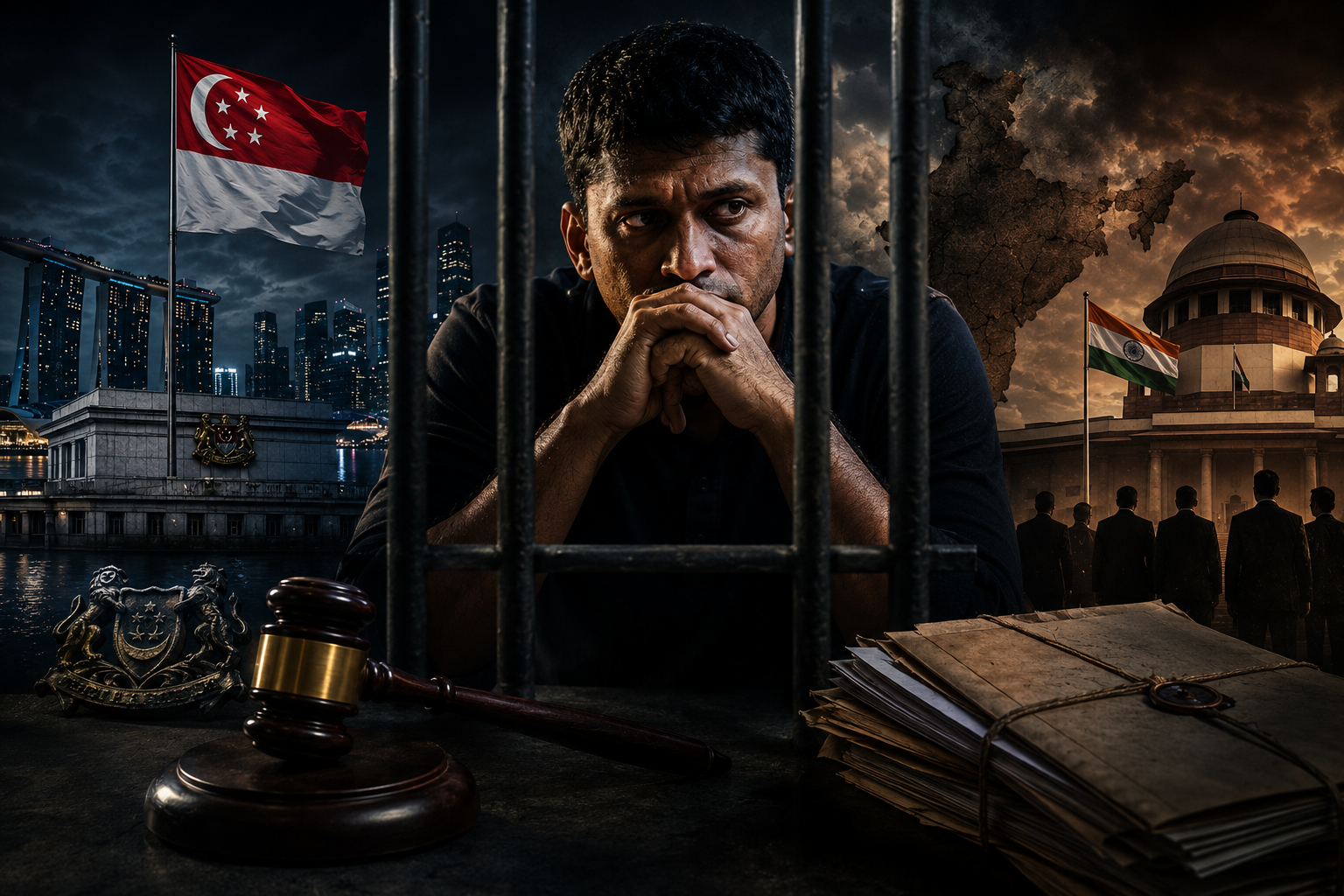
Singapore moved first. A court there has sentenced Byju Raveendran to six months in jail for refusing, across 25 months and multiple orders, to identify the owner of one specific Singapore shell company.
Of all the courts that could have come for Byju Raveendran first, none of them were in India.
The sentence handed down by the Singapore High Court on May 26, 2026 is six months in jail, S$90,000 in costs, and a fresh order to surrender documents he has spent 25 months not surrendering. The case was brought not by the American distressed-debt funds chasing him through Delaware, and not by the Indian creditors chasing him through the NCLT in Bengaluru. It was brought by Qatar Holding LLC, a subsidiary of the Qatar Investment Authority, which is owed $235 million plus interest under a Singapore International Arbitration Centre award rendered in July 2025.
The underlying transaction is small enough to recount in a sentence. In September 2022, Qatar Holding lent $150 million to Byju's Investments Pte Ltd, a Singapore vehicle owned by Raveendran. The money was used to acquire shares in Aakash Educational Services Ltd. Raveendran personally guaranteed the loan. The loan terms expressly prohibited transferring the pledged Aakash shares to any other entity.
In March 2023, six months after the loan closed but a year before it formally went into default, a new Singapore company called Beeaar Investco Pte Ltd was incorporated. By the time Qatar got around to asking the Singapore court to enforce its arbitration award, the Aakash shares Qatar had taken as collateral were no longer where the loan agreement said they should be.
Beeaar Investco is the company Raveendran has now been sentenced to six months in jail for refusing to identify ownership of.
He chose contempt over disclosure. The Singapore court read that choice the way a reasonable court would read it.
The Shape of the Case
You can read a great deal into the specificity of the fight. Qatar did not, in the contempt proceeding, ask the Singapore court to claw back its $235 million or freeze new assets. It asked, repeatedly and patiently across April 2024 to May 2026, for one thing: documents proving Raveendran's legal ownership of Beeaar Investco. The reason is that if he owns Beeaar, and if Beeaar is where the pledged Aakash shares went, then Qatar has the complete evidence chain linking him personally to a deliberate breach of the loan covenant. If he doesn't own Beeaar, he could have said so under oath in April 2024 and the contempt question would never have arisen.
He did not say so. He kept not saying so for 25 months across multiple court orders. A Singapore High Court judge eventually concluded that the silence had a meaning the court was entitled to act on.
Six months is not a symbolic sentence. It is the kind of committal order Singapore courts use when civil enforcement has been exhausted and the defendant has shown the court that the costs of contempt are lower than the costs of compliance. That calculus just got more expensive by a quantum that involves actual jail time.
Or it would, if anyone could put Raveendran in a Singapore jail.
Where He Actually Is
Raveendran has been living in Dubai since September 2021. He confirmed this himself in a long-form interview with Smita Prakash of ANI in May 2025, citing his father's medical treatment as the reason for the move. He has not been in India in any material sense for over four years. He was not in Singapore when the Singapore court issued any of its disclosure orders. He was not in Delaware when the US bankruptcy court held him in civil contempt in July 2025. He was not in Bengaluru when the Karnataka High Court barred him from selling Indian assets in September 2025.
Singapore and the United Arab Emirates do not have a bilateral extradition treaty. The UAE is not on Singapore's published declared list under the Extradition Act 1968. A six-month committal sentence in Singapore is procedurally enforceable through an arrest warrant if Raveendran sets foot in Singapore, and through an Interpol Red Notice request if Singapore chooses to pursue one. Whether Interpol will issue a Red Notice for a civil-contempt order is genuinely uncertain. Interpol's own Article 3 generally discourages it.
So the practical answer is: the sentence is real, the jail is real, but the bridge between them runs through a passport control he will not voluntarily walk into. The power of the order, in the near term, is reputational and financial. It strengthens enforcement of the underlying $235 million SIAC award. It hardens the asset-freeze position. It tells every future court in every future jurisdiction what a court in Singapore concluded about the credibility of his disclosures.
That is, by itself, more than what India has done.
The Defense
Raveendran responded to the sentence with a public statement. It is worth reading carefully, because what it says is interesting and what it does not say is more interesting.
The core of his framing is that a settlement is imminent. "The lenders, including GLAS Trust and QIA, as well as other stakeholders, have been in discussions with the founders and other parties. A settlement has been agreed in principle, with only a few residual minor issues left to be finalised between certain parties. I have no role in those remaining issues." Against this backdrop, he says, "the decision by QIA to continue pressing this matter appears to be an unnecessary pressure tactic at a sensitive stage of the settlement process."
Then comes the line that does most of the actual work in the statement. "I have not been actively contesting several court proceedings in recent months precisely because the parties were working towards a comprehensive settlement. I chose resolution over confrontation."
Read that twice. He is not disputing that he failed to comply with the Singapore court's disclosure orders. He is offering a reason for the failure: that he was negotiating a deal in the background and didn't want to litigate. The Singapore court did not find that reason compelling. The court's view, evident from the sentence, was that twenty-five months of refusing to identify the owner of one specific Singapore shell company is not "choosing resolution over confrontation." It is choosing silence over disclosure.
Two other claims in the statement deserve a closer look.
He says the parties have "acknowledged that there has been no wrongdoing on my part or on the part of the other founders." This is a remarkable assertion. If GLAS Trust and QIA have, in the settlement discussions, signed off on a no-wrongdoing acknowledgment, that is news of its own. If they have not, it is a unilateral characterization of confidential negotiations and worth treating with appropriate caution. Neither GLAS Trust nor QIA has, at the time of writing, issued any public statement confirming or denying his characterization. Glas Trust has, in earlier statements, categorically denied Raveendran's framing of their dispute; whether something has shifted in private since is unknown.
He also says "neither I nor any of the founders personally received any portion of the disputed funds, and that the funds were used for legitimate business purposes." This is a defense of the underlying Delaware allegations about the $533 million sent to Camshaft Capital, not the Singapore matter directly. It is also the same defense his side has offered since 2024. The Delaware court, which has read his briefs, issued a $1.07 billion default judgment against him personally in November 2025 anyway.
What Raveendran does not address in the statement is the specific factual question the Singapore sentence is about. He does not say whether he owns Beeaar Investco. He does not say where the pledged Aakash shares went. He does not explain why he could not produce, in twenty-five months, a single document responsive to the Singapore court's orders. The statement responds to the framing of the news cycle. It does not respond to the question of the case.
What India Has, and Has Not, Done
Here is the part of the story that should make every Indian reader stop and think.
The Enforcement Directorate, in November 2023, issued a show-cause notice to Think & Learn Pvt Ltd for FEMA violations totalling ₹9,362 crore, roughly $1.1 billion in alleged unlawful foreign remittances and investments. In February 2024, the ED issued a Look-Out Circular against Raveendran personally. So it is not true to say Indian regulators have done nothing. The ED has a live FEMA case that is, by quantum, the largest single regulatory exposure he faces anywhere in the world.
What is true is that no Indian regulator has converted that exposure into a criminal sanction.
The ED has not, as far as public records show, registered an ECIR or initiated PMLA proceedings, the steps that would convert FEMA's civil character into criminal liability with arrest powers. SEBI, constrained by Think & Learn's unlisted status, has not publicly moved on the Aakash transactions, where AESL is registered with the regulator even if not listed. The Serious Fraud Investigation Office was considered in 2023 and, as of the Ministry of Corporate Affairs' last public statement in June 2024, "proceedings are ongoing" with no final report. The Income Tax Department has not registered a public survey or assessment producing a leaked headline. The Karnataka police have not produced an FIR personally naming Raveendran. The NCLT in Bengaluru is processing the BYJU's insolvency but has not held Raveendran in personal contempt on the BCCI insolvency case that brought the company there.
The list is not an oversight. It is a system.
Indian regulators have spent three years investigating BYJU's. Singapore took two years from its first disclosure order to a custodial sentence. Delaware took eighteen months from the Chapter 11 filing to a $1.07 billion default judgment, since amended to set up a damages-determination phase in January 2026 but with the personal liability finding still in place.
The Qatari sovereign wealth fund and a US bankruptcy court have, between them, established the personal financial and criminal exposure Indian regulators have spent four years circling. India still has the largest claim against him by quantum. It does not yet have the smallest concrete consequence.
The First Indian-Domiciled Unicorn Founder Jailed
To be precise about what was true before today and what isn't true any more.
Subrata Roy of the Sahara group went to jail in India in 2014, but Sahara was a chit-fund and quasi-banking case, not a venture-backed startup. Vijay Mallya remains in the UK fighting an extradition case that started in 2017. Nirav Modi and Mehul Choksi sit in their respective extradition limbos for the PNB diamond fraud. Manish Lachwani, the Indian-American founder of HeadSpin, was sentenced to 18 months in California in 2023 for investor fraud, often cited as the first unicorn founder jailed globally, but he is a US case from end to end.
Byju Raveendran is the first founder of an Indian-domiciled, venture-capital-backed unicorn to receive a personal custodial sentence from a court in a major financial-center jurisdiction connected to the conduct that brought his company down. The Lachwani precedent makes it precisely framed. The Sahara precedent makes it categorically distinct.
It is the venture-era version of personal accountability that India had not produced. Singapore produced it instead.
What This Signals
Ritesh Agarwal at OYO has just filed a confidential ₹6,650 crore DRHP at a $7-8 billion valuation. His parent entity, Oravel Stays, has a Singapore arm holding the SoftBank-routed cap table. Vijay Shekhar Sharma at Paytm has been personally barred for two years from director positions in any SEBI-registered entity. Ashneer Grover at BharatPe has live civil and criminal cases that have so far produced no custodial outcome. The founders of FirstCry, Lenskart, PhonePe, Swiggy, Zepto, and the rest of the IPO pipeline are all watching this morning.
The signal is not that any of them is at risk of a Singapore committal order. The signal is that the era in which an Indian founder could rely on the protective opacity of cross-border corporate structures has just ended. Once one major Indian unicorn founder has been sentenced for the way he handled a cross-border collateral package, every cap table containing foreign sovereign or institutional money becomes a future evidence file. Drew & Napier, the law firm representing Qatar Holding in this matter, will get other calls.
The other signal, the one nobody in the Indian press will write up cleanly today, is for the regulators themselves. The ED has spent two years on a ₹9,362 crore FEMA case without converting it to PMLA. SEBI, MCA, SFIO, and the income tax department have been outpaced in public view by a court in a country one twentieth the size of India. Whatever combination of internal politics, capacity constraints, and institutional caution has kept Indian agencies from moving from investigation to consequence has just been shown, by direct comparison, to be the choice it always was, not the constraint it claimed to be.
The Qatari sovereign wealth fund did what the Indian state would not.
That sentence deserves to sit on its own.
The Qatari sovereign wealth fund did what the Indian state would not.
What Comes Next
Whether Raveendran serves any of the six months depends on whether he leaves Dubai voluntarily. He has shown, across multiple jurisdictions, no inclination to comply with court orders that require him to. His defense — that he was choosing settlement over confrontation — will be tested in the coming weeks by whether GLAS Trust and QIA publicly endorse his version of where the settlement discussions actually stand. If they do, the story rewrites itself in his favor. If they don't, his claim that the contempt was a strategic restraint rather than evasion becomes much harder to sustain.
The Delaware $1.07 billion default judgment is the larger claim. The Singapore six months is the louder signal. The Karnataka asset freeze is the most immediate threat to any wealth he holds onshore in India. The ED's ₹9,362 crore FEMA exposure is the largest unresolved Indian regulatory matter sitting on the docket.
The four sit in four different courts, in four different countries, against the same man, for variations of the same alleged conduct. None of them have reached him personally where he lives.
But there are now four of them. There used to be one. The accumulation has its own momentum.
Nobody, it turns out, was ever coming for him from India.