
Demis Hassabis Biography: The Man Behind DeepMind and AlphaFold
👨💻 StartupTalkersDemis Hassabis is one of the leading figures in artificial intelligence. From building video games to creating DeepMind and solving complex scientific problems with AI, his journey is shaping the future of technology.

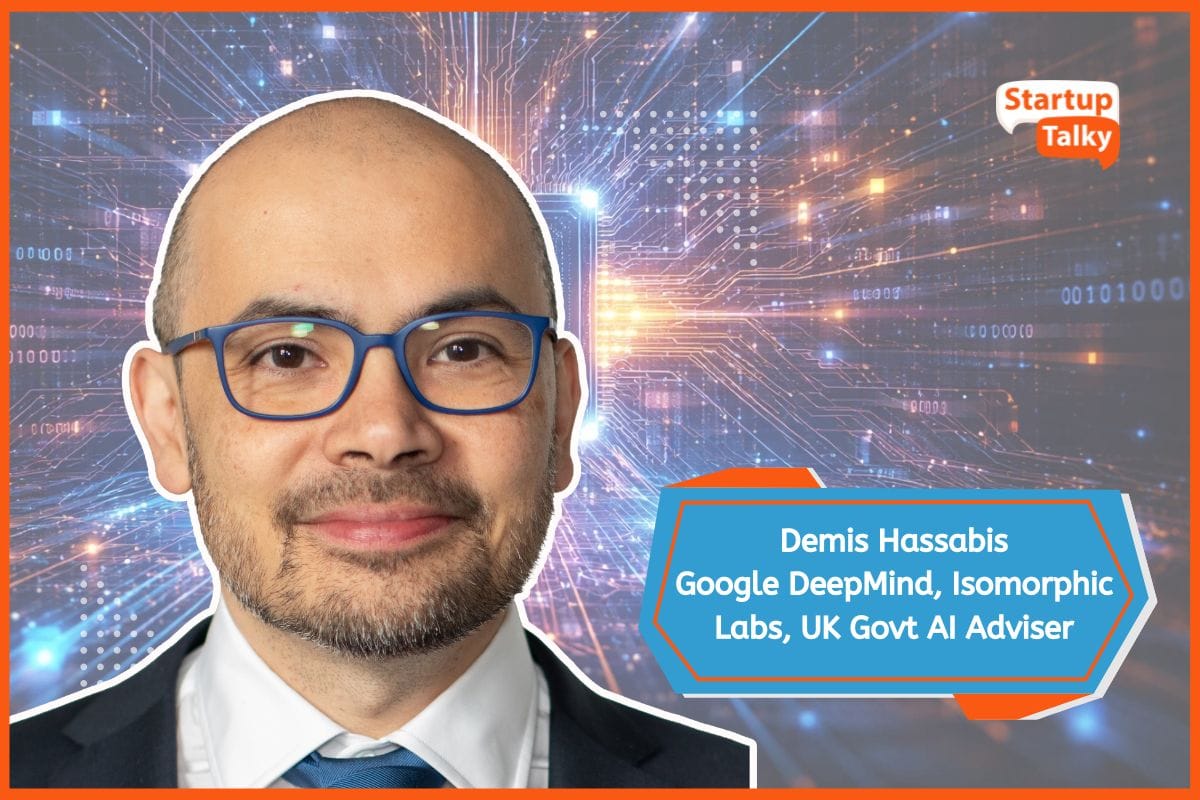
At the age of 49, Demis Hassabis created a new era of Artificial Intelligence with his advanced research techniques. Hassabis is the co-founder and CEO of Google DeepMind and Isomorphic Labs. He is also a UK AI Adviser.
Hassabis was awarded the Nobel Prize in Chemistry for his contribution to AI research in protein structure prediction jointly with John M. Jumper, an American computer scientist. He is a member of the Royal Society.
He has won various awards and titles, including Time’s 100 Most Influential People in the World in 2017 and 2025, and was one of the "Architects of AI" collectively chosen as Time's Person of the Year in 2025.
Demis Hassabis Biography
| Detail | Information |
|---|---|
| Birth | 27 July 1976, London, England, UK |
| Nationality | British |
| Profession |
Co-founder and CEO of Google DeepMind Co-founder and CEO of Isomorphic Labs UK Government AI Adviser |
| Education |
B.A./M.A in Computer Science – University of Cambridge PhD in Cognitive Neuroscience – University College London |
| Spouse | Teresa Hassabis |
| Children | Two sons |
Early Life and Personal Background
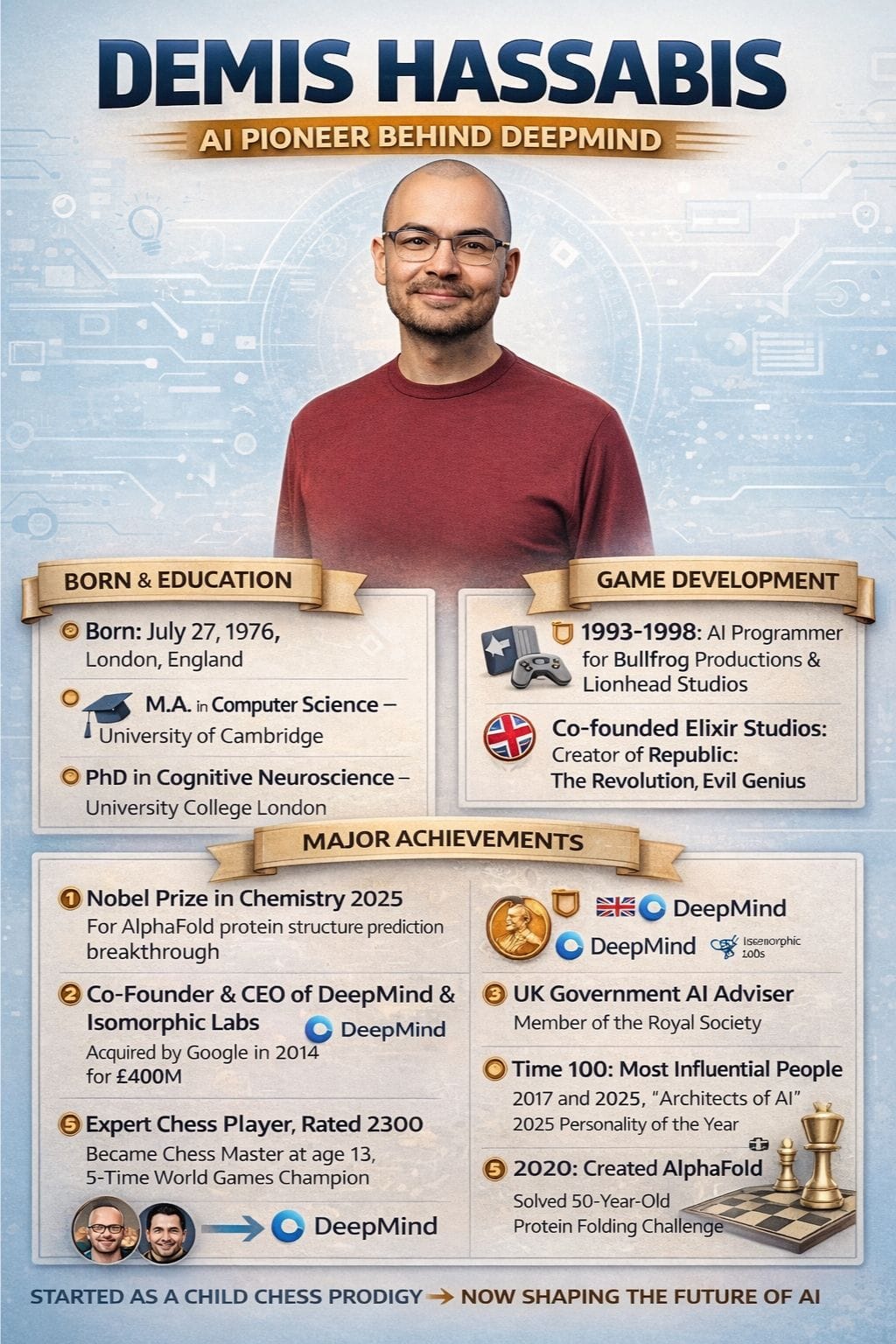
Demis Hassabis was born on July 27, 1976, in London. His father, Costas Hassabis, is a Greek Cypriot, and his mother, Angela Hassabis, is a Chinese Singaporean. His father worked as a singer-songwriter, and his mother was in the retail business, with both described as "bohemian".
He has two siblings and spent his childhood in North London with his family. Demis was fascinated by chess in his childhood, and as his skills developed, he became a child prodigy at the age of four. He became a chess master at the age of 13 with an Elo rating of 2300 and led many junior teams in England. He is a 5-time World Games Champion.
He represented the University of Cambridge in the Oxford–Cambridge varsity chess matches in 1995, 1996, and 1997 and won a half blue.
Hassabis is married to Teresa, who is a molecular biologist specialising in Alzheimer’s research, and they have two sons. He currently resides in North London with his family.
Education and Academic Journey
Demis, at a tender age, developed a keen interest in chess, computer programming, and video games as he bought his very first computer in 1984 with the money he won in his chess tournaments. He taught himself how to program and code and formed his very first game on a Commodore Amiga, which played the Reversi board game.
In 1988, Demis joined Queen Elizabeth’s School, Barnet, a boys’ grammar school in North London. Thereafter, he was home-schooled for one year. Then he studied at Christ’s College in East Finchley, a comprehensive school. At the age of 16, he completed his A-level exams, which was two years earlier than usual students.
He took a year’s gap as he was told by Cambridge University, due to his young age. In that gap, he joined Bullfrog Productions and was enrolled at Queen’s College of the University after a year’s gap. There, he studied Computer Science Triops and completed his graduation in 1997 with a double first, i.e., a bachelor’s and an integrated master’s degree altogether.
As his interest in Neuroscience grew after working in various companies, in 2009, Hassabis, under the supervision of Eleanor Maguire, obtained his PhD in cognitive neuroscience from University College London, Queen Square Institute of Neurology.
Early Career in Gaming and AI Development
Demis Hassabis initially was a video game AI programmer and designer. He was also an expert player of board games. At 17, before attending Cambridge, he worked in computer games at Bullfrog Productions, making code for their games.
He started playtesting on Syndicate, and later he became the lead developer of the AI-generated video game Theme Park. As he was interested in designing, he co-designed the game with Peter Molyneux.
After completing his graduation from Cambridge, he started working at Lionshead Studios. There, he became a lead AI programmer on the god game Black & White (2001). In 1998, he left Lionhead and created Elixir Studios, where he signed deals with Eidos Interactive, Vivendi Universal, and Microsoft for production.
With management, he also became executive designer of the AI-based video games Republic: The Revolution and Evil Genius. Both games received BAFTA nominations for their music scores.
 Sakshi Jadhav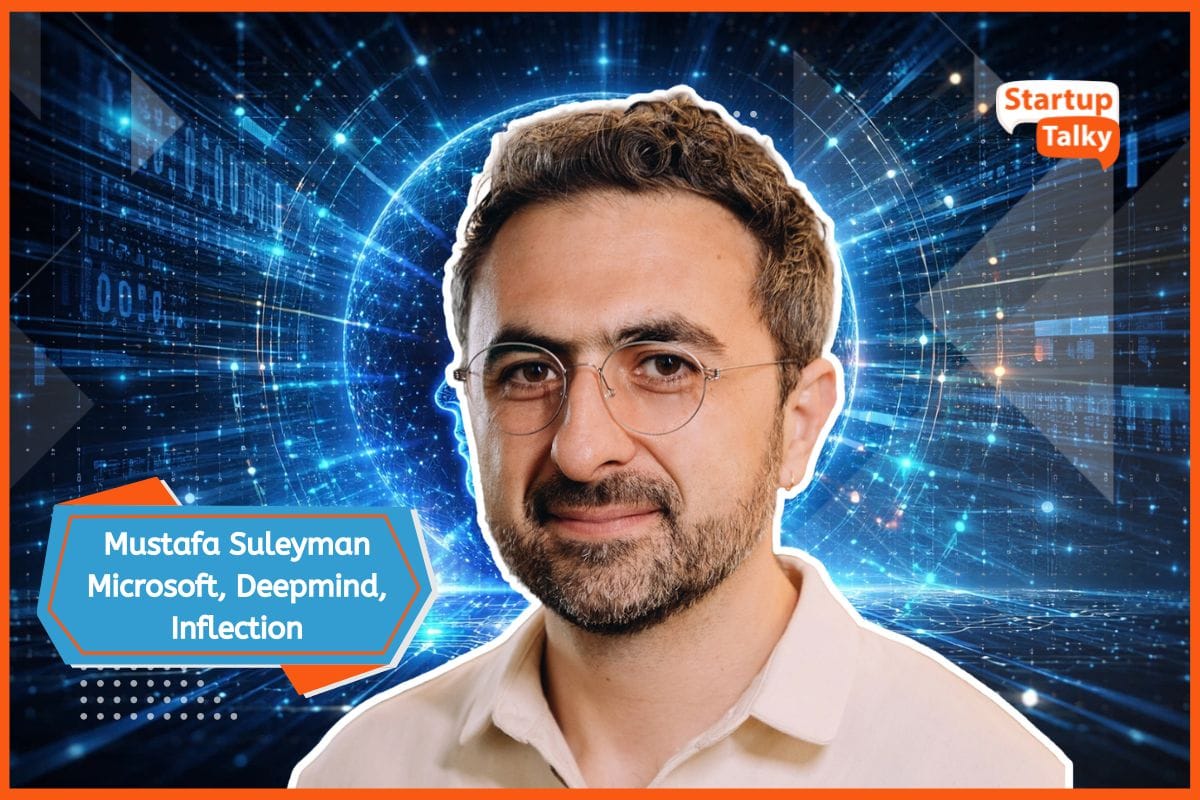
Neuroscience Research and Scientific Breakthroughs
As Hassabis sold the rights of Elixir Studios and completed his PhD from UCL, he continued his research in neuroscience and artificial intelligence as a visiting scientist at the Massachusetts Institute of Technology and Harvard University jointly.
In 2009, he got a Wellcome postdoctoral research fellowship at the Gatsby Computational Neuroscience Unit at UCL.
As he researched imagination, memory, and amnesia, Demis co-authored various noteworthy papers that were published in journals such as Nature, Science, Neuron, and PNAS. His very first academic work was published in PNAS.
His research on connecting episodic memory with imagination received widespread attention and was listed in the Top Ten Scientific Breakthroughs of 2007 by the journal Science.
Founding DeepMind and AI Revolution
In 2010, Demis Hassabis founded a machine learning AI organisation named DeepMind with Shane Legg and Mustafa Suleyman. He is currently the CEO of DeepMind. The mission of DeepMind is to solve intelligence and utilise it to solve everything else.
It aims to merge insights from systems neuroscience with new advances in machine learning and computing hardware to enable powerful general-purpose learning algorithms to create an Artificial General Intelligence.
The company particularly trains the learning algorithms to master games. In December 2013, DeepMind made a breakthrough by training an algorithm known as Deep Q-Network (DQN) to play Atari games at a superhuman level using only raw pixels on the screen as inputs.
With the company’s achievements in the AI field, Google decided to purchase DeepMind for £400 million in 2014. Most of the company has been an independent entity, based in London, but DeepMind Health has been directly merged into Google Health.
AlphaGo Breakthrough and AI Milestones
With Google’s acquisition, DeepMind created a gaming program named AlphaGo. It defeated many famous players of Go, including world champion Lee Sedol, European champion Fan Hui, and the world's top-ranked player Ke Jei. Go had been considered a treasure of AI, due to its large number of possible board positions and resistance to present programming techniques.
The company has made significant advances in machine learning, particularly in the fields of deep learning and reinforcement learning, and has also produced numerous award-winning papers.
With AI’s developments and their benefits, Hassabis has foreseen that artificial intelligence will be one of the most beneficial technologies for humans ever. But he has also cautioned the world about the potential hazards of AI. According to Hassabis, there is a crucial need to measure the proficiency and control that the new AI models have.
Sakshi Jadhav
AlphaFold: Solving Protein Structure Prediction
Achieving continuous progress in Artificial Intelligence, DeepMind transformed its course to a 50-year grand challenge in science, Protein Structure Prediction. It is to predict the 3D structure of a protein from its 1D amino acid sequence.
This problem in biology is important due to the protein’s essentiality; every biological function depends on proteins, and the function of a protein is thought to be related to its structure.
This problem encouraged them to make AlphaFold- an AI programme that predicts protein structure. This tool predicted the most accurate structure for 25 out of 43 proteins. AlphaFold won the 13th Critical Assessment of Techniques for Protein Structure Prediction (CASP) in 2018.
With a new version of AlphaFold, DeepMind declared results in the CASP 14th edition of the competition with AlphaFold 2 in late 2020. It accomplished a median global distance test score of 87.0 across protein targets in the free-modeling category. This led the organisers of CASP to announce that the problem is basically solved.
Impact of Demis Hassabis on AI
Hassabis has helped shape modern AI through:
- Deep learning advancements
- Reinforcement learning
- Scientific AI applications
He believes AI will be one of the most beneficial technologies for humanity but also warns about its risks, emphasizing the need for control and safety.
Final Insight
Demis Hassabis stands at the intersection of AI, neuroscience, and real-world impact. From gaming to groundbreaking scientific discoveries, his work continues to redefine how machines learn and how science progresses.
FAQs
Who is Demis Hassabis?
Demis Hassabis is a British artificial intelligence researcher, entrepreneur, and co-founder & CEO of Google DeepMind. He is known for his groundbreaking work in AI and neuroscience.
What is Demis Hassabis famous for?
He is best known for co-founding DeepMind and developing AI systems like AlphaGo and AlphaFold, which achieved major breakthroughs in gaming and protein structure prediction.
Did Demis Hassabis win a Nobel Prize?
Yes, Demis Hassabis was awarded the Nobel Prize in Chemistry for his contribution to AI-based protein structure prediction along with John M. Jumper.
What are Demis Hassabis’ major achievements?
His key achievements include founding DeepMind, leading AI breakthroughs like AlphaGo and AlphaFold, being named in Time’s 100 Most Influential People, and serving as a UK AI adviser.