
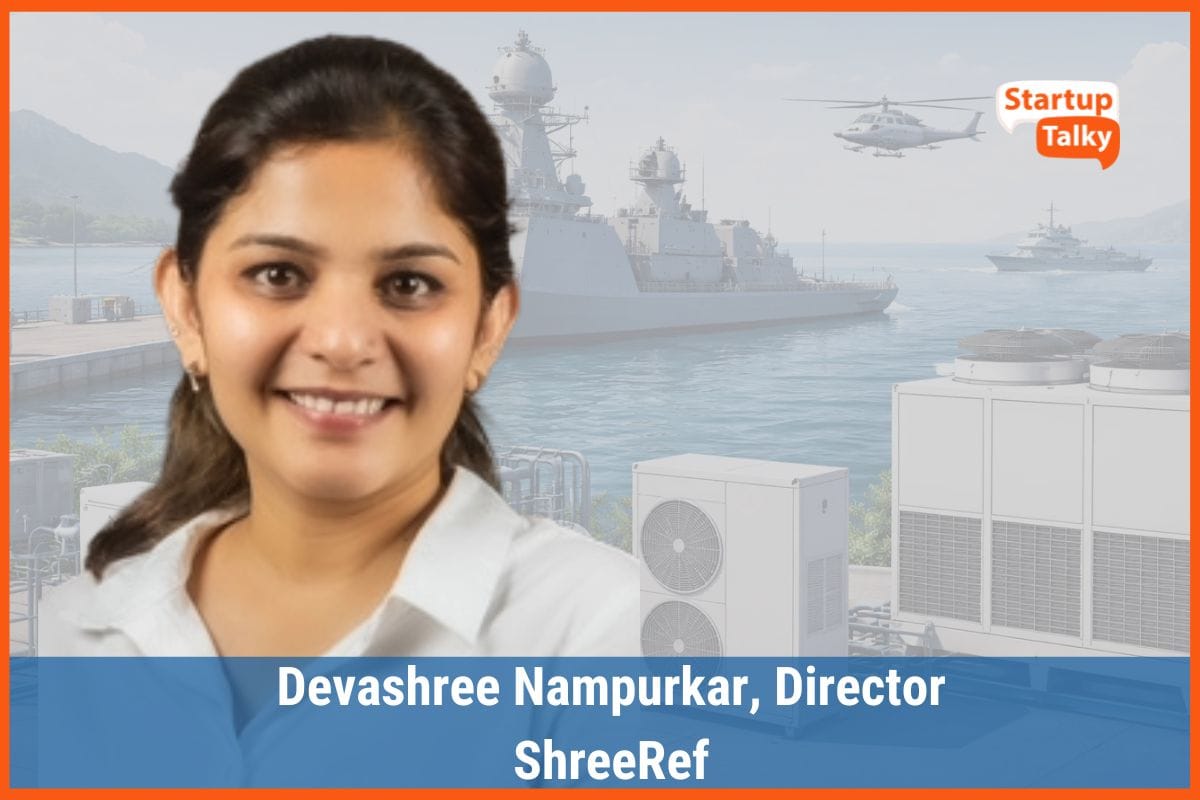
Engineering the Future of Defence: How Devashree Nampurkar Is Driving Innovation at ShreeRef
📰 NewsAs part of StartupTalky’s International Women’s Day 2026 series, Devashree Nampurkar discusses breaking barriers in defence manufacturing, driving engineering innovation, and contributing to India’s self-reliance through deep-tech solutions.
India’s defence manufacturing sector is undergoing a significant transformation, fueled by government initiatives like Atmanirbhar Bharat and rising investments in indigenous production. The sector is projected to reach $25 billion by 2025, with a strong push toward reducing import dependency and strengthening domestic capabilities in critical technologies.
Within this evolving ecosystem, thermal management and HVAC-R systems play a crucial role in ensuring the performance and reliability of mission-critical defence equipment, from warships to submarines.
As part of StartupTalky’s International Women’s Day 2026 special series, highlighting women breaking barriers in unconventional industries, we spoke with Devashree Nampurkar, Director at Shree Refrigerations (ShreeRef), about building a deep-tech engineering company in one of India’s most male-dominated sectors.
Entering Defence Manufacturing: A Journey Rooted in Engineering
StartupTalky: Defence manufacturing is one of India’s most male-dominated industries. What drew you to this sector, and how has her experience shaped ShreeRef’s approach to innovation?
Devashree Nampurkar: Engineering and manufacturing have always been part of my family business environment. Growing up, it helped me understand industrial problem-solving. What drew me to defence manufacturing is how it combines nation-building, engineering precision and long-term impact. Over the years, I've focused on building systems that prioritise reliability, customisation and performance under extreme conditions. Cooling solutions in defence sectors are critical for the performance of the sensitive equipment on board. Reliable cooling solutions are essential to maintain the fighting capabilities of warships and submarines. This helps reduce dependency on foreign vendors for such critical applications and promotes self-reliance in defence.
At Shree Refrigerations, this experience has shaped our approach to innovation. We emphasise engineering-led innovation, focusing on solutions that meet the needs of demanding sectors like pharmaceuticals, chemicals and defence. We design our chillers and HVAC-R systems for robustness, reliability, long-term performance and ease of maintenance.
Innovating for Extremes: Thermal Management in Defence Applications
StartupTalky: ShreeRef operates at the intersection of precision engineering and defence requirements. What innovations has the company brought to thermal management and HVAC-R solutions for defence applications?
Devashree Nampurkar: Our focus has been on custom-built thermal management systems. Defence applications need engineering designed for sensitive environments, including high temperatures, dust, humidity and vibration. They also need uninterrupted performance for equipment that faces the roll, pitch, and Yaw movements of a ship.
We develop compact, high-efficiency chillers and HVAC systems for mission-critical equipment cooling. Since warships and submarines have limited space, we integrate energy-efficient designs and compact systems, making them suitable for such defence installations.
Our approach is application-focused, so we adapt HVAC-R solutions to specialised defence infrastructure and equipment environments. We keep improving our precision manufacturing and testing processes, with in-house testing capabilities for all critical tests needed to meet naval standards.
Driving Self-Reliance: ShreeRef’s Role in Atmanirbhar Bharat
StartupTalky: India’s Atmanirbhar Bharat initiative is transforming defence manufacturing. How is ShreeRef contributing to India’s self-reliance?
Devashree Nampurkar: Earlier, many specialised cooling solutions were import-dependent, but the Atmanirbhar Bharat vision has created strong momentum for indigenous defence manufacturing. We see this as an opportunity to develop domestic capabilities in niche engineering areas like HVAC-R for defence applications. We're contributing through indigenous design, local manufacturing and building engineering expertise.
The policy push has opened doors for MSMEs and specialised engineering firms to participate in the defence ecosystem. We collaborate with Indian defence manufacturers, shipyards, research organisations, and infrastructure projects.
Breaking Barriers: Building Credibility in a Male-Dominated Industry
StartupTalky: As a young woman director in this sector, what challenges has Ms. Devashree faced in building trust with stakeholders?
Devashree Nampurkar: Defence and heavy engineering are traditionally credibility-driven and relationship-driven industries. Being a young woman, in my early career days, I had to prove my technical understanding more strongly. But I overcame this by staying involved in project details, understanding the technical and operational aspects of the business and delivering on commitments.
Credibility builds through performance, product reliability and professionalism. We should always focus on competence and solutions rather than perceptions.
Zero-Compromise Engineering: Ensuring Precision and Reliability
StartupTalky: The defence sector demands extreme precision and reliability. How does ShreeRef ensure its products meet these standards?
Devashree Nampurkar: Every system for defence applications requires zero-compromise engineering standards, always keeping the specific application in mind. We focus on design validation, rigorous testing and quality control processes. We use precision manufacturing practices and comply with technical specifications. Our teams also work with clients and their technical experts to ensure systems perform in real operational conditions. Over time, we've built strong internal systems and processes, with manufacturing that emphasises durability, reliability and long lifecycle performance. Our internal culture prioritises engineering integrity, transparency, collaboration and agility.
Viksit Bharat Vision: Building an Inclusive and Advanced Industrial Future
StartupTalky: What does Viksit Bharat mean to you as a woman entrepreneur in deep-tech defence manufacturing?
Devashree Nampurkar: To me, Viksit Bharat means India becoming a global leader in advanced manufacturing and engineering, and building indigenous capabilities in critical sectors like defence, which will create innovation, jobs and technological independence.
As a woman entrepreneur, it also means a more inclusive industrial ecosystem where talent is recognised regardless of gender. When more women participate in engineering, drive innovation, and bring diverse leadership to these sectors, everyone benefits.
Advice for Women: Entering Engineering and Defence Industries
StartupTalky: What advice would you give to young women who want to enter engineering-intensive defence industries?
Devashree Nampurkar: Don't be intimidated by industries that appear male-dominated. Engineering-intensive defence industries value strong technical knowledge and problem-solving ability. Be patient because sectors like manufacturing and defence reward long-term commitment and credibility.
Seek hands-on exposure to engineering, operations and product development. Work closely with manufacturing teams, projects and clients so it gives you a real understanding of the industry. And lastly, focus on creating an impact rather than fitting into stereotypes.
Final Takeaway: Powering India’s Defence Future Through Engineering Excellence
As part of StartupTalky’s International Women’s Day 2026 series, Devashree Nampurkar’s journey highlights how women are breaking barriers in deep-tech and defence manufacturing, industries traditionally dominated by men.
By focusing on innovation, reliability, and indigenous engineering, ShreeRef is contributing to India’s vision of self-reliance and technological leadership, while inspiring the next generation of women to step into high-impact engineering roles.
 Sanvi Barjatya