

Eddie Wu: The Low-Profile CEO Leading Alibaba’s Biggest Transformation
👨💻 StartupTalkersFrom Alibaba’s first programmer to CEO, Eddie Wu is quietly driving the company’s AI-first transformation, focusing on innovation, sustainability, and long-term growth.

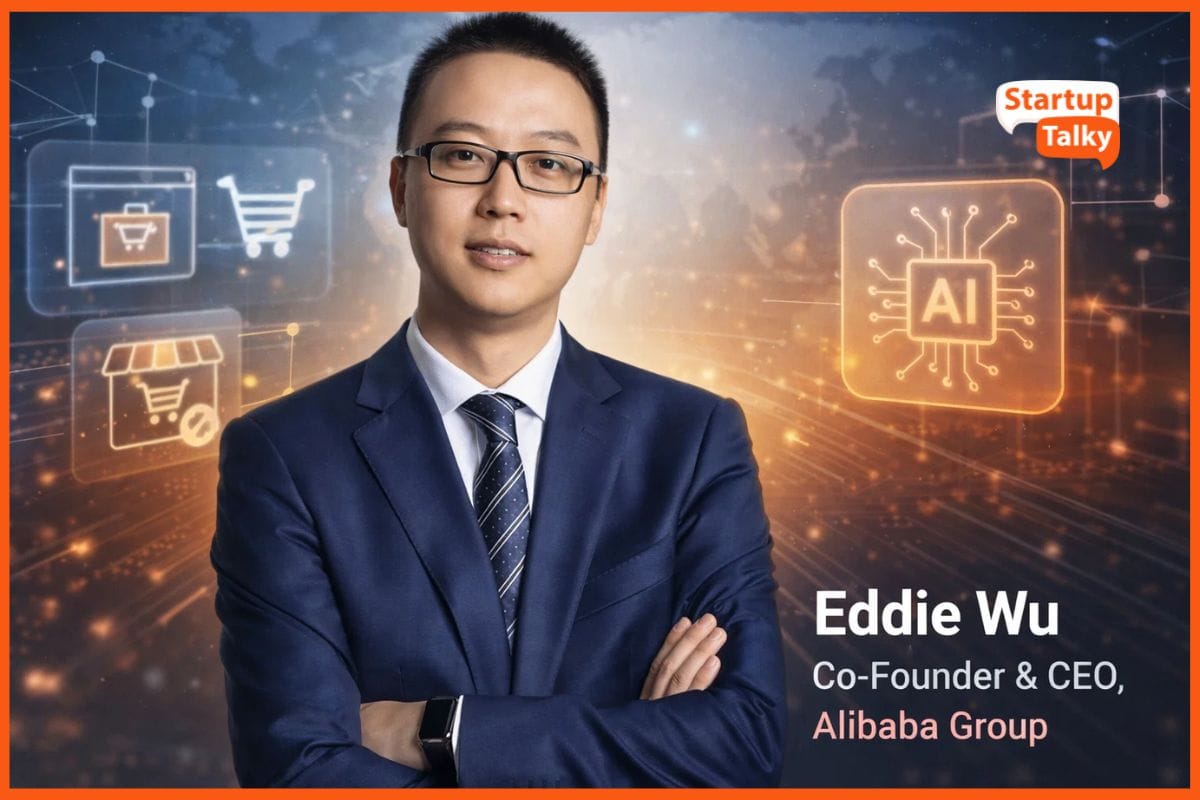
The sign outside Alibaba’s Beijing office looks ordinary. Inside, one of the world’s most powerful tech empires is being reshaped. But the man leading this transformation is not a celebrity CEO. He is not loud, visible, or widely known.
In fact, when Eddie Wu became CEO in 2023, many employees paused. They searched internal systems to understand who he really was. No grand speeches. No dramatic entry. Just quiet authority.
Wu was there from the beginning. He wrote code when Alibaba was just an idea. While others built headlines, he built the backbone of the company.
Now, the same silent architect faces his biggest test. Alibaba is splitting, competition is rising, and AI is rewriting the rules.
The question is simple, yet urgent:
Can a low-profile technologist lead a global giant into its next era? Or will silence struggle in a world that rewards noise?
Eddie Wu - Biography
| Attribute | Details |
|---|---|
| Full Name | Eddie Yongming Wu |
| Known for | Co-founder and CEO of Alibaba Group |
| Nationality | Chinese (Singaporean citizen) |
| Education | B.S. in Computer Science, Zhejiang University of Technology |
| Major Roles | CTO of Alipay, CTO of Taobao, Chairman of Taobao/Tmall, Alibaba Group CEO |
| Key Achievements |
Launched Alipay and Taobao’s mobile app Founded Vision Plus Capital Driving AI and sustainability initiatives |
Eddie Wu - Early Life and Education
Wu earned a computer science degree at Zhejiang University of Technology in 1996, a respected engineering institution in Hangzhou.
In 1996, he joined Jack Ma’s first venture (China Yellow Pages) as a student programmer. He followed Ma to Beijing and later moved to Hangzhou in 1999 when Alibaba was founded.
Wu became the company’s first tech hire, laying the foundation for its future.
Eddie Wu - Career Beginnings
Wu was named Alibaba’s technology director at its founding in 1999.
He played a key role in building core products:
- Designed Alipay (2004)
- Led Taobao’s ad platform
By 2008, he became CTO of Taobao.
In 2015, he founded Vision Plus Capital and joined Alibaba Health’s board, serving as chairman until 2020.
In early 2023, he became Chairman of Taobao-Tmall, before stepping in as Alibaba Group CEO. He also took charge of Alibaba’s cloud business, which houses the Tongyi Qianwen AI model.
 Piyush Mishra
Eddie Wu - Leadership Style
Wu is known as a calm, tech-focused leader. Staff nicknamed him “Wu Ma” (Mother Wu) for his supportive, mentoring style. He emphasises agility and innovation. In his first internal memo, he said Alibaba will be “user first” and “AI-driven”.
He urged staff to maintain a startup mindset. He even said employees born after 1985 would be groomed as the next generation of leaders. He warned that if Alibaba does not adapt to the AI era, “we will be displaced”, aiming to keep the company agile.
He also stressed that this focus on youth would prevent Alibaba from getting “stuck in our old ways”. Wu often underscores active innovation.
He said, “In technology, standing still means falling behind” when discussing the new AI task force.
Eddie Wu - Sustainability and Technology Initiatives
Wu highlights that Alibaba’s ESG efforts shape its identity. He said being a “better company” is as important as profits. In 2024 Alibaba cut its own carbon emissions by 5%. It also increased renewable energy use (clean power was 56% of its data centre energy).
Alibaba’s platforms also promoted green choices. Taobao/Tmall helped customers save over 10 million tonnes of CO₂ by offering greener products. Tools like Taobao’s OCR now enable over 260,000 visually impaired users to shop via audio. Wu reiterated Alibaba’s goal of carbon neutrality by 2030 and noted Alibaba’s ESG goals “shape the essence” of the company.
On technology, Wu is pushing Alibaba to the AI forefront. He launched a new Token Hub unit and an executive AI task force to coordinate cloud and AI strategy. He declared pursuing artificial general intelligence as a “primary objective” and reiterated Alibaba’s ¥380 billion, 3-year AI/cloud investment plan.
Alibaba has pledged roughly ¥380 billion (≈$53B) to AI and cloud infrastructure. He noted that generative AI is raising demand for computing power. Alibaba is expanding its clean-energy data centres in response. AI products already account for over 20% of Alibaba Cloud’s revenue, underscoring how central AI is to Wu’s strategy.
Tejas Mundhada
Eddie Wu - Recent Statements
In early 2025 Wu told investors that pursuing AGI is Alibaba’s “first and foremost goal”. He committed heavy investment: Alibaba pledged roughly ¥380 billion to AI and cloud infrastructure. He emphasised that without more investment, AI resources would remain in short supply.
Later that year, on an earnings call, he dismissed talk of an AI bubble. He said, “We’re not even able to keep pace with the growth in customer demand” for AI. He emphasised that without more investment, AI resources would remain undersupplied. These remarks stress his aggressive, tech-driven agenda.
Eddie Wu - Real-World Examples
Wu’s leadership has delivered measurable outcomes:
Sustainability Impact
- Cainiao reused 47.6 million packages
- Over 10 million tonnes CO₂ savings via platforms
AI and Innovation
- Qwen chatbot: 10 million downloads in first week
- Open-source AI models: 20+ million downloads
Investments
- Backed Tuya (IPO ~$900M)
- Invested $0.8B in Moonshot AI
These initiatives reflect Alibaba’s shift toward AI, cloud, and sustainability leadership.
Conclusion: The Quiet Leader Shaping Alibaba’s Future
Eddie Wu started as Alibaba’s first programmer. His journey to CEO has brought a deeply technical perspective to the top job. He said ESG efforts “shape the essence of Alibaba”. He has positioned AI and cloud as the company’s future.
He blends Jack Ma’s innovation mindset with Daniel Zhang’s execution discipline.
His success will depend on how well these bets pay off in an increasingly AI-driven global economy.
FAQs
Who is Eddie Wu?
A co-founder of Alibaba, Wu became its CEO in September 2023. He had long led the company’s technology units (e.g. CTO of Taobao and Alipay).
What is his background?
Wu earned a computer science degree from Zhejiang University of Technology. He joined Jack Ma’s ventures in the 1990s and was a founding technologist at Alibaba in 1999. He later founded Vision Plus Capital in 2015.
What are Eddie Wu's priorities as CEO?
He has emphasised that Alibaba must be “user first” and “AI-driven”. He focuses on accelerating AI and cloud investment, improving consumer services, and promoting a startup culture inside Alibaba.
What has Eddie Wu said about AI?
Wu declared pursuing AGI (artificial general intelligence) an Alibaba primary objective. He noted AI demand far exceeds supply (“not even able to keep pace”) and has vowed aggressive investment in AI infrastructure.
How is Alibaba addressing sustainability under Eddie Wu?
Wu stated that ESG efforts “shape the essence of Alibaba”. Alibaba has pledged carbon neutrality by 2030 and, in FY2024, cut its own emissions by 5%. It is increasing renewable energy use and green practices (e.g., recyclable packaging).
What are some recent initiatives of Eddie Wu?
He formed a new Alibaba Token Hub AI group and oversaw the Tongyi Qianwen AI lab. Through Vision Plus, he backed IoT startup Tuya (2021 IPO ~$900M), and Alibaba invested in AI firm Moonshot. These illustrate his “AI-first” push under Wu.