

From 'Dirty, Perverted' To Netflix Headliner In 14 Months: The Ranveer Allahbadia Playbook"
How India's most-watched podcaster turned the worst week of his career into a 15-month engineered rehabilitation — and what it teaches us about reputation, PR, and the modern internet.
TL;DR — Read this before the long version
Editorial Disclosure: This content was produced with assistance from AI-based tools to support research, drafting, and language optimization. Our editorial team independently reviews facts, sources, claims, and conclusions prior to publication.
In February 2025, Ranveer "BeerBiceps" Allahbadia made an obscene joke on Samay Raina's India's Got Latent and detonated the biggest creator-economy controversy India has ever seen. He was hauled into the Supreme Court, lost 56,000 followers in 48 hours, watched brands run, faced FIRs across multiple states, and had imposters showing up at his mother's clinic to threaten his family.
Fifteen months later — by May 2026 — he is back on Netflix's flagship comedy show, joking about the controversy with the same comedian he was blamed for "destroying," he has 11 million+ subscribers on his Hindi channel alone, his podcast empire is running at four episodes a week, he has a documentary on the controversy itself in production, and the subreddit-level hate has been replaced by a "give him one more chance" sentiment that he himself manufactured one carefully scripted post at a time.
This is the most documented narrative reversal in Indian creator history. It is also, depending on who you ask, either a textbook crisis-management case study or proof that India's internet has the memory of a goldfish.
This piece tries to do both: chronicle every public move he made, expose the contradictions, and then extract the playbook — the things you can copy if you ever find yourself in a public hole, and the things you should refuse to copy because they were paid for by other people.
1. The man before the fall — what was actually at stake
To understand the comeback, you have to understand what was on the line. Ranveer Allahbadia in early February 2025 was not just another YouTuber. He was:
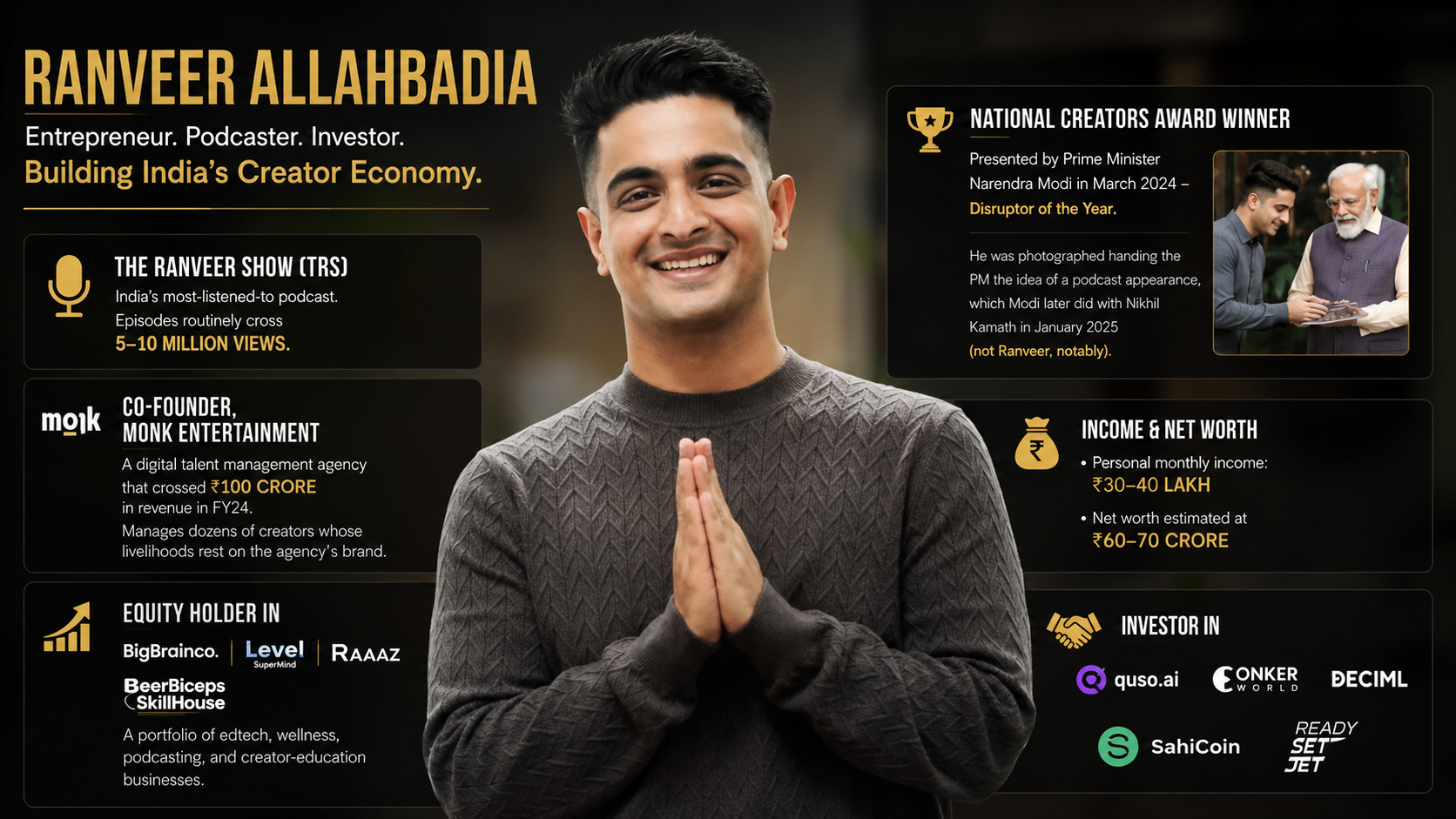
- The host of India's most-listened-to podcast — The Ranveer Show (TRS) and its Hindi sibling, with episodes routinely crossing 5–10 million views.
- Co-founder of Monk Entertainment, a digital talent management agency that crossed ₹100 crore in revenue in FY24. Monk doesn't just manage him — it manages dozens of other creators whose livelihoods rest on the agency's brand.
- An equity holder in BigBrainco, Level Supermind, RAAAZ, and BeerBiceps SkillHouse — a portfolio of edtech, wellness, podcasting, and creator-education businesses.
- A National Creators Award winner, presented by Prime Minister Narendra Modi himself in March 2024 — the Disruptor of the Year. He was photographed handing the PM the idea of a podcast appearance, which Modi later did with Nikhil Kamath in January 2025 (not Ranveer, notably — that detail will matter later).
This was not a 22-year-old college creator. This was a 32-year-old businessman with 300+ employees across his ventures, multiple revenue lines, and a brand built — relentlessly — around a specific archetype: the disciplined, spiritual, self-improving, slightly-libertarian-slightly-Hindutva-curious "Indian Joe Rogan."
When the Latent clip went viral, every one of those assets was suddenly at risk. That is the single most important fact about the comeback. It was not a personal redemption arc. It was a corporate restructuring, a brand surgery, and a legal defence — disguised as a personal redemption arc.
2. The detonation — anatomy of one bad joke
On November 14, 2024, Samay Raina shot a five-hour bonus episode of India's Got Latent with four guest judges: Ranveer Allahbadia, Ashish Chanchlani (one of YouTube India's biggest creators), Apoorva Mukhija (the influencer who goes by "Rebel Kid"), and Jaspreet Singh (financial educator). It was a paid, members-only episode — meaning viewers had to subscribe to Samay's channel to access it.
The episode aired on February 8, 2025. During the show, Ranveer asked a contestant a "Would you rather…" question:
"Would you rather watch your parents have sex every day for the rest of your life, or join in once to make it stop forever?"
In the edited version that aired, the question was asked once. In the actual five-hour shoot, Samay later revealed in his March 2026 stand-up special Still Alive, Ranveer asked the same line eight times. Samay said he edited it down to one instance to "save" Ranveer.
This single fact reframes everything that followed — but in February 2025, nobody knew it yet.
The clip went viral within 36 hours. By February 10, the question was a national news story. Members of Parliament demanded action. The National Commission for Women issued a summons. The Maharashtra Cyber Cell registered FIRs. By February 11, the Assam Chief Minister Himanta Biswa Sarma personally ordered an FIR. Cases multiplied across Assam, Maharashtra, Rajasthan, and beyond — eventually crossing 30+ FIRs against the panel, with police summoning over 30 comedians who had ever appeared on the show.
This is the part most people miss. The fallout was never just about Ranveer. It blew apart Samay Raina's career, sent the entire Indian stand-up ecosystem into legal chaos, killed India's Got Latent as a show, got Apoorva Mukhija doxxed and threatened with rape and acid attacks, and forced the Centre to push hard on the Broadcasting Bill — a piece of legislation that internet-freedom groups had been trying to stall for two years.
One sentence on a podcast became the largest single trigger for online speech regulation in modern Indian history.
3. The first 72 hours — the apology, the silence, the legal armour
Day 1 (Feb 10): The first apology
Within hours of the clip going nuclear, Ranveer posted a 90-second video on X with the caption:
"I shouldn't have said what I said on India's Got Latent. I'm sorry."
Inside the video, two phrases did all the heavy lifting:
"My comment wasn't just inappropriate — it wasn't even funny."
"Comedy is not my forte. I'm just here to say sorry."
Read this line again: "Comedy is not my forte."
This was the first piece of narrative engineering. By saying he is "not a comedian," he gently relocated himself out of the comedy ecosystem — which was the ecosystem under fire. He is a podcaster, an entrepreneur, a self-improvement guru. The comedy people can deal with the comedy mess.
It was also, in retrospect, a lie. He had asked the question eight times in the shoot. You don't repeat a punchline you don't believe in.
Day 5 (Feb 14): The Supreme Court route
While the FIRs were piling up across multiple states — a tactic activists call "FIR shopping" because it forces a defendant to fight the same case in multiple jurisdictions — Ranveer's lawyers approached the Supreme Court of India asking for the FIRs to be clubbed and for protection from arrest.
This was a sophisticated, expensive move. Most creators in trouble go to High Courts; the Supreme Court is reserved for matters of constitutional importance. By framing his case as a free-speech and federalism question — multiple states piling on, threats to life, chilling effect on creators — he elevated himself above the fray. He stopped being "the obscene podcaster" and became "the test case."
Day 5 (Feb 15): The second statement — weaponising the threat
On February 15, Ranveer issued a second statement. This one was different in tone. It was no longer about the joke. It was about his mother.
"People have invaded my mother's clinic posing as patients. They want to kill me. I'm scared. I'm not running away."
This is a textbook PR pivot. The audience for this statement wasn't the people angry about the joke — those people were never coming back. The audience was the fence-sitters: the moderate Indian who had clucked at the joke but not fully committed to the lynching. By introducing his mother and physical threats, he repositioned himself from offender to victim. The story became "things have gone too far" instead of "this guy said something gross."
Most creator-economy crises die on Day 5. This one was kept alive — but the target of the rage shifted from him to "online mobs going too far." That is the move.
Day 9 (Feb 18): The Supreme Court hearing — "Dirty mind, perverted"
On February 18, the SC bench heard the matter and lashed out. The court called the comments "disgusting," "filthy," "insulting," and accused Ranveer of having a "dirty, perverted mind." The judges did not let him off easy. But they did three crucial things:
- Stayed his arrest in all FIRs.
- Barred new FIRs from being registered.
- Required him to surrender his passport but did not bar his work.
The verbal beating got the front-page headline. The legal protection got buried in paragraph nine. The signal mattered more than the rebuke. The Supreme Court had effectively said: we hate this, but you cannot be jailed for it. That is all his lawyers needed to start the rebuild.
Day 22 (March 3): The podcast clearance
On March 3, 2025, the Supreme Court allowed Ranveer to resume The Ranveer Show — on the condition that he maintain "morality and decency" in his content. This was framed by the court as a free-speech consideration; in practice, it was the green light for a corporate empire that had been frozen for three weeks to start the engine again.
4. The disappearance — what the silence was doing
Between February 18 and March 30, Ranveer Allahbadia barely posted. No new podcast episodes. No vlogs. Limited social media. The man who used to be on at least one platform every single day vanished for almost six weeks.
Most people read this as remorse, or shame, or processing. It was — but it was also strategy. Several things were happening behind the scenes:
- The legal team consolidated the FIRs and got the SC orders cemented.
- Monk Entertainment quietly retained brands that hadn't yet pulled out, while letting visibly bad ones (KFC, B Praak, Myntra) go without public fight. You don't argue with a brand that's running away during a fire — you let them run, then call them back six months later.
- The content team rebuilt the production calendar around a different theme universe: spirituality, history, defence, geopolitics, monks. The "edgy bro" Ranveer Show was being quietly rewritten as the "thinking Indian" Ranveer Show.
- The personal narrative was reverse-engineered. Later, in conversation with actor Raghav Juyal, Ranveer would reveal he had a "terrible breakup" with his then-girlfriend Nikki Sharma "ten days before" the Latent shoot. This detail did not exist in February. It surfaced months later, when the rehabilitation needed an emotional anchor — a "he was already broken when this happened" frame.
The silence was not absence. It was reloading.
5. The comeback opens — March 30, 2025
The "Let's Talk" video
On March 30, 2025, Ranveer broke six weeks of silence with a video on YouTube titled simply "Let's Talk." It was shot in soft light, no music, direct-to-camera, in Hindi — a deliberate departure from his usual aggressive English-language thumbnails.
The key beats of the script:
"Namaste friends, first of all I would like to say thank you to all the supporters and all the well-wishers."
"After this full stop, I am trying to write a new story."
"In the next 10, 20, 30 years, as long as I create content, I will create content with more responsibility. This is my promise to you."
"In this TRS restarting phase, all the people who have supported us so far, I have only one request. If possible, please make space for me in your heart. Give me one more chance."
Notice the structure. This is not an apology video — that was Day 1. This is a return video. The architecture of the language is borrowed from political speeches: thanks → reflection → vow → ask. Every sentence is calibrated to convert anger into permission.
The phrase "give me one more chance" became the line that defined the entire comeback. It was clipped, captioned, subtitled, recirculated. It became the official narrative anchor.
The first new podcast — March 31, 2025
Twenty-four hours later, on March 31, the first new episode of The Ranveer Show dropped. The guest was Buddhist monk Palga Rinpoche.
This was not a random booking. Of all the people Ranveer could have started his comeback with — a politician, an actor, a businessman, a sportsperson — he chose a Buddhist monk discussing anger, forgiveness, and letting go.
The visual symbolism was deliberate: shaved head, robes, calm. The thumbnail's colour palette shifted from his usual high-contrast black-and-orange to a muted ochre. The 35-minute conversation was about the "challenging realities" of life — phrased so abstractly that it could be about him without ever being about him.
This is the Aikido principle of crisis comms: don't fight the energy of the attack, redirect it. The country was angry that Ranveer was crude and shallow. So his first move back was to be the opposite — meditative and deep. The audience didn't have to forgive him. They just had to associate him with a different feeling than the one in the Latent clip. Mission accomplished in 35 minutes.
6. The rebuild calendar — March 2025 to March 2026
Over the next twelve months, Ranveer ran the most consistent content calendar of his career. Four podcast episodes a week. Hindi and English channels in parallel. A re-energised vlog series under "Life of BeerBiceps." Documentary-style episodes from Varanasi, Bhutan, the North-East, the Himalayas. A blizzard of safe, "respectable" subject matter.
The guest list tells the story better than any press release. In rough rotation:
- Spiritual figures: Palga Rinpoche, Gauranga Das (the IIT-engineer turned ISKCON monk), Sadhguru clip recirculations, Aghori-and-Tantra explainer episodes.
- Historians and culture: Medha Bhaskaran on Shivaji and Aurangzeb, Ashish Bharatvanshi on the Maratha legacy, Vinay Varanasi on Dashavatara, Sambhaji-vs-Aurangzeb specials timed to ride the Chhaava movie wave.
- Defence and geopolitics: Yalda Hakim on India-Pakistan-World War 3, episodes on Pakistan's "brutal reality in 2025," military politics, civil-war scenarios.
- Business: Founders, fund managers, CXOs — the safe, suit-wearing crowd.
- Almost zero stand-up comedians. This is the loudest absence. Ranveer's pre-controversy podcast had regularly featured comedians. Post-comeback, comedians were quietly removed from the booking pool. The category that had embarrassed him was no longer a category.
This is content as alibi. Every episode about Shivaji is also an episode that is not about Latent. Every conversation with a monk is a conversation that is not a vulgar joke. After a hundred such episodes, the search results, the recommendation algorithm, and the public memory all start to look different. You don't have to delete the past. You have to bury it under enough new soil that it stops growing.
The vlog channel — the slow image rebuild
The "Life of BeerBiceps" channel — separate from his main podcast feed — became the engine for the personality rebuild. Long-form vlogs, often 20–40 minutes, shot in places that did the work of the brand for him:
- Kashi/Varanasi spiritual journey vlogs.
- Bhutan trips.
- Himalayan hikes.
- "My Life At Age 32 — UNFILTERED VLOG" type personal pieces.
- IPL matches and lifestyle content where he could be seen as a normal high-earning Indian male, not a defendant.
The vlogs do something the podcasts can't: they show a life. Cooking. Working out. Praying. Reading. They are a post-controversy character study, presented one casual upload at a time. You can't sustain hatred for someone you've watched eat dal at a roadside dhaba for ten minutes.
The breakup → new girlfriend pivot
Sometime in mid-2025, Ranveer's relationship with Nikki Sharma — a fitness influencer he'd been semi-publicly dating — ended. By his account in the Raghav Juyal podcast, the breakup happened ten days before the Latent shoot. By Nikki's later comments and a series of cryptic Instagram posts, the breakup happened after the controversy, with her describing it as a fallout from the storm itself.
We will never fully know which version is true. What matters is that "ten days before Latent" is a strategically perfect timing claim — it provides emotional cover ("I wasn't in my right mind") without requiring proof.
Then on Diwali 2025, Ranveer "hard launched" his new girlfriend, Dehradun-based influencer Juhi Bhatt, with a Studio-Ghibli-style illustration on Instagram. By IPL season, they were photographed leaving Wankhede Stadium together. By early 2026, they were doing brand-collab style "couple" content from a Kenya safari (Masai Mara).
The personal-life rebrand worked because it ran in parallel with the content rebrand, not after it. The audience saw "Ranveer recovering professionally" and "Ranveer rebuilding personally" simultaneously, each lending credibility to the other.
7. The "Lost & Gained" Instagram post — the masterstroke
Months into the rebuild, in a casual Instagram Q&A, Ranveer answered a follower question with what may be the single most quoted sentence of the entire comeback:
Lost: Health, money, opportunity, repute, mental health, peace, parents' contentment & much more.
Gained: Transformation, spiritual growth, toughness.
This deserves its own dissection because it is the most studied piece of crisis-comms copywriting in Indian creator history.
Look at what the structure does:
- It admits losses without admitting fault. Every item on the "lost" list is a consequence, not a cause. He doesn't say "I lost my dignity because I was crude." He says "lost mental health" — as if mental health is a thing the universe took from him.
- The "gained" list is shorter than the "lost" list — but heavier. "Transformation" is a story. "Spiritual growth" is a brand. "Toughness" is a t-shirt. These three words are worth more than the eight on the loss side.
- "Parents' contentment" is a deeply Indian emotional trigger. He's not just a man who lost a contract — he is a son who disappointed his parents. In a country where the audience overwhelmingly relates to the parent–child guilt pipeline, this single phrase is worth a thousand apology videos.
- It is symmetric, listicle-friendly, screenshot-ready. Every news outlet ran it as a graphic. It became its own piece of media.
In a different career, the line "lost everything, gained transformation" would be on the back of a self-help book. In Ranveer's career, it became the new About page.
8. The Sant Kabir doha — March 26, 2026
Almost a year to the day after the controversy, on March 26, 2026, Ranveer posted a long reflective note on X that included a Sant Kabir doha:
"धीरे-धीरे रे मना, धीरे सब कुछ होय, माली सींचे सौ घड़ा, ऋतु आए फल होय।"
(Slowly, oh heart, slowly everything happens; the gardener may water with a hundred pots, but fruit comes only in its own season.)
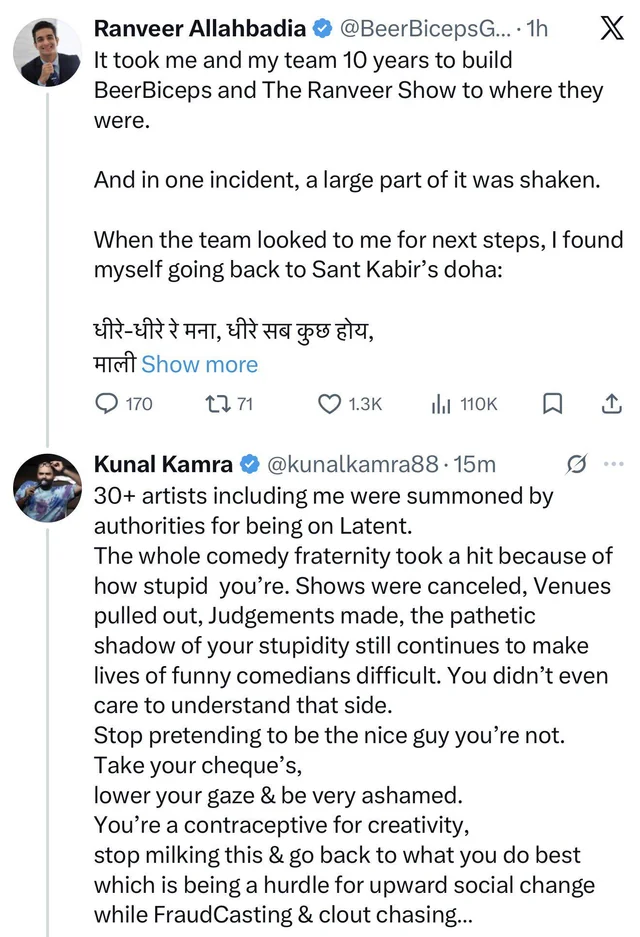
The post started with: "It took me and my team 10 years to build BeerBiceps and The Ranveer Show to where they were. And in one incident, a large part of it was shaken…"
This is the anniversary play — every comeback artist eventually does the "one year later" reflection. It serves three purposes: it reminds the audience how far he's come, it reframes the controversy as a single bad day in a ten-year story, and it provides quotable content for the press cycle.
But it is also the post that triggered the fiercest blowback he'd received since February 2025 — from comedian Kunal Kamra.
9. The Kunal Kamra reality check — "Stop milking this"
Within hours of the Sant Kabir post, Kunal Kamra — possibly the most acidic political comedian in India — replied on X:
"You're a contraceptive for creativity. Stop milking this and go back to what you do best, which is being a hurdle for upward social change while fraudcasting and clout chasing."
"More than 30 artists were summoned because of you. Shows were cancelled, venues pulled out, lives upturned. Stop pretending to be the nice guy you're not. Take your cheques, lower your gaze, and be very ashamed."
Kamra's intervention is the single most important external voice in this case study because it is the only one that punctures the constructed narrative. His point, distilled:
- Ranveer had legal protection, money, and a team. He could afford to "go on a journey."
- Thirty-plus stand-up comedians who appeared on Latent over its run did not have any of those resources. Their shows were cancelled, sponsors fled, some had to take day jobs.
- The very controversy Ranveer is "reflecting" on is the same controversy that destroyed careers he is now ignoring.
- Worse, by publicly performing his recovery, Ranveer is keeping the Latent episode alive in the news cycle — which keeps the police and political attention alive too.
The damage is not symmetric. Ranveer has a podcast empire to come back to. Smaller comics had a Sunday-night gig at a Powai café and that's gone now.
This critique never went mainstream because the people who would amplify it — the comedy fraternity — were too afraid of more FIRs. The silencing was the success. Ranveer's comeback was, in part, possible because the people most equipped to call him out had been legally muzzled by the same wave he was riding.
10. Samay Raina's "Still Alive" — the receipts arrive
For most of 2025, Samay Raina disappeared from public view almost entirely. He cancelled his international tour. He told friends he was close to bankruptcy. His Netflix collaborations were quietly shelved.
Even during the fallout period, Samay experimented with podcast-style branded collaborations and advertiser-backed conversational content, a sign that he was trying to rebuild commercially while staying away from regular streaming and live comedy.
He resurfaced on March 7, 2026, with a YouTube comedy special called Still Alive — released on his own channel, free, after almost a year off the grid. Within two weeks, it crossed 57 million views and became the most-watched stand-up comedy special in YouTube India history.
The special is mostly about Samay's own anxiety, his fear of arrest, and his fall — but it has two segments dedicated to Ranveer. The most damaging:
"He asked that question eight times. Eight. I edited the show to keep only one of them. I killed 99% of Ranveer's germs."
In one line, Samay flipped the dominant narrative. The version most Indians had internalised — that Ranveer made one careless mistake — was wrong. The actual story was: Ranveer kept asking, the host protected him in the edit, and now Ranveer was using the protected version to play the victim.
Samay's other big line:
"He destroyed my mental health. He knows meditation. I know nothing."
The contrast — Ranveer doing yoga retreats while Samay lost his career — landed hard. For about ten days in March 2026, the public sentiment shifted. Reddit threads pivoted. Twitter reposted Samay's bits. A second wave of "actually, Ranveer never paid for this" sentiment began.
Then Netflix announced The Great Indian Kapil Show reunion.
11. The Kapil Sharma show — the closure that doubled as a coronation
On May 2, 2026, Netflix India released a special "World Laughter Day" episode of The Great Indian Kapil Show featuring Samay Raina and Ranveer Allahbadia together for the first time since the controversy. The marketing line was deliberately blunt: "World Laughter Day pe laughter ka double dose — Samay Raina x Ranveer Allahbadia in Mastiverse."
This episode is the most important single move of the entire comeback. Here's why.
What it accomplished
It was a Netflix-stamped certificate of forgiveness. Netflix had been one of the platforms most damaged by the Latent fallout — the show was a member-perk on a YouTube channel, but the legal and reputational chill had affected Netflix's own creator deals. By putting the two principals on its biggest comedy IP, Netflix was effectively saying: we, the establishment, have decided this story is over.
It re-paired Ranveer with the comedy ecosystem. For 14 months, he had carefully avoided comedians. Now he was on stage with Samay, Sunil Grover, Krushna Abhishek, Kiku Sharda, and Navjot Sidhu — household-name comics. The visual told a story: the comedy fraternity has accepted him back. Whether it had or not (it largely had not — Kunal Kamra's view was widely shared in the green rooms) didn't matter. The optics did.
It allowed him to joke about it. This is the highest possible level of crisis-recovery: when the thing that almost destroyed you becomes material. On the show:
- Kapil Sharma's setup: He teased Ranveer about "last year's controversy" right at the top, signalling to the audience that nothing was off-limits.
- Ranveer about Samay: "He has a very pure heart, and people need to know that."
- Kapil's response: "Yes — after all, if you manage to get someone's show shut down and they still let you live, they must truly have a pure heart!"
- Ranveer claiming the friendship had "deepened" — Samay deadpanning that this reflected Ranveer's perspective rather than objective reality.
- Kapil's "in the same boat" line — joking that both were stuck with identical legal charges.
- Sidhu's "If God closes one door, He opens ten windows" — and Samay's perfect comeback: "People throw stones at us using all of those things, sir!"
Notice what's NOT in the episode: No real apology. No acknowledgement of the eight-times reveal from Still Alive. No mention of Apoorva Mukhija or Ashish Chanchlani, who are still being summoned to police stations. No mention of the 30+ comedians whose careers were collateral. No mention of the Broadcasting Bill the controversy accelerated.
The episode resolves the relationship between the two famous men, and only between the two famous men. Everyone else who was hurt by the controversy is invisible in this resolution — because they were not famous enough to need a closure arc on Netflix.
Why it worked
Comedy, in this format, became the perfect solvent for accountability. You cannot demand a stern reckoning of a man who is making you laugh. The Kapil Show is sketch-and-banter — a format that is constitutionally allergic to seriousness. By choosing this particular stage, Ranveer turned the audience into accomplices: every laugh was a forgiveness, every clap was a permission slip.
Sidhu calling the episode "one of the top 5 in 21 years" was the seal. Mainstream daytime aunties — the demographic least likely to know what Latent even was — saw a happy reunion of two boys who had a "phase." That demographic is also the one whose opinion the brands sales-and-marketing teams care most about. When the Tier 2/3 mom-audience normalises you, your sponsorship file reopens.
12. The documentary — monetising the controversy itself
Right after the Kapil show, in a behind-the-scenes vlog with Samay, Ranveer announced a documentary on the India's Got Latent controversy itself — chronological, "every day recorded," with viewer input on what angles to explore.
This is the most audacious move in the playbook. It is the fourth-quarter pivot from defence to offence: not just surviving the controversy, but converting it into the next product.
Three things this documentary does:
- It owns the narrative permanently. Whoever tells the definitive version of an event owns its meaning. By releasing the official documentary, Ranveer pre-empts every future YouTuber, every documentary maker, every news channel that might tell a less flattering version. His version becomes the archive.
- It monetises the audience the controversy built. The people who searched "Ranveer Allahbadia Latent" for 15 months — that's a massive, indexed, search-validated traffic source. The documentary is the conversion product for that audience. The crisis built the funnel; the documentary cashes it.
- It reframes one more time. The documentary will not be sold as "the obscene podcaster's confession." It will be sold as "the man who survived India's biggest cancel-culture wave." The genre shifts from scandal to survival. Same content, different shelf.
This is, frankly, the part of the playbook most ethically grey. Apoorva Mukhija was sent rape and acid-attack threats. Samay Raina almost went bankrupt. 30+ comedians lost gigs. The documentary will likely include all of this — packaged as Ranveer's personal arc, with Ranveer's monetisation, with Ranveer's distribution. It is their trauma, his content.
This is also why it will work commercially. Indian audiences love a redemption arc. They will watch.
13. The numbers — what actually happened to the empire
A reality check, in numbers. (All figures aggregated from Social Blade, HypeAuditor, vidIQ, public reporting, and his own statements.)
| Metric | Pre-controversy (Jan 2025) | Trough (Feb 2025) | Now (May 2026) |
|---|---|---|---|
| TRS Hindi YouTube subscribers | ~10.5M | ~10.4M | ~11.0M |
| BeerBiceps (English) channel | ~5.0M | -40K in 48 hrs | Marginal recovery |
| Instagram (personal) | ~5.0M | -12.8K in 48 hrs | Stable, slow growth |
| Total followers lost in 48 hrs | — | ~56,000 | — |
| Monthly views (Hindi) | ~100M | Shut for 3 weeks | ~142M |
| Monthly subscriber growth | ~250–400K/month | Negative for 6 weeks | ~100K/month (slow) |
| Estimated YouTube ad earnings | $5K–$8K/month | Zero in Feb–Mar | $2.8K–$3.9K/month |
| Net worth | ₹60–70 cr | (illiquid, hard to mark) | Estimated similar, possibly higher |
| Brand deals | Active | KFC, B Praak, Myntra walked | Mostly returned, new categories added |
The headline: he kept the audience but lost the velocity. The total subscriber number is roughly the same. The growth rate is dramatically slower (0.08% per month vs. 2–3% pre-controversy). The earnings are visibly down. He is, in the most precise sense, not back yet — he is no longer falling. That distinction is important. The comeback isn't complete. It is in maintenance mode.
But the brand — the equity, the long-term valuation, the ability to host PMs and CEOs, the ability to take a Netflix slot — that has actually recovered faster than the numbers, because the brand is downstream of perception, and perception is what the playbook above was engineered to fix.
14. The contradictions — where the rehab story doesn't add up
Honest case studies are not hagiographies. Here are the gaps in the comeback narrative that anyone with time and a search bar can find:
Contradiction 1: "Comedy is not my forte" vs. eight repetitions in the shoot.
He apologised by claiming he didn't know how to do comedy. Samay's Still Alive later proved he asked the same question eight times in five hours, which is not the behaviour of a man who tried a joke once and didn't realise it landed badly. It is the behaviour of someone workshopping the line — multiple takes, multiple deliveries, looking for the one to keep.
Contradiction 2: "Lost everything" vs. corporate empire intact.
The "Lost: health, money, mental health" line was deployed in interview after interview. Monk Entertainment posted ₹100 crore revenue in FY24 and per all reporting did not collapse in FY25. His net worth is in the same band today as it was in January 2025. The personal ledger may have been bloodied; the corporate ledger barely flinched.
Contradiction 3: Spiritual rebrand vs. unaddressed past content.
The new Ranveer is a meditation-and-monks man. The old Ranveer had a 2021 tweet about kurtis bringing men "to their knees." The old Ranveer hosted advocate J. Sai Deepak in an episode where the conversation included "name people who should leave India" — a clip Ranveer later deleted. The old Ranveer is grouped, in international media, alongside Joe Rogan and Russell Brand for "rugged masculine individualism" content. None of these have been acknowledged in the spiritual phase. They have just been covered. Soil over weeds.
Contradiction 4: "Give me one more chance" vs. monetising the chance immediately.
He asked for a chance. He got it. The first thing he did with it was launch a podcast cycle, then a vlog series, then a documentary on the very thing the chance was for. The ask was framed as a request from a vulnerable person. The execution looked like a product launch.
Contradiction 5: Personal narrative timing.
He told Raghav Juyal his breakup with Nikki Sharma happened ten days before Latent. Nikki's posts and timeline suggest the relationship was active well into early 2025 and ended because of the controversy. The "I was already broken" framing is a piece of narrative scaffolding, not a piece of biography.
Contradiction 6: The "victim" framing of the mother-clinic incident.
The clinic incident was real, and the fear was real. But the story was strategically deployed — released in a second statement at exactly the moment the public mood was hardening, framed in a way that activated the most sympathy. The same tactic that creators use for clickbait is the tactic that was used in the recovery — knowing what feels true and serving it, on time, in the right format.
Contradiction 7: He is positioned as an outsider to the comedy disaster.
But it was his line, asked eight times, that triggered all 30+ summons against the comedy ecosystem. The phrasing he used in apologies — "the comedy show India's Got Latent" — quietly puts the show as the agent and him as the visitor. In legal and ethical terms, he was the trigger. The narrative makes him look like a guest who got caught up in someone else's mess.
15. The full timeline at a glance
A reference table for anyone writing about this later, because the story has been deliberately fragmented across so many news cycles that most readers don't have it linearly:
| Date | Event |
|---|---|
| Nov 14, 2024 | India's Got Latent bonus episode shot in Mumbai, 5 hours, members-only. |
| Mar 8, 2024 (prior) | Ranveer wins National Creators Award (Disruptor of the Year) from PM Modi. |
| Feb 8, 2025 | Episode airs. |
| Feb 9, 2025 | Clip goes viral. National outrage. |
| Feb 10, 2025 | First apology video on X: "Comedy is not my forte." |
| Feb 10–11, 2025 | YouTube removes episode. ~56,000 followers lost in 48 hours. |
| Feb 11, 2025 | Assam CM orders FIR. FIRs filed in multiple states. |
| Feb 12, 2025 | Samay Raina deletes all Latent episodes from his channel. |
| Feb 14, 2025 | Ranveer approaches Supreme Court. |
| Feb 15, 2025 | Second statement: mother's clinic invaded; death threats. |
| Feb 18, 2025 | SC hearing: "dirty mind, perverted." Stay on arrest granted. |
| Mar 3, 2025 | SC allows podcast resumption with decency conditions. |
| Mar 7, 2025 | Ranveer questioned by Cyber Crime in Guwahati. |
| Mar 30, 2025 | "Let's Talk" comeback video: "Give me one more chance." |
| Mar 31, 2025 | First new podcast: Buddhist monk Palga Rinpoche. |
| Apr 8, 2025 | Apoorva Mukhija reactivates social media. |
| Apr 15, 2025 | Sambhaji-vs-Aurangzeb special on TRS — "Chhaava" tie-in. |
| Q2 2025 | "Lost / Gained" Instagram Q&A goes viral. |
| Mid-2025 | Personal-life pivot. Nikki Sharma exit. |
| Jun 12, 2025 | Apoorva Mukhija on The Traitors (Amazon). |
| Aug–Oct 2025 | Heavy spiritual / nationalist / defence content cycle. |
| Oct 20, 2025 | Diwali "hard launch" of new GF Juhi Bhatt. |
| Late 2025 | Raghav Juyal interview: "breakup 10 days before Latent" framing. |
| Mar 7, 2026 | Samay Raina releases Still Alive — reveals 8x repetition. |
| Mar 26, 2026 | Ranveer's Sant Kabir doha post on X. |
| Mar 26–28, 2026 | Kunal Kamra: "Contraceptive for creativity. Stop milking this." |
| May 2, 2026 | The Great Indian Kapil Show reunion on Netflix — World Laughter Day special. |
| May 2026 | Documentary on Latent controversy announced; release planned for June 2026. |
16. The playbook — the lessons in narrative reversal
Strip away the names and the specifics, and what's left is a sequence — a sequence that is increasingly the default response any large public figure runs when they're in a hole. We can call it the Ranveer Sequence, fairly. He didn't invent it; he executed it cleaner than anyone in India has.
Phase 0 — Have something to come back to (years before the crisis)
This is the part nobody talks about. The reason Ranveer survived is that he didn't enter the crisis as a creator — he entered as an empire. Multiple revenue lines, multiple platforms, multiple businesses. A crisis cannot kill a diversified man. It can only damage him. If your entire identity is one TikTok account or one show, a controversy is fatal. If your identity is spread across podcast + agency + edtech + wellness app + book + speaking circuit, a controversy is expensive, not terminal. Build the empire before you need it.
Phase 1 — Apologise once, fast, in writing AND in video
Within 24 hours. Use both formats — the X post for the headline writers, the video for the audience. Keep the apology short. Don't explain. Don't justify. Don't litigate. Just say "I shouldn't have said it, I'm sorry." Anything longer becomes ammunition. He did this on Day 1 and didn't repeat it.
Phase 2 — Disappear
The single most counter-intuitive move. Most creators in trouble talk more — more posts, more stories, more reels, more "let me explain." That fuels the cycle. Ranveer did the opposite: six weeks of total silence. The internet's outrage cycle has a half-life of about three weeks. If you are not in the feed, the outrage starves. You are giving the algorithm nothing to amplify.
Phase 3 — Build legal armour
Most creators panic-hire someone local. Ranveer went straight to the Supreme Court and consolidated. Lesson: when the legal exposure is constitutional-grade, get constitutional-grade lawyers. Cheap legal help is the most expensive thing in a crisis.
Phase 4 — Insert the family / vulnerability narrative carefully
The mother's-clinic statement was timed. The breakup detail was inserted later. You don't deploy your most sympathetic personal beat on Day 1 — you deploy it when the public mood needs softening. The risk of "playing the victim" is real and Kunal Kamra called it out. But for most audiences, it works because most audiences want a reason to forgive. You give them one.
Phase 5 — Reframe through content, not statements
Don't write a long blog post about "why I was misunderstood." Drop a 35-minute conversation with a Buddhist monk about anger and forgiveness. The content is the apology. Audiences trust experiences over explanations. A hundred episodes of new, calm, useful content is worth more than fifty press releases.
Phase 6 — Pick your first guest like your life depends on it
Because it does. The first guest after a crisis sets the new positioning. Ranveer picked a Buddhist monk. He could have picked a politician (would have looked aligned), an actor (would have looked frivolous), a businessman (would have looked unchanged). Instead he picked the human equivalent of a clean reset button.
Phase 7 — Pivot the content category
Edgy is over. Spiritual + historical + geopolitical + safe-respected-experts is in. He didn't tell anyone he was pivoting. The pivot was visible only in retrospect, after eight months of episodes. Don't announce a pivot. Execute one.
Phase 8 — Run the personal life rebuild in parallel, not in sequence
The new girlfriend, the IPL outings, the safari photos — these aren't separate from the comeback. They are the comeback. Audiences need to see the whole life recovering, not just the work. People recover, brands rebuild — but only when they're seen happy, in love, and at the cricket. The visual story matters more than the verbal one.
Phase 9 — Do the anniversary post
One year later, ideally with a literary or spiritual reference (Sant Kabir works for India; an obscure poem works for the West). The anniversary post does three things: it buys you a fresh news cycle, it lets you reframe the original event as part of a larger story, and it restarts the empathy clock for any audience member who had drifted.
Phase 10 — Take the joke, with the right partner, on the right platform
This is the highest-risk, highest-reward move and it has to be timed perfectly. Too soon and it looks tone-deaf. Too late and it looks unresolved. Ranveer's Kapil Sharma appearance was 14 months in — almost exactly the right window for a year-long controversy of that magnitude. He picked a comedy show that the most forgiving demographic watches, with the partner most damaged by the same controversy (so that both of them get the cleansing), and he made himself the joke before anyone else could. When you become the joke, you stop being the villain.
Phase 11 — Convert the controversy into a product
The documentary is Phase 11 and Phase 11 is where most public figures stop. Most stop at "I survived." Ranveer didn't. He's selling the survival back to the audience that nearly destroyed him. The story of your worst moment is, eventually, the most valuable IP you'll ever own. It is the only story your audience already knows, already has emotion about, and is already looking up.
Phase 12 — Never close the loop with the people you hurt
This one is the dark side. Ranveer never publicly thanked Samay for editing him down from 8 to 1 in the Latent edit. He never publicly addressed the 30+ comedians whose careers were impacted. He never engaged with Apoorva Mukhija's specific harassment. The pattern is clear: the comeback is for the audience, not for the people who paid the price. This is how every modern public-figure recovery works in practice. It is not how it should work in principle. We will return to this in the final section.
17. What you should NOT copy from this playbook
Honest case studies have to draw the line. Here is what the Ranveer comeback gets ethically wrong, even where it gets strategically right:
- Outsourcing the cost to other people. The 30+ comedians, the smaller creators, the host who edited him down — they paid for this comeback in ways he never has and never will. If your "comeback" is built on damage other people absorbed, you owe them more than a friendship reunion on Netflix.
- Spiritual content as cover for unchanged values. Posting a Buddhist monk does not equal becoming a different person. The audience cannot see your ledger of inner change. So if you are using the spiritual aesthetic, you owe the audience an actual change underneath. Otherwise you are just exploiting religion for SEO.
- The "victim" pivot — used too aggressively. It is fair to say "I was scared, my mother got threats." It is not fair to make those statements the story while also being the trigger of the larger fire. There's a difference between admitting you were hurt and using the hurt as a deflection. Phase 4 is a knife. Use it lightly.
- The documentary play, when others can't tell their version. Apoorva Mukhija isn't making a documentary about her experience. Most of the 30+ comedians can't afford to. When you control the only narrative on the market, you control history. That is power. Power has duties. The minimum duty is to give airtime to the people you cost most.
- "Lost everything" as a phrase. You did not lose everything. You lost momentum. Saying you lost everything when you have ₹60 crore in net assets, a 300-person team, and a podcast that still gets 142 million views a month is, frankly, an insult to people who actually lose everything. Use plainer language.
18. What this case really teaches us — beyond Ranveer
Strip the personalities out and three structural truths emerge from this story:
Truth 1: India's outrage cycle is shorter than its memory but longer than its attention.
The country can stay angry for 14 months, but it cannot stay focused. That gap is the operating window for any comeback. If you can stay quiet during the first three weeks (peak outrage), survive the next two months (institutional response — courts, FIRs, NCW), and produce useful content for the next nine (the rebuild), you reach the 12-month mark where the audience is curious about what you have to say next. The country will let you back into the room. You just have to wait, and produce, in the right order.
Truth 2: The legal system is now inseparable from PR.
What used to be a legal battle and what used to be a PR battle are now the same battle. The Supreme Court order on Feb 18, 2025 was both a court order and a press release. The "you can host the show but maintain decency" condition was both a legal constraint and a marketing message. In modern India, your lawyer is your spokesperson is your strategy team. This will only get truer as the Broadcasting Bill matures.
Truth 3: Comedy is now the most powerful PR tool we have.
The Kapil Sharma show closure worked because comedy disarms accountability in ways no press conference ever could. You cannot interrogate a punchline. You cannot fact-check a sketch. You cannot demand justice from a man making your aunt laugh. The comedy stage is the new courtroom of public opinion, and it has different rules. This is true everywhere — Trump on SNL, Ranveer on Kapil — and India will see more of it. Every fallen public figure now has a comedy-show appearance in their recovery roadmap.
Truth 4: The audience wants to forgive. The audience does not want to forget.
Notice the math: he kept his subscribers but his growth velocity slowed. The audience didn't unfollow. They also didn't expand. They are, instead, watching. They want to see if he means it. They will not punish him with a mass exit. They will punish him with slow growth — which is the modern internet's quiet, devastating verdict. Ten years of slow growth is a real cost. It just doesn't make headlines.
Truth 5: The most valuable product a public figure can sell is closure.
Audiences are exhausted. They have been outraged at thirty things this year already. They want a story to resolve so they can spend their remaining attention on the next one. The Kapil reunion gave the audience permission to file the Latent story away. The documentary will give them the option to file it forever. Whoever delivers closure to a tired audience wins the next round.
19. The honest verdict
The Ranveer Allahbadia comeback is a masterpiece of crisis engineering. The execution is, on a technical level, the best you'll ever see in Indian media. Twelve phases, played in order, with patience, with capital, with discipline, with the right legal team, the right content team, the right new partner, the right first guest, the right anniversary post, the right closing comedy episode, and the right final-act documentary.
It is also, on an ethical level, an example of how the system favours the already-powerful. The comeback worked because he had:
- the empire to retreat into,
- the legal budget to consolidate FIRs,
- the team to ghostwrite the apology cycle,
- the platform leverage to call in a Buddhist monk with 24 hours' notice,
- the brand of seriousness to be taken seriously when he claimed loss, and
- the network access to be reunited with his ecosystem on Netflix's biggest show.
A smaller creator with the same mistake would still be in court. A regional comedian with the same line would still be in jail. The playbook is universal in theory. The execution is class-exclusive in practice.
If you are reading this as a creator or an entrepreneur in India in 2026, take both lessons. The mechanics are real and they work. The ethics are also real and they don't go away.
When you fall, run the sequence — disappear, lawyer up, rebuild content, pivot category, return small, return spiritual, return personal, return funny, return commercial. Do it in that order. You will recover.
But also: when you have recovered, go back to the people who paid for the recovery, the ones whose names did not get on the Kapil show, the ones who absorbed your punishment in courts they couldn't afford. Pay them. Hire them. Promote them. Name them. That is the part of the playbook Ranveer hasn't run yet.
That is the chapter still open.