How FIFA Makes $13 Billion: Inside Football's Strangest Business Model
FIFA is a non-profit registered in Zurich. It is also on track to collect roughly $13 billion in four years, almost all of it from a single tournament. Let's Learn how the money is actually made, where it goes, and why the whole machine runs on a four-year clock.
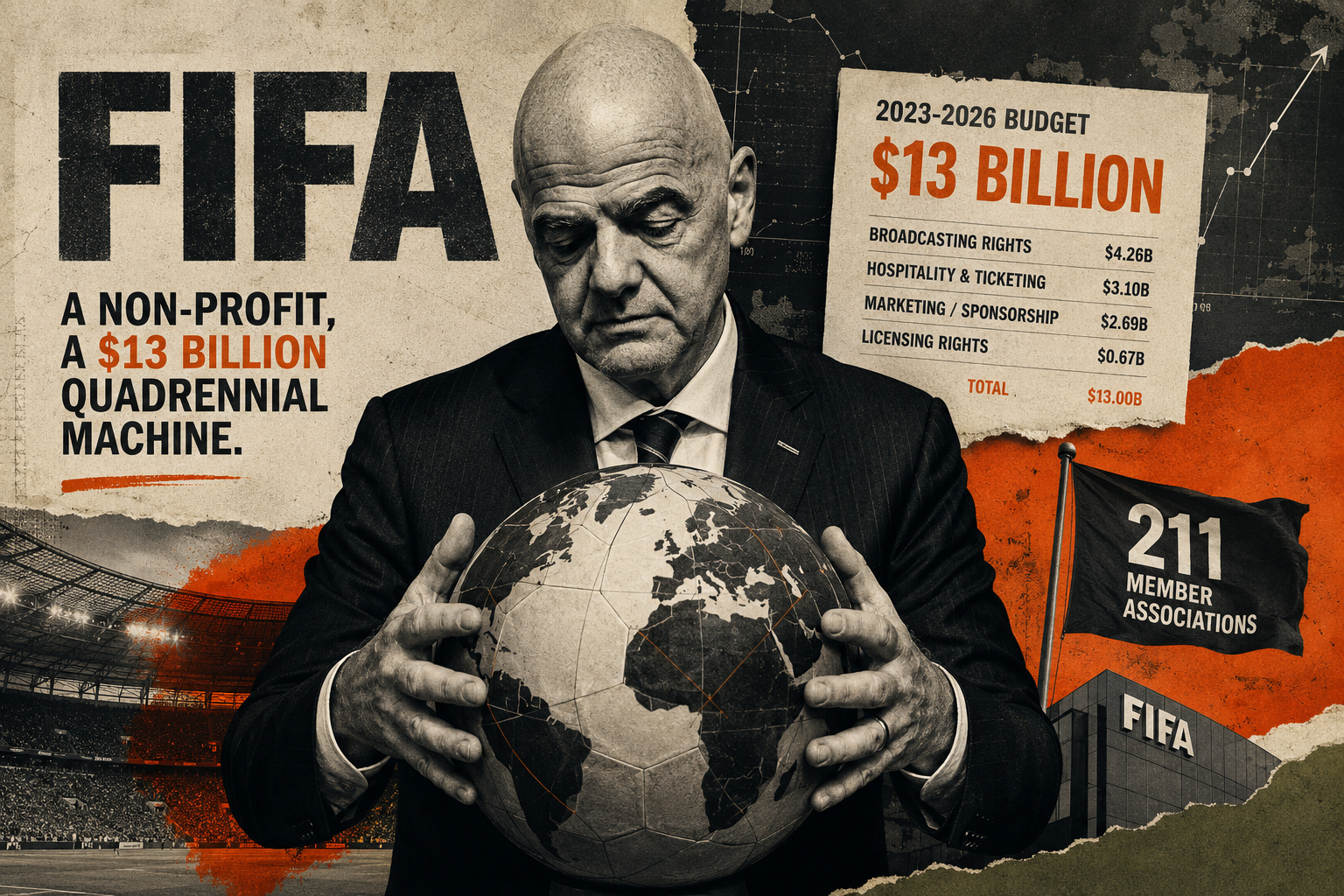
Strip away the trophies and the anthems, and FIFA is one of the most unusual businesses on earth. It is legally a non-profit association under Swiss law. It has just 211 member associations as its "shareholders." It does its real earning for about one month every four years. And in the current cycle it expects to take in close to $13 billion.
That combination, a tax-favoured non-profit running a multi-billion-dollar, quadrennial, single-event revenue machine, explains almost everything FIFA does. Once you see the model, the expansions, the new tournaments and the Gulf money all start to make sense.
FIFA's business, at a glance
| Legal status | Non-profit association, based in Zurich, Switzerland |
| "Shareholders" | 211 member associations |
| 2019-2022 revenue | $7.57 billion (record at the time) |
| 2023-2026 revenue (budget) | ~$13 billion (revised up from ~$11 billion) |
| Cycle-on-cycle jump | ~72%, the largest in FIFA's history |
| Reserves (end 2022) | ~$3.97 billion |
| Revenue engine | The men's World Cup (2026 edition alone ~$8.9 billion) |
Source: FIFA financial reports and 2023-2026 budget; figures rounded.
The four-year clock
The first thing to understand is that FIFA does not earn evenly. Its revenue arrives in a four-year cycle that builds to the men's World Cup and then resets. Each cycle has been bigger than the last:
- 2015-2018: $6.4 billion
- 2019-2022: $7.57 billion (a record, powered by Qatar 2022, the most profitable World Cup to date)
- 2023-2026: budgeted at roughly $13 billion, a jump of about 72% over the previous cycle
That 72% leap is the largest in FIFA's history, and it is not organic growth in the usual sense. It is the product of deliberate decisions to make the one big event much bigger (a 48-team 2026 World Cup, up from 32) and to add a second one (the new 32-team Club World Cup, launched in 2025). FIFA's growth strategy is, quite literally, more football to sell.
The four revenue pillars
Almost all of FIFA's money comes from four sources, and the mix tells you what FIFA actually sells.
| Revenue pillar | 2023-2026 budget | What it is |
|---|---|---|
| Broadcasting rights | ~$4.26 billion | TV and streaming rights, the single biggest line |
| Hospitality & ticketing | ~$3.10 billion | Match tickets and premium hospitality packages |
| Marketing / sponsorship | ~$2.69 billion | FIFA Partners and World Cup sponsors |
| Licensing rights | ~$0.67 billion | Brand licensing, royalties, video games and merchandise |
Two shifts stand out. Broadcasting is still king at over $4 billion, but hospitality and ticketing is the fastest-growing pillar, budgeted to roughly treble versus the prior cycle. That is the financial fingerprint of staging the 2026 World Cup in the United States, a market with the stadiums, the corporate appetite and the willingness to pay premium prices that FIFA has been chasing for years.
A non-profit that prints billions
Here is the part that confuses people. FIFA is a non-profit, yet it sits on reserves of about $3.97 billion and grows them every cycle.
The contradiction dissolves once you see how the structure works. As a Swiss association, FIFA is not in business to distribute profit to owners. Instead, the surplus is recycled in two directions. A large share flows back to the 211 member associations through development programmes, most visibly FIFA Forward, which funds federations from the giants to the tiniest island nations. The rest is banked as reserves, FIFA's war chest for the rare bad cycle and its cushion of independence.
That recycling is not just charity. The member associations are also FIFA's electorate. Every federation gets a vote in the FIFA Congress, and the development money that flows to them is part of what keeps the system stable and the leadership in place. The non-profit structure, the development spending and the political machine are the same mechanism viewed from different angles.
Why the model is powerful, and fragile
The strength of FIFA's model is obvious: it owns the single most valuable event in sport and sells it to a planet. The fragility is just as real, and it drives the strategy.
The revenue is dangerously concentrated. One tournament, once every four years, generates the overwhelming majority of the money. The 2026 World Cup alone is expected to deliver about $8.9 billion of the cycle's ~$13 billion. A single disrupted World Cup would blow a hole in FIFA's finances that nothing else in the portfolio could fill.
That concentration is exactly why FIFA keeps doing the things that generate headlines. Expanding the World Cup to 48 teams adds matches, host cities, sponsors and broadcast inventory. Launching the Club World Cup creates a second tentpole in the off-years. Courting Gulf sovereign wealth brings deep, stable capital to underwrite it all. Every one of those moves is the same business logic: reduce the dependence on a single month, and grow the machine.
What it means
FIFA is best understood not as a sports body that happens to make money, but as a revenue institution that happens to run football. Its non-profit status shapes where the money goes, not how hard it works to earn it. Its four-year clock shapes its calendar. And its dependence on one tournament shapes its entire growth strategy.
The rest of this series follows that logic into its three biggest current bets: the record-breaking 2026 World Cup, the $1 billion Club World Cup gamble, and the Gulf money that increasingly underwrites both. They are different stories, but they are all the same machine, trying to turn one month of football into more than four years of cash.