India Made 44 Unicorns in 2021. Let's see where they stand today
A third of every Indian unicorn that exists today was crowned in a single year. We took Tracxn's full list of 132 Indian unicorns, isolated the 44 minted in 2021, and traced where each one stands five years on.
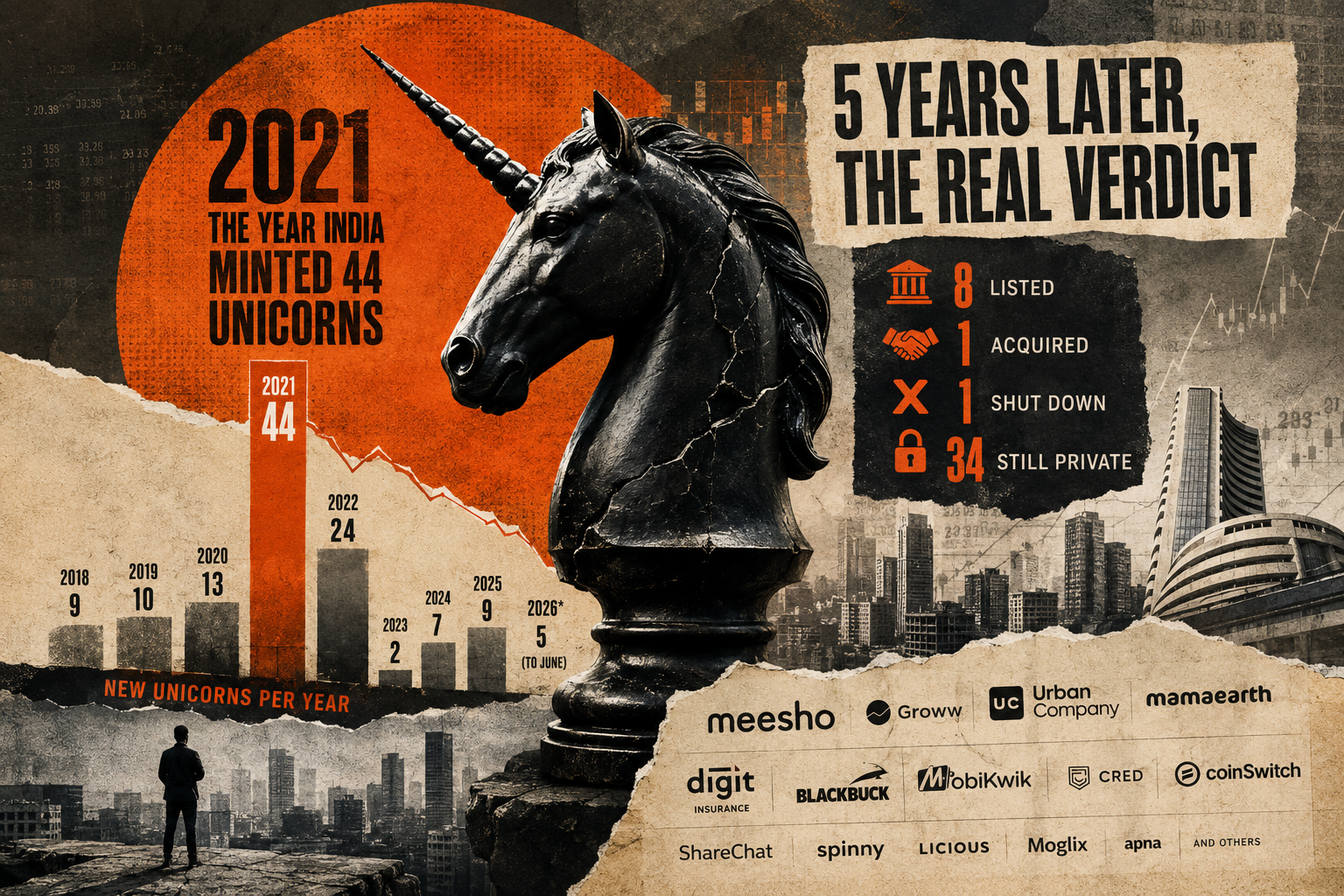
In 2021, India turned a company into a unicorn roughly every eight days. Forty-four of them crossed the billion-dollar line that year, more than the previous three years put together. Then the tap closed. In 2023, the entire country produced two.
| Year | New unicorns |
|---|---|
| 2018 | 9 |
| 2019 | 10 |
| 2020 | 13 |
| 2021 | 44 |
| 2022 | 24 |
| 2023 | 2 |
| 2024 | 7 |
| 2025 | 9 |
| 2026 (to June) | 5 |
New unicorns minted per year, per Tracxn (132-company set, retrieved 29 June 2026).
Read the table once and the story is plain. 2021 was not a good year. It was an outlier so large that it distorts the whole decade. The Class of 2021 is, by itself, 33 percent of every Indian unicorn alive today, and what happened to those 44 companies is the closest thing the ecosystem has to a controlled experiment: same vintage, same euphoric capital, five years to prove it.
The money that made them
The unicorns were a symptom. The cause was the capital.
Across the companies in this dataset, $27.9 billion flowed in during calendar 2021, over 185 rounds, the single biggest year of venture funding India has seen. The next year it nearly halved. The year after that it fell off a cliff.
| Year | Funding into these companies | Rounds |
|---|---|---|
| 2020 | $6.4 billion | 107 |
| 2021 | $27.9 billion | 185 |
| 2022 | $10.4 billion | 105 |
| 2023 | $3.6 billion | 50 |
| 2024 | $5.5 billion | 72 |
| 2025 | $4.3 billion | 63 |
Capital raised by these unicorns by calendar year, per Tracxn funding-round records.
A unicorn is made the moment an investor agrees to a valuation. In 2021, investors agreed to almost anything. Tiger Global alone wrote into a third of the eventual unicorn list. The crowning was not a verdict on the businesses. It was a verdict on the market. Which is exactly why the five years since are the interesting part: that is when the businesses had to answer for the price.
Where the Class of 2021 stands now
Five years on, the 44 sort into four piles.
| Outcome | Count | Companies |
|---|---|---|
| Reached the public market | 8 | Meesho, Groww, Urban Company, BlackBuck, Mamaearth, Digit Insurance, Five Star Business Finance, MobiKwik |
| Acquired | 1 | Blinkit (to Zomato, 2022) |
| Shut down | 1 | The Good Glamm Group (2025) |
| Still private | 34 | CRED, ShareChat, BharatPe, Spinny, Licious, Moglix, CoinSwitch and 27 others |
Eight IPOs, one trade sale, one death, and a large private middle that has neither listed nor failed. The two ends of that table are the entire argument about whether 2021 was a bubble or a beginning. Both ends are real.
The graduates
Eight of the 44 made it to the public market, and the timing tells its own story. Only one listed during the boom itself. The rest waited out the winter and went out in the 2024 to 2026 window, when public investors had stopped paying for growth alone and started asking for a path to profit.
- Five Star Business Finance listed first, in November 2022, a 38-year-old NBFC that had been a billion-dollar company in fundamentals long before it carried the label.
- Mamaearth followed in November 2023, the consumer-brand test case.
- Digit Insurance and BlackBuck went out in 2024.
- Then the rush: Urban Company (September 2025), Groww (November 2025), Meesho (December 2025). MobiKwik had listed in December 2024.
Eight public listings out of one cohort is not a failure rate. It is the highest graduation rate of any unicorn vintage India has produced, precisely because the cohort was so large. A third of the club came from one year, and a quarter of that third has already found the exit that the previous decade of Indian startups mostly could not.
The frozen middle
Then there is the part the celebratory version leaves out. Of the 34 still private, a cluster has not raised fresh primary capital since 2021 or 2022. Their last priced round is also their unicorn round. They are carried, on paper, at a number the market set at the very top.
This is where honesty matters, because "has not raised since 2021" means two completely different things.
For some, it is a sign of strength. BrowserStack and Upstox have not raised because they do not need to. Both are profitable; a profitable company does not sell equity to fund itself. Silence, here, is the opposite of distress.
For others, the silence is the story. CoinSwitch, crowned in the crypto frenzy, has not taken a priced round since 2021, through a brutal two years for Indian crypto. Moglix and Mindtickle have been quiet since 2022. GirnarSOFT and Apna since 2021. None of these is dead. But none has been able, or willing, to test its 2021 valuation against a 2026 market, and a valuation that cannot be retested is a valuation on hold.
A unicorn that has not raised since 2021 is one of two companies. One does not need the money. The other cannot face the price. The dataset cannot always tell you which, and that ambiguity is the whole condition of the Class of 2021.
The instant unicorns
A handful of 2021's unicorns were not startups in any normal sense. GlobalBees and BRND.ME were both founded in 2021 and became unicorns in 2021, zero years from incorporation to billion-dollar tag. They were roll-ups, assembled from capital and acquisitions rather than grown. CarDekho and Gupshup show up in the cohort carrying almost no disclosed fresh funding at the unicorn moment at all.
These are the purest artefacts of the year. A unicorn is supposed to be the outcome of a decade of compounding. In 2021, for a brief window, it became something you could assemble in months if you had enough money and a roll-up thesis. That is not a moral failing. It is simply what a billion-dollar valuation meant in the one year it meant the least.
What it says, and what to watch
Three things fall out of the cohort.
One, 2021 was a capital event, not a company event. Forty-four unicorns followed $27.9 billion the way a shadow follows a light. When the capital fell to $3.6 billion in 2023, the minting fell to two. The label tracked the money almost perfectly, which is the cleanest possible evidence that the label was pricing the market, not the businesses.
Two, the cohort is graduating anyway. Eight public listings, and counting, is a genuinely strong outcome, and it has come disproportionately from companies that were billion-dollar businesses on fundamentals before 2021 ever happened. The year did not create most of them. It just labelled them at the same time as everyone else.
Three, the frozen middle is the open question. Thirty-four companies are still private, several of them carried at a price last tested in the year prices were highest. Some are profitable and simply quiet. Some are waiting for a market that will agree with their 2021 number, and may be waiting a long time.
The thing to watch is which of those 34 lists next, and at what price relative to its 2021 round. Every IPO from this cohort is a public retest of a private 2021 valuation. So far, the retests have mostly held. The ones still waiting are the real verdict on whether 2021 was a bubble, a beginning, or, as is usually the case, some unsatisfying amount of both.
Built from Tracxn's unicorn dataset (retrieved 29 June 2026): unicorn-creation dates, funding-round records, and IPO filings. Funding figures are as reported by investors. If you have a correction on any company's status, write to StartupTalky's desk and we will update.