From ₹2 Lakh to ₹120 Crore: Maya Varma Shares The Untold Joker & Witch Story
Maya and Satish turned ₹2 lakh and a small Bangalore apartment into Joker & Witch and Teejh, now a ₹120 Cr profitable D2C brand built without external funding. In this StartupTalky conversation, Maya shares their unfiltered founder journey and growth story. Watch the full conversation.
In January 2015, Maya Varma and her husband Satish Singh made a decision that raised more than a few eyebrows. Newly married, having quit their well-paying jobs within months of each other, and armed with just INR 2 lakh in starting capital, they set out to build a fashion accessories brand from a two-bedroom apartment in Bangalore. Today, that brand, Joker & Witch, is on track to close the year at INR 120 crore in revenue, with a team of 150 people and two offline stores. Not a single rupee of external funding was raised along the way.
In this candid virtual conversation on the StartupTalky podcast, Maya Varma, Co-founder and Chief Brand & Product Officer, walked us through the unfiltered story of how it all happened.
The Accidental Entrepreneur
Entrepreneurship, Maya admits, was never part of the plan. Growing up in Delhi, though originally from Kerala, she was the studious type with a strong creative streak: drawing, painting, dance. When the time came to choose a career path, she defied her father's wish for her to become a doctor and enrolled at NIFT Delhi to study accessory design. What followed was a varied corporate career. She worked as an accessory designer with renowned designer Rajesh Singh, then as a product designer at Hidesign in Pondicherry, where she got her first exposure to retail management. Her final job before entrepreneurship was at StyleTag, an early-stage e-commerce platform in Bangalore, and that's where everything changed.
"I always saw myself climbing the corporate ladder," she says. "Entrepreneurship happened by chance, honestly."
A Brand Born From a Tattoo and a Gap in the Market
The idea for Joker & Witch came from two places simultaneously: a market observation and a personal joke. While working at StyleTag, Maya and Satish noticed that the Indian watch market was entirely dominated by legacy players. There was no modern, fashion-forward brand filling the space. Meanwhile, Maya's own background in accessory design drew her naturally toward jewellery. The product combination was obvious.
The name, however, came from something far more personal. Satish had a Joker tattoo on his arm, long before any brand was conceived, and it had become a running joke between them that he was "the Joker," and she was "the Witch." When they needed a brand name, the answer had been hiding in plain sight.
"Once you know the brand, you'll never forget the name," Maya says. It was quirky, memorable, and told their story.
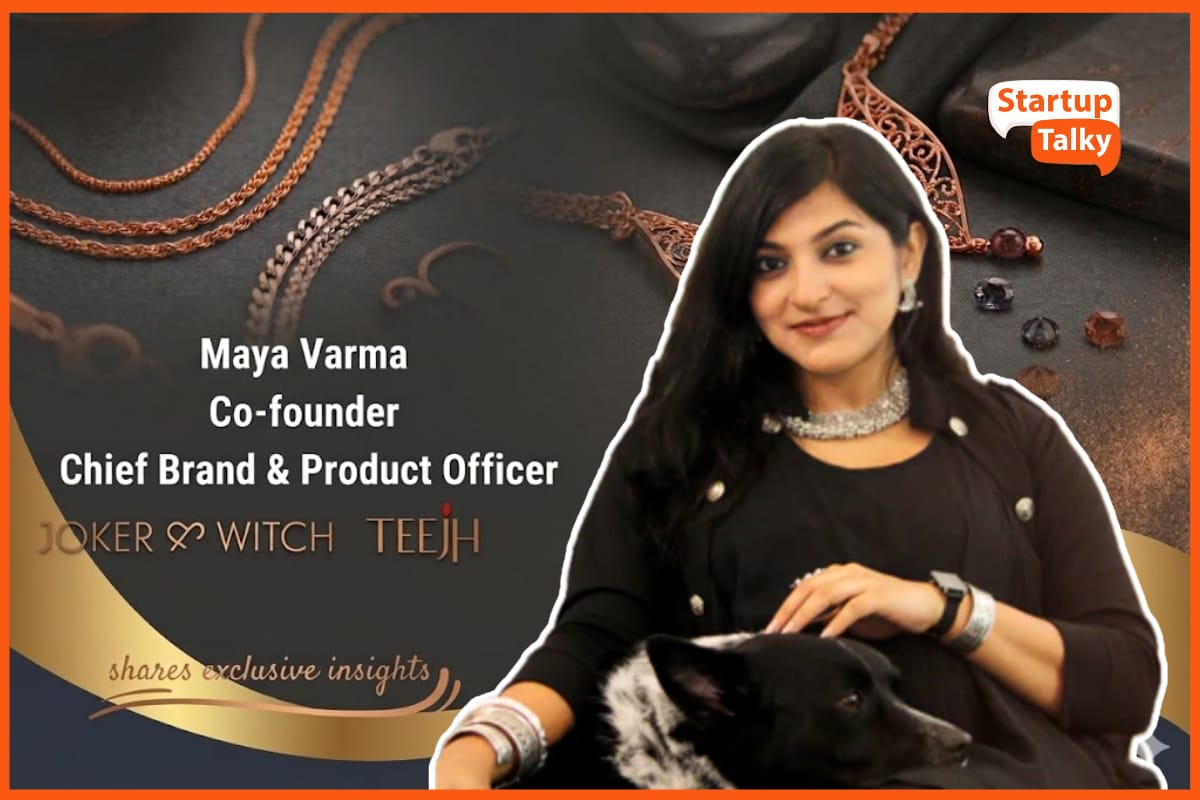
Maya Varma, Co-Founder and Chief Brand & Product Officer, Joker & Witch and Teejh in Conversation with StartupTalky
The Early Grind, and the First Crisis
The first few months were deceptively smooth. Joker & Witch was listed on Fashion Era, a popular platform at the time, using a consignment model that kept logistics simple. Products were selling, and the founders felt the wind behind them. Then, abruptly, Fashion Era failed to raise its next funding round and shut down, leaving approximately INR 11 lakh in stock and pending payments stuck.
It was a brutal early lesson. Starting with only INR 2 lakh in capital, INR 11 lakh frozen was existential. They recovered what they could, stock, partial payments, and made a decision that would define their approach going forward: never depend on a single platform again. Within months, they were listed on 10 to 12 marketplaces, simultaneously, doing everything themselves. Photography, listings, packing, dispatches.
"There was one night we packed 100 orders," Maya recalls. "That felt like a milestone."
The Pivot That Changed Everything
By 2016, two strategic decisions had reshaped the business. First, they cut their product range from five categories: watches, jewellery, handbags, footwear, and sunglasses, down to two. Footwear, they learned, was a size management nightmare that drained capital. Accessories, by contrast, worked across all sizes and were inventory-efficient. The focus paid off immediately.
Second, and more consequentially, they launched their own Shopify website in April 2016, building it entirely themselves without agencies or external help. On day one, they received their first order. A customer had trusted a brand-new website, which felt remarkable at the time. From that point, their own platform became the engine. Today, their website contributes 60% of total revenue. Marketplaces are a complement, not the core.
In 2018, they took a calculated loan to fund the manufacturing of watches with their own branding, moving away from white-label sourcing. The shift in customer trust was immediate and significant.
Building Teejh, Spotting the Next Gap
By 2019, Joker & Witch had found its footing as a modern, minimal Gen Z accessories brand. But Maya noticed something about their own customers: the same young woman wearing a Joker & Witch watch on a weekday also wore ethnic Indian jewellery for weddings and festivals, yet had no satisfying brand to turn to. The ethnic jewellery market was flooded with loud, heavy, ornate pieces. There was almost nothing subtle, wearable, or everyday-friendly.
That gap became Teejh. Starting with oxidised jewellery as its core, the brand was built around a simple philosophy: ethnic jewellery that isn't shouting, that works with a saree and a casual Western outfit alike. Over time, Teejh expanded into sarees, again, deliberately understated: cotton linens, breathable fabrics, nothing too elaborate. The brand found a slightly older, millennial audience, distinct from Joker & Witch's Gen Z core.
Bootstrapped by Conviction, Not Circumstance
Perhaps the most striking aspect of Joker & Witch's story is what they chose not to do. Despite having opportunities to raise external funding, Maya and Satish consistently declined. The reasoning was clear: investors bring scaling pressure and directional influence that conflicted with their intent to build slowly, sustainably, and profitably.
"Profitability has to be part of the journey from the beginning, whether you're bootstrapped or funded," Maya says. "We've seen too many brands scale fast and burn out."
Three years ago, the company was partially acquired by GlobalBees, which brought corporate structure and financial support while leaving operational independence intact. Today, the brands are present on Amazon, Flipkart, Myntra, and other major platforms, but the website remains dominant.
The Advice She'd Give Every D2C Founder
When I asked what she would tell a founder just starting out, Maya didn't offer platitudes.
She speaks from a decade of hard-won experience: "The first five years of any business are the hardest. Most founders quit before the inflection point. If you have genuine faith in your idea, and you can see the gap you're filling, persistence is everything. Just keep going at it."
For a woman who once imagined herself climbing the corporate ladder, Maya Varma has built something far harder to replicate: two profitable, category-defining brands, built on complementary strengths, strong discipline, and the stubborn refusal to scale before the foundation was solid. The Joker and the Witch, it turns out, made a powerful team.