

Meta Subscriptions Are Here: Instagram Plus, Facebook Plus & WhatsApp Plus Signal the End of the Free Internet
Meta just launched paid plans for Instagram, Facebook & WhatsApp. With Meta One and AI subscriptions on the way, the free social media era is entering its premium phase, and nothing online will look the same again.
For nearly two decades, Meta made the world's most seductive promise: billions of people could have a global social life, entirely for free. No subscription. No invoice. Just sign up, connect, scroll.
The price, of course, was attention. Your feed was the product. Your behaviour was the inventory. Advertisers paid handsomely to reach you, and Meta became one of the most profitable companies in human history without charging its users a single penny.
That era is not quite over. But on Wednesday, it developed a very significant crack.
Meta officially launched paid subscription tiers across Instagram, Facebook, and WhatsApp — the three apps used by roughly four billion people, whilst simultaneously unveiling a broader premium ecosystem it is calling Meta One. It is the company's most explicit acknowledgement yet that advertising alone can no longer carry the weight of what it wants to build.
This is not a product announcement. It is a philosophical shift.
What Meta Actually Announced
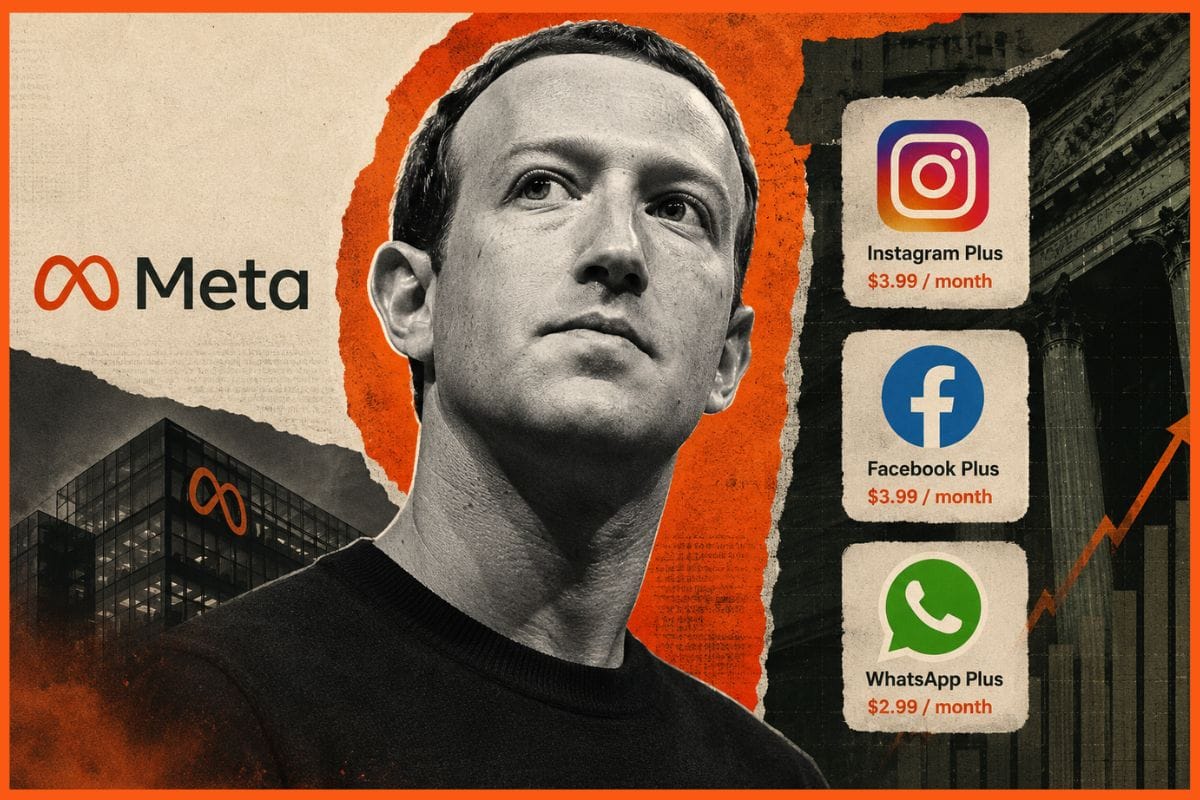
Instagram Plus and Facebook Plus are priced at $3.99 per month, while WhatsApp Plus comes in at $2.99 per month. The features are modest but shrewdly chosen: Instagram Plus subscribers can see how many people have rewatched a Story in aggregate, create unlimited audience lists beyond the standard Close Friends option, spotlight a Story once a week for additional views, extend a Story beyond 24 hours, and preview a Story without appearing as a viewer.
WhatsApp Plus focuses on personalisation, including premium stickers, custom ringtones and app themes.
| Platform | Tier | Price/Month | Key Features | Strategic Goal |
|---|---|---|---|---|
| Instagram Plus | $3.99 | Story insights, audience lists, profile customisation | Creator & power user retention | |
| Facebook Plus | $3.99 | Analytics, story tools, animated reactions | Deepen engagement, ARPU growth | |
| WhatsApp Plus | $2.99 | Themes, ringtones, pinned chats | Monetise messaging at scale | |
| Meta AI | Meta One Plus | $7.99 | Higher compute, reasoning, image generation | AI subscription entry tier |
| Meta AI | Meta One Premium | $19.99 | Deeper reasoning, expanded video generation | Compete with ChatGPT Plus |
| Creators/Business | Meta One Essential | $14.99 | Verified badge, analytics, link sheet | Lock in creator ecosystem |
| Creators/Business | Meta One Advanced | $49.99 | Feed optimisation, scheduling, content protection | B2B monetisation |
Meta One is described by head of product Naomi Gleit as a place that brings Meta subscriptions "together" across all Meta apps, with plans described as "just the beginning with a lot more value to come."
For Meta AI users, Meta One Plus at $7.99 and Meta One Premium at $19.99 offer the same core features, but Premium unlocks more capacity for higher-compute queries, meaning deeper reasoning for complex tasks and more video and image-generation capabilities across Meta's apps.
The Real Question: Why Now?
The surface answer is simple. The move comes as Meta faces investor scrutiny over its massive AI spending, the company has projected capital expenditure of between $125 billion and $145 billion for the year, mainly for AI data centres.
Total expenses in the first quarter of 2026 ballooned 35% to $33.4 billion, driven mostly by infrastructure costs and employee compensation. The Big Four tech companies, Meta, Microsoft, Alphabet, and Amazon, are on track to spend upward of $650 billion on AI investments in 2026.
The deeper answer is structural. Apple's App Tracking Transparency framework kneecapped the precision of Meta's ad targeting from 2021 onwards, costing the company billions in estimated revenue. TikTok reshaped user attention habits, forcing Meta to spend aggressively on algorithmic upgrades just to stay competitive. And global ad markets, whilst recovering, carry an inherent ceiling that a company with four billion users bumps against quickly.
For years, Meta earned most of its money from advertising. But there is a problem: user growth is slowing in many regions because Meta's apps are already used by billions. When you have saturated the planet, the only direction left is depth, extracting more value per user rather than adding new ones.
For years, Meta monetised attention. Now it wants to monetise utility.
The AI Cost Problem
Generative AI is, in blunt economic terms, extraordinarily expensive to run at scale. Training a frontier model costs hundreds of millions of dollars. Inference, actually answering your questions in real time, compounds those costs daily across billions of interactions.
Meta is testing a freemium model for Meta AI, introducing usage limits on extended reasoning and Thinking mode, and also setting paywalled caps on image and video generation across the company's apps. Meta AI will remain free in some capacity, but its more complex uses will be locked to certain tiers.
This mirrors almost exactly what OpenAI, Google, and Anthropic have already done. ChatGPT Plus, Gemini Advanced, and Claude Pro all operate on the same logic: the base model is free enough to attract users, and the premium tier funds the infrastructure that keeps everything running. Together, these represent Meta's first large-scale attempt to monetise everyday consumer use of its flagship apps through subscriptions rather than relying solely on advertising.
AI may ultimately force the internet to abandon the free model it relied on for two decades.
The Subscription Internet: A Landscape Forming Fast
Meta is not pioneering this territory, it is joining a movement already well underway.
| Platform | Subscription Tier | Est. Paying Users | Monthly Price |
|---|---|---|---|
| YouTube | YouTube Premium | ~100m | $13.99 |
| X (Twitter) | X Premium | ~1m+ | $8–$16 |
| Snapchat | Snapchat+ | ~14m | $3.99 |
| Telegram | Telegram Premium | Growing | $4.99 |
| LinkedIn Premium | ~40m | $29.99–$59.99 | |
| Discord | Discord Nitro | ~10m+ | $9.99 |
| ChatGPT | ChatGPT Plus/Pro | ~15m+ | $20–$200 |
| Meta | Meta One (testing) | TBD | $7.99–$19.99 |
The pattern across all of them is identical: free access remains, but meaningful capability sits behind a paywall. The free tier is the acquisition engine; the premium tier is the business.
Social media is no longer just competing for attention. It is competing for recurring revenue.
Winners, Losers, and the Sceptics
Meta's stock rose nearly three per cent on the news, a telling reaction from investors who have grown anxious about whether the company can justify its colossal AI expenditure. Subscription revenue, even modest at first, signals a more diversified and predictable income stream.
For creators, the calculus is mixed. Better analytics and visibility tools are genuinely useful. But the prospect of algorithmic advantage for paying users, "pay to win" social media, as critics are already calling it, threatens to undermine the organic meritocracy that made Instagram and YouTube compelling platforms in the first place.
For regular users, the concern is enshittification: the well-documented pattern where platforms degrade the free experience incrementally to push people towards paid tiers. When a Story's rewatch data moves behind a paywall, what comes next? Reach? Distribution? Discoverability?
For advertisers, the picture is nuanced. A subscriber who has voluntarily shared payment information is an extraordinarily valuable audience signal. First-party data from paying users is more reliable than any third-party tracking pixel. Meta's subscription push could, paradoxically, make its advertising products more effective even as it builds alternatives to them.
The Competitive Map
| Company | Monetisation Model | AI Strategy | Subscription Play |
|---|---|---|---|
| Meta | Ads + emerging subscriptions | Meta AI, Llama | Meta One |
| Ads + cloud + hardware | Gemini | Google One AI Premium | |
| Apple | Hardware + services | Apple Intelligence | Apple One bundle |
| OpenAI | Subscriptions + API | GPT-4o, o3 | ChatGPT Plus/Pro/Team |
| Microsoft | Enterprise + cloud | Copilot | Microsoft 365 Copilot |
| X | Ads + subscriptions | Grok | X Premium |
Meta's Family of Apps brought in a stunning $55.9 billion in Q1 2026, almost entirely from advertising. Even if subscriptions eventually account for five per cent of that figure, the ARPU uplift across four billion users would be transformative.
What Meta Could Become by 2030
The trajectory, if subscriptions gain traction, points somewhere genuinely interesting. Meta is not merely launching a £3.99 sticker pack, it is building the architecture for a subscription-based AI consumer platform that spans communication, content, commerce, and computing.
WhatsApp, with over two billion users and near-total messaging penetration across South Asia, Latin America, and Africa, is arguably the most underleveraged asset in tech. A WhatsApp AI assistant that handles customer service, bookings, financial queries, and personal productivity, available for £2.99 a month, is not a niche product. It is infrastructure.
The question Meta is really answering is this: can a social media company transform itself into a subscription utility? Apple did it with services. Microsoft did it with Office 365. Spotify did it with music.
If Meta succeeds, it will be the largest such transition in the history of consumer technology.
The Bigger Picture
There is something philosophically significant in this moment. The internet was built on an implicit contract: services would be free, and users would pay with their data and attention. That contract was never quite honest, but it was enormously convenient, and it brought billions of people online who could not have afforded subscription fees.
Subscriptions change that dynamic. They filter by willingness to pay, which often correlates with income. They create two-tier platforms where the free experience becomes a permanent advertisement for the paid one. They shift power from advertisers to platforms directly.
The initial extras that subscriptions include may not be enough to tempt large numbers of people into paying the monthly fee, particularly when there is no bundle available. Meta knows this, which is precisely why Meta One is designed to eventually consolidate everything, apps, AI, creator tools, and business services, into a single, stickier offering.
The free social media era is not ending. But it is clearly entering a premium phase.
For two decades, the internet taught users that social platforms were free. AI is now rewriting that contract, and Meta, the company that perfected the free model, is leading the revision.
Perhaps that was always inevitable. When intelligence becomes infrastructure, someone has to pay for it.


