Biryani Bees Raises $1 Million From Vivek Oberoi Family Office
Three biryani shops in Uttar Pradesh are running at an annual rate of about ₹25 crore between them. That implies roughly ₹8.3 crore per outlet, or about ₹69 lakh a month each, and it is the number behind this raise.
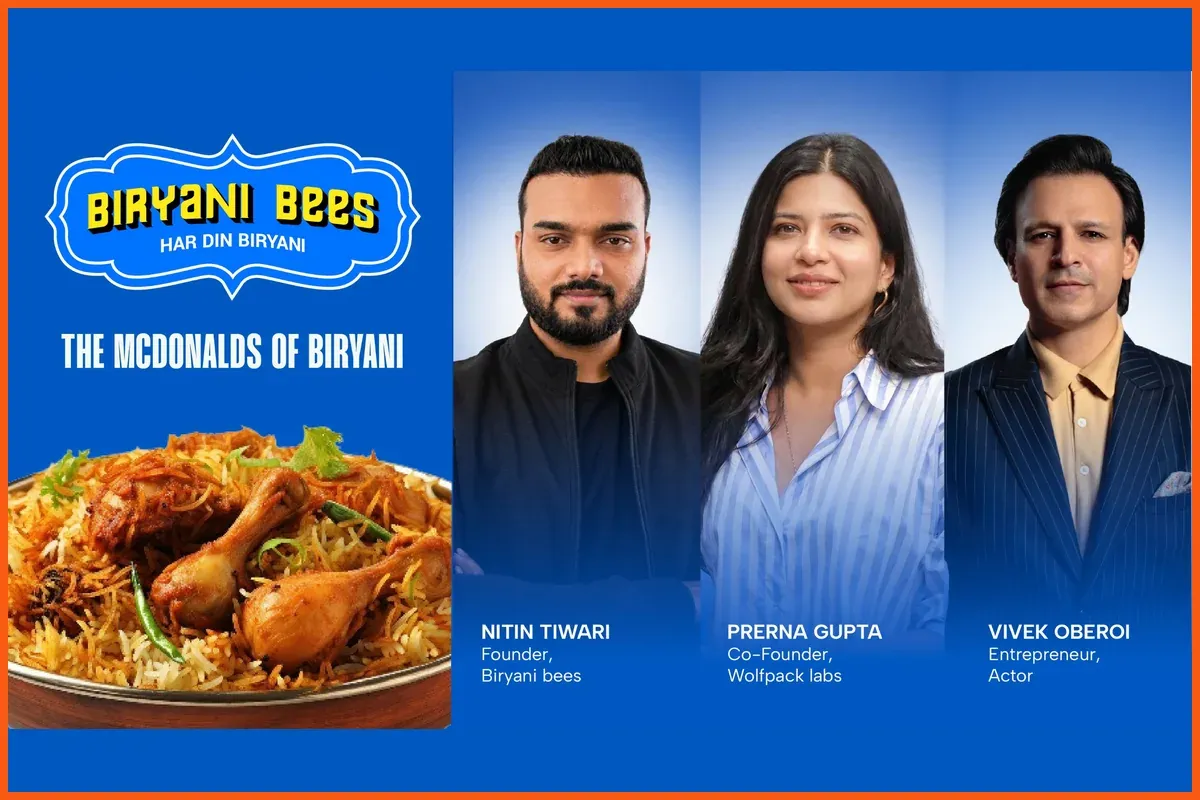
Biryani Bees has raised $1 million from the Vivek Oberoi Family Office, announced in August 2026. The money takes it from three outlets to ten, across Uttar Pradesh, Madhya Pradesh and other Tier 2 markets.
The brand is incubated by Wolfpack Labs, a Gurugram venture studio set up in 2024 by Aakash Anand, with Prerna Gupta as founding partner. Biryani Bees itself is run by founder Nitin Tiwari.
What $1 million has to stretch to
Seven new outlets, a bigger central kitchen, an operating team and an expansion playbook, out of roughly ₹8.8 crore. Split evenly across the outlets alone that is about ₹1.26 crore each, and it has to cover the kitchen and the team as well.
That is a lean number for a restaurant rollout, and it is only workable because of how the company is built. Biryani Bees runs a central-kitchen model, so an outlet is closer to a finishing and dispatch point than a full restaurant. Fewer chefs, less equipment, smaller footprint, and the expensive part of the operation sits in one place serving all of them. It is the same cloud kitchen logic Rebel Foods scaled into a platform running dozens of brands out of more than 450 shared kitchens.
Hold the current per-outlet figure steady and ten outlets implies something near ₹83 crore a year. Whether it does hold is the entire question, and it is not a given: the three shops that produced it are in cities the team knows, on delivery platforms where the brand has had time to build a ranking.
Vivek Oberoi:
"What attracted us to Biryani Bees is not just the love for the product, but the business model behind it. India's next wave of consumption is going to come from Tier 2 and Tier 3 cities, and we believe there is a massive opportunity to build high quality, standardised and affordable food brands for these consumers. Biryani Bees has the potential to become to Indian food what McDonald's became to QSR: consistent, accessible and trusted. We are excited to partner with Nitin and the team as they take the brand to its next phase of growth."
The delivery platforms are doing the heavy lifting
The company says it holds one of the highest biryani market shares on Zomato and Swiggy in the cities where it operates. For a three-outlet brand that is the whole distribution strategy, and it is why the per-outlet revenue looks the way it does. A dine-in restaurant is limited by how many people walk in. A central kitchen feeding a delivery radius is limited by how fast it can cook and how high it ranks in an app. The bar keeps moving, too, with food delivery platforms compressing the times they promise customers.
It also explains the McDonald's framing better than the branding does. What McDonald's actually standardised was not the burger, it was the kitchen behind it: the same process, the same timings, the same output whichever franchise you walked into anywhere in the world. Biryani Bees is making that same bet on rice, which is a considerably harder product to hold consistent than a patty, because biryani varies with the grain, the water, the vessel and the hand of whoever is cooking it. Doing that through a kitchen the company controls, rather than franchisees it does not, is the part of the model that has to work before anything else does.
Nitin Tiwari, Founder, Biryani Bees:
"We started Biryani Bees with a very simple belief: consumers in India's Tier 2 cities deserve food brands that offer the same consistency, quality and experience they expect from the best national chains, but at a price that works for an everyday meal. This investment gives us the opportunity to take what we have built in Uttar Pradesh and replicate it across markets. Our immediate goal is to reach 10 outlets, prove the model at scale and then build Biryani Bees into India's most trusted everyday biryani and meals brand."
A venture studio building the brand before the business
Wolfpack Labs' involvement is the less obvious part of this. A venture studio incubating a food brand usually means the brand identity arrived early rather than late, which is unusual in Indian food where the food tends to come first and the packaging catches up years later.
Prerna Gupta, Co-Founder, Wolfpack Labs:
"From the beginning, we wanted Biryani Bees to look and feel like a national brand, not a local biryani business. We built the visual identity, packaging and brand world with the ambition of making Biryani Bees feel as polished, recognisable and aspirational as the global QSR brands people already know and trust. The opportunity now is to take that brand equity and pair it with a highly efficient operating model to build something truly national."
The company says it is profitable at its current size and expects to raise a larger institutional round once it has proved the model across ten outlets in multiple states.
The number that decides this
Everything rests on whether ₹8.3 crore per outlet survives contact with a city where nobody has ordered from Biryani Bees before. In its home markets the brand has ranking, repeat customers and a kitchen already running at scale. In Madhya Pradesh it will have a new kitchen, a cold start on the apps and a paid-marketing bill it does not currently carry.
I would take the ten-outlet target seriously and the ₹83 crore implied by it with some caution. Getting to ten is a logistics problem the money solves. Holding the per-outlet economics while doing it is the thing worth measuring, and it is the number a larger institutional round will be priced on.
Revenue run rate, outlet counts, expansion plans, platform share and quotes come from the company's announcement and have not been independently verified. Wolfpack Labs' founding year, location and leadership come from Tracxn, retrieved 27 August 2026.