
Failed Vote Halts Swiggy’s Proposed Inventory-Led Business Shift
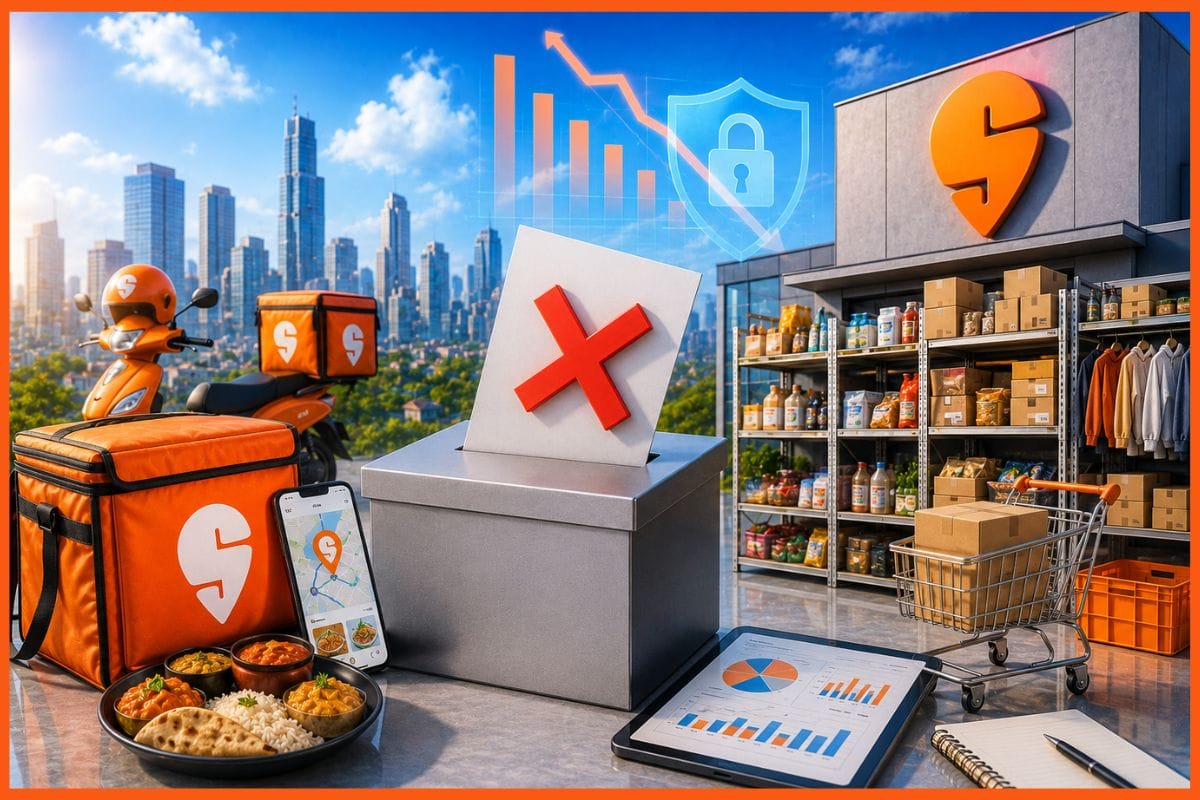
Swiggy, a food tech giant, had its bid to become an IOCC (Indian-owned and controlled company) rejected by shareholders. The foodtech juggernaut was unable to restructure its board nominating process and change its articles of association (AoAs) due to a lack of support. The business reported 72.36% support for the revision in its file with the exchanges, which is 2.65% points lower than the necessary 75%.
Since becoming public in November 2024, the foodtech company has never before had shareholders vote down a proposal. Earlier this month, the firm sent out a postal vote notice to shareholders, asking for their agreement to change the articles of association and to nominate Renan De Castro Alves Pinto as a nominee director without executive authority. On April 21, the remote e-voting began, and on May 20, it ended.
Swiggy Addressing Investors’ Queries
In response to questions from institutional investors, Swiggy had previously explained that the planned modifications to its board nomination process were an effort to become an IOCC under the country's foreign currency legislation. The explanation was given in response to questions from institutional investors who wanted to know more about the reasoning behind the board change proposals.
Existing FEMA regulations provide that in order for a business to be considered Indian-owned and managed, either all or part of its ownership must be held by Indian individuals or qualified Indian entities. This includes establishing a system of board nominations and composition that allows for domestic control over the board. The business announced that the planned appointments of supplementary executive, non-independent directors will not go into force as of June 1, 2026, due to the resolution's failure. The nomination of Renan De Castro Alves Pinto as a non-executive, non-independent director was approved by shareholders with 98.98% of the vote.
|
Some Interesting Facts of the Story |
|
1.Swiggy wanted to become an Indian-Owned and
Controlled Company (IOCC) under FEMA regulations. 2.IOCC status would have allowed the company to
directly source products from brands, reducing reliance on intermediaries. 3.Despite the rejection, shareholders strongly
backed the appointment of Renan De Castro Alves Pinto with 98.98% approval. |
Why Swiggy Wanted to Become IOCC?
By formally becoming an IOCC, Swiggy would have been able to bypass middlemen and buy products directly from brands to sell on its marketplace. Consequently, net sales will replace commission income. More profit, more command over logistics and warehousing, and superior service to customers would have resulted from this. Though the plans have been temporarily shelved, Swiggy has been gearing up for the inventory flip for quite a while.
It launched a distinct Instamart app in May of last year, indicating that the fast commerce business needs its own identity. In September, it further separated its fast-commerce vertical into a step-down subsidiary in anticipation of the possible turn. Later, in October 2025, during the company's Q2 FY26 earnings call, CEO Sriharsha Majety mentioned that Instamart would transition to an inventory-led strategy in the future. In terms of finances, Swiggy was able to reduce its consolidated net loss from INR 1,081 Cr in Q4 FY25 to INR 800 Cr in Q4 FY26, a 26% improvement. Concurrently, operational revenue increased by 44.7% to INR 6,383 Cr from INR 4,410 Cr in the corresponding period last year.
|
Quick Shots |
|
•Swiggy failed to secure shareholder approval for
its proposed IOCC restructuring. •The proposal received 72.36% support, below the
required 75% threshold. •The failed vote blocked changes to the company’s
Articles of Association (AoA) and board nomination structure. •This marks the first shareholder proposal rejection
since Swiggy went public in November 2024. |