
Google.org Commits $15 Mn to The/Nudge for India's MSMEs
The grant names The/Nudge, but the programme will be built by the^delta, which already runs an AI-for-impact programme with Meta. At about ₹143 crore, it exceeds the nonprofit's reported annual budget.
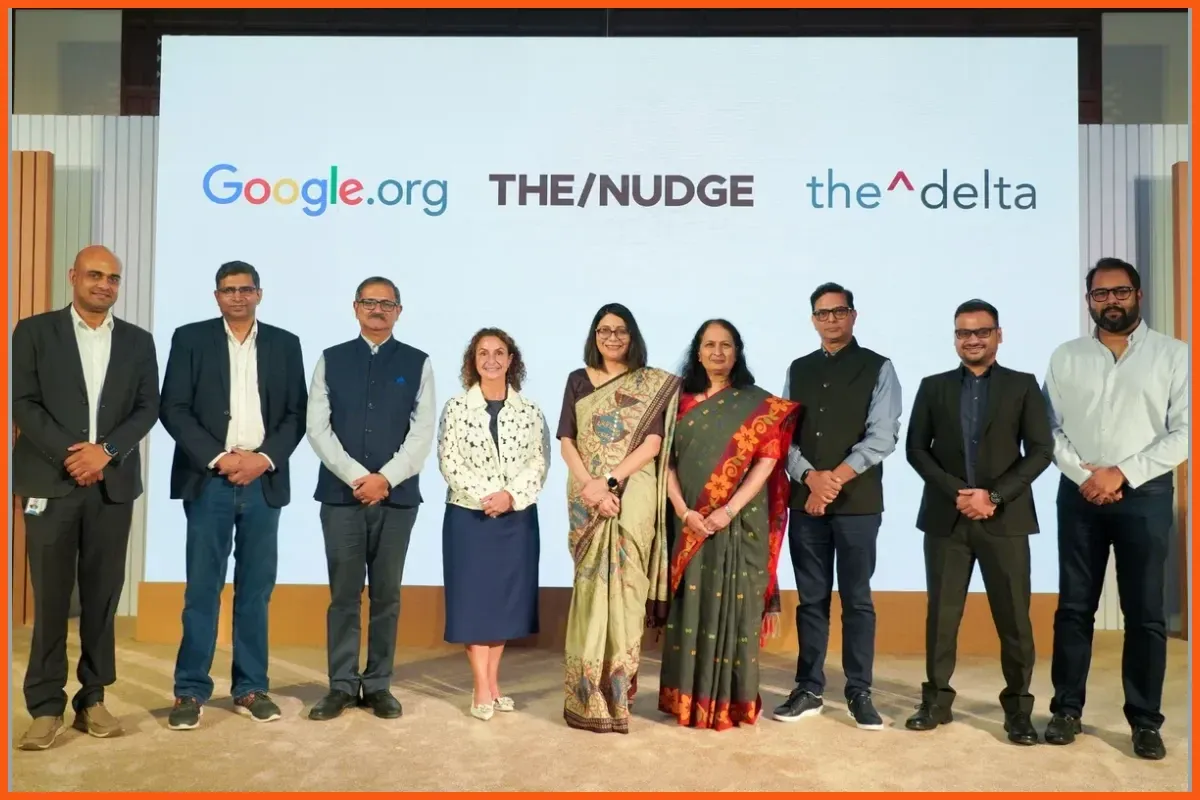
Google.org has committed $15 million to India's small businesses. The announcement names The/Nudge as the partner, but the organisation that will build the programme is called the^delta.
At current rates the grant is worth about ₹143 crore. It will fund AI tools aimed at three things that trip up small enterprises in India: getting formal credit, staying compliant, and being found by buyers. The programme runs an open call for proposals, and alongside it a multilingual, voice-led platform meant to train people in Tier 3 and Tier 4 towns and connect them to small businesses that need the skills.
the^delta is The/Nudge's social entrepreneurship arm under a new name
The/Nudge Institute is a Bengaluru nonprofit founded in 2015 by Atul Satija, formerly chief business officer at InMobi and before that at Google. Its work splits into livelihood programmes and what it calls the Livelihoods Ecosystem, and it is that second half the^delta now carries. The programme lists line up almost exactly: an incubator, an accelerator, a prize that runs open challenges, and Pragati, its AI-for-impact arm. Two of the people presented as the^delta's leadership also appear on The/Nudge's own programme leadership roster, with Subhashree Dutta down for social entrepreneurship and Kanishka Chatterjee for the prize. Dutta is the^delta's chief executive and Chatterjee its managing director.
The overlap is not subtle.
Google.org is funding an outfit that already runs an AI programme with Meta
Pragati, the AI-for-impact programme the^delta lists among its own, is run in collaboration with Meta. The/Nudge also names Meta among its partners. So the organisation taking $15 million from Google's philanthropic arm to put AI in the hands of Indian small businesses is already running an AI-for-impact programme with Google's largest rival in consumer technology.
I find that the most interesting thing in this announcement. It is not a conflict, and nobody has hidden it. It says something about how Indian social-sector infrastructure actually gets built: a small number of organisations have the distribution and the government relationships, and the technology companies queue up behind them rather than building parallel programmes of their own.
How big $15 million is, measured three ways
Against Google.org's own India record, this is the larger end. In January 2026 Google.org gave Wadhwani AI about ₹85 crore for AI-assisted learning. Globally, its AI Opportunity Fund is a $120 million commitment spread across many countries, so a single $15 million grant to one Indian organisation is a meaningful share of that kind of money.
Against the recipient, it is very large. Forbes India has put The/Nudge's annual budget at around ₹100 crore, which would make this one grant bigger than what the institution spends in a year. The announcement does not say over how many years the $15 million is deployed, and grants of this size are usually multi-year, so the annual figure is likely a fraction of the headline.
Against Google's own spending in India, it is small. In October 2025 the company announced a $15 billion AI and data centre hub at Visakhapatnam, its largest investment in India and its biggest AI campus outside the United States. The philanthropic grant announced a year later carries the same figure with a different unit. These are different kinds of money, capital expenditure against charitable giving, and the comparison is not a criticism. It is just the clearest way to see the scale.
The MSME numbers behind the announcement
Google.org put India's small business count at over 90 million, employing more than 345 million people. The official count runs a little higher. Registrations across the Udyam portal and the Udyam Assist platform passed 8.7 crore by June 2026, with the government putting employment reported through those registrations near 39 crore. The ministry credits the sector with roughly 31.1% of GDP and 48.58% of exports.
Formalisation is the reason those numbers have moved so fast. Udyam Assist exists to bring informal micro-enterprises onto the register, and much of the growth is businesses that already existed becoming countable rather than new businesses being created. That matters for a credit programme, because a registered enterprise is one a lender can underwrite.
Who was in the room
The launch in New Delhi drew the Ministry of MSME secretary Bharat Khera, and from Google's side Preeti Lobana, its India country manager, and Lila Ibrahim of Google DeepMind. Ibrahim's title is worth noting: she was DeepMind's founding chief operating officer from 2018 and moved in 2026 into a newly created role as its first chief AI readiness officer, a job she has said she may be the only person anywhere to hold.
Frequently asked questions
Who is receiving Google.org's $15 million grant?
The/Nudge, a Bengaluru-based nonprofit founded in 2015 by Atul Satija. The programme will be built by the^delta, which carries The/Nudge's social entrepreneurship and livelihoods ecosystem work, including its incubator, accelerator and prize.
What will the money be used for?
Developing AI tools to widen small enterprises' access to formal credit, market discovery and compliance. It includes an open call for proposals to source solutions, and a multilingual, voice-led platform to train people in Tier 3 and Tier 4 towns and connect them with small businesses.
How many MSMEs are there in India?
Registrations across the Udyam portal and the Udyam Assist platform passed 8.7 crore by June 2026. The sector accounts for roughly 31.1% of GDP and 48.58% of India's exports, according to the Ministry of MSME.