Government Considers $1 Billion Aid Plan for Private Electric Commercial Vehicles in India
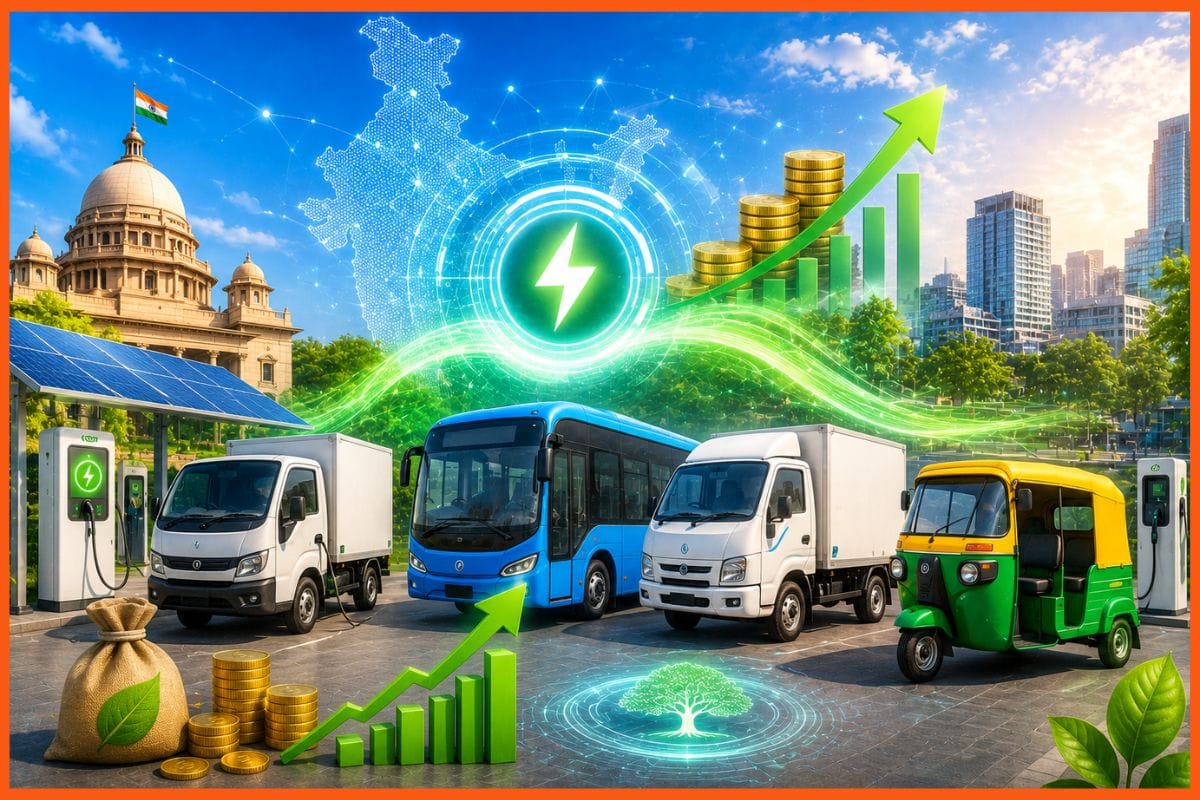
To increase commercial electric mobility and decrease emissions from the transportation sector, India is contemplating a $1 billion (approximately INR 8,300 crore) incentive programme. The step is taken to encourage private fleet operators to purchase electric buses and trucks. Despite having lower operating expenses than conventional diesel vehicles, electric commercial vehicles, like buses and heavy-duty trucks, incur high upfront costs.
The proposed scheme aims to ease this problem. Fleet operators, logistics providers, and public transportation agencies are reportedly the targets of the government's efforts to increase private sector involvement in electric mobility. Decarbonisation of the transport sector and the initiative are both anticipated outcomes of India's larger clean mobility goals.
Why Government is Pushing for Green-Mobility?
Following supply interruptions associated with the West Asia crisis, which rekindled worries about energy security and imported inflation, the Indian government is speeding up its efforts to reduce reliance on fossil fuels. Nearly 90% of India's crude oil comes from imports, leaving the country susceptible to price fluctuations and geopolitical crises. Commercial transport that runs on electricity would also contribute to reducing the severe air pollution in India.
The International Council on Clean Transportation cites studies that show that in cities like New Delhi, vehicle emissions can cause fine particulate matter pollution to reach levels of up to 40% per year. In the last five years, electric bus adoption has skyrocketed, propelled mostly by transportation companies that are run by the states. Diesel is still the fuel of choice for the vast majority of newly registered buses in India.
Although India is not alone in its reliance on diesel, other regions are making greater strides in electrifying their commercial fleets. A large number of electric trucks and buses are in operation in China, and similar initiatives are underway in the United States and Europe to power urban logistics and public transportation.
|
Some Interesting Facts of the Story |
|
1.Electric buses and trucks cost more upfront but can
significantly reduce fuel and maintenance expenses over their lifetime
compared to diesel vehicles. 2.The government is reportedly considering lifetime interest
subsidies of up to INR 15 lakh per electric commercial vehicle 3.China currently leads the global electric commercial vehicle
market with massive deployment of electric buses and heavy-duty trucks. |
The Proposed Package Might be a Game-Changer
The planned assistance package has the potential to expedite India's transition to electric commercial transport if it is approved. Meanwhile, it will increase demand for batteries, charging infrastructure, and domestic manufacturing in India's developing electric vehicle ecosystem. One of the incentives being considered is a life-long interest subsidy of up to INR 1.5 million ($17,500) per vehicle, with the subsidy decreasing with time. For private businesses looking to finance the purchase of electric commercial vehicles, the government is also considering a mechanism to partially guarantee loans.
Various media reports stated that lenders, guarantee providers, car manufacturers, and fleet operators have all been involved in the consultations. An initial focus has been on funding for 10,000 buses, with plans to increase that number to 40,000 to 50,000 vehicles in the future, according to the sources. Reports went on to say that in an effort to reduce operational expenses, the industry has also pursued charging parks, toll and tax exemptions, and power concessions. In India, the electric mobility incentive programmes are overseen by the Ministry of Heavy Industries.
|
Quick Shots |
|
•India is considering a $1 billion (around INR 8,300 crore)
incentive package to accelerate electric commercial vehicle adoption. • The proposed scheme focuses on private fleet operators,
logistics companies, and public transport agencies purchasing electric buses
and trucks. • Electric commercial vehicles have significantly lower running
and maintenance costs compared to diesel vehicles, despite higher upfront
prices. • India imports nearly 90% of its crude oil requirements, making
transport electrification a major energy security priority. |