Haryana Unveils New Industrial Policy to Boost High-Tech Manufacturing and Innovation
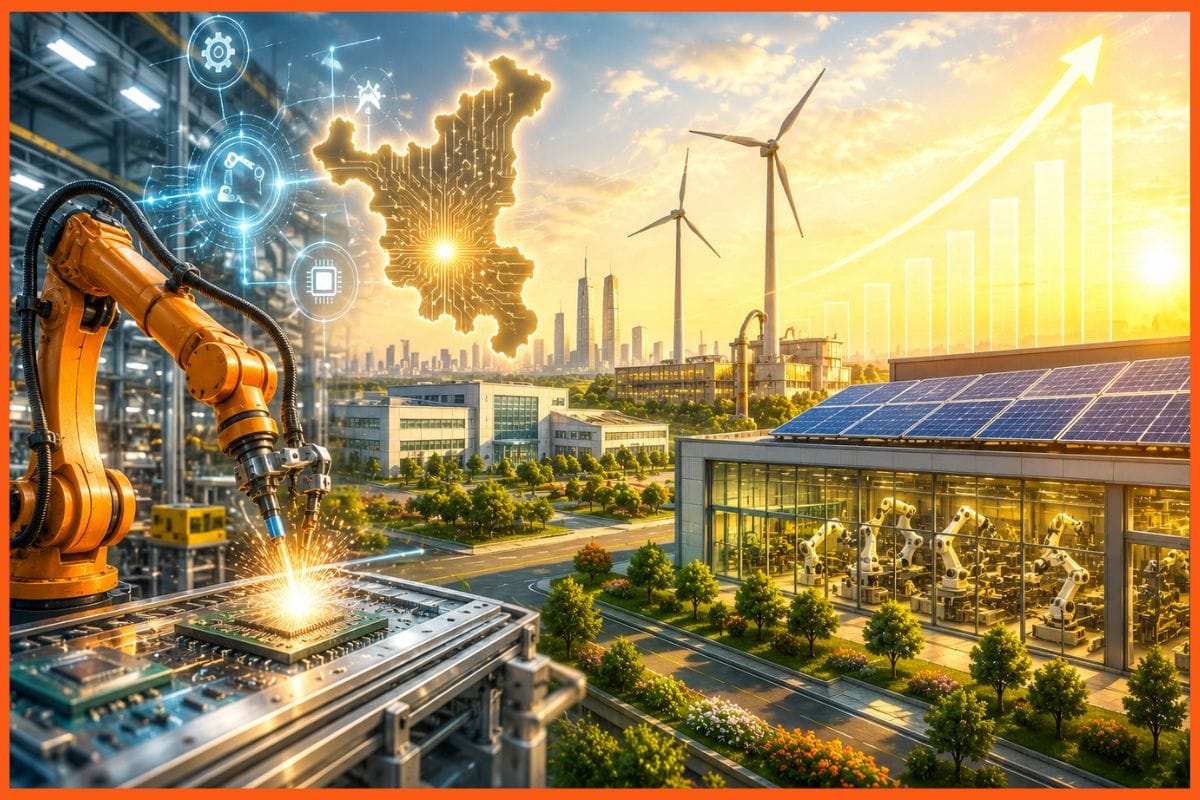
The 'Make in Haryana' Industrial Policy, an ambitious undertaking, has been unveiled by the Haryana government. Subsequently, targeting the generation of 10 lakh jobs and the attraction of INR 5 lakh Cr in investments. The move is part of the state's strategy to become a centre for global capability centres (GCCs), data centres, new technology, and future-ready manufacturing.
This strategy was one of ten new policies targeted at specific industries that Chief Minister Nayab Singh Saini unveiled today. Electric automobiles and semiconductors, as well as renewable energy initiatives, green hydrogen, textiles and clothes, automobile components, footwear, and recycling of electronic trash are all encompassed by these rules. Data centres, global supply chains, electronics, emerging markets, and advanced manufacturing are some of the next-generation businesses that the strategy aims to support.
Haryana Making Investor-Centric Policies
Officials have stated that the Gurugram non-transit-orientated development (non-TOD) zones are receiving investment priorities under the GCC and data centre policies 2026. The state also witnessed early interest from the sector, with INR 30,000 Cr in foreign direct investment (FDI) and MoUs worth 1.10 Lakh Cr being signed on the first day. Saini, speaking to investors and business tycoons, emphasised that ecosystem strength, not incentives alone, is driving the global investment climate.
According to Saini, these days, investors look at the whole picture when making decisions. Their goal is to find a state that can partner with them for long-term growth, make decisions quickly, and be trustworthy and reliable. "Speed and trust" are the guiding ideals of Haryana, he said.
The policy, as stated by the CM, signifies a change from conventional manufacturing to innovation-driven industrial expansion with an emphasis on sustainability, competitiveness, exports, and employment generation. The state of Haryana has stated that the Intelligent Investment Facilitation Portal, an AI-enabled 'Single Window 2.0' system, signifies the shift from digitisation to "intelligent governance" and is a key change under the strategy.
Sharing his views on the development, Dr. Daniel Penkar, Group Dean, ASM Group of Institutes said, "With the rapid expansion of India's data centre network, its digital transformation journey has reached a significant turning point. The development of robust data centre infrastructure is imperative to support cloud computing, artificial intelligence, digital governance, fintech, e-commerce, and emerging technologies, as data becomes the foundation of contemporary economies."
"India's increasing digital adoption is reflected in the expansion of data centres, which establish the country as a strategic global hub for data storage, processing, and innovation. We expect that this expansion will strengthen the digital ecosystem, attract investments in technology and infrastructure, and generate substantial job opportunities," added Dr. Penkar.
Echoing similar sentiment, Manoj Dhanda Founder and CEO of Utho Cloud said, "Today, global data centre and cloud infrastructure markets are getting into a more constrained phase, where rising power costs, stricter environmental rules, and limited land availability in key areas are making companies pause and rethink where future digital capacity can actually be built. In this wider global situation, India is showing up as a major growth hub for digital infrastructure. The data centre ecosystem here is also showing a bigger shift that’s already in motion, i.e., the rise of a digital-first economy. Every AI model, cloud application, digital payment, e-commerce platform, and even government digital service really leans on dependable underlying infrastructure."
|
Some Interesting Facts of the Story |
|
1.Within hours of the policy launch,
Haryana reportedly attracted FDI interest worth INR 30,000 crore and signed
MoUs valued at INR 1.10 lakh crore. 2.Haryana is positioning itself as a major
hub for Global Capability Centres (GCCs), a sector currently dominated by
cities like Bengaluru, Hyderabad, and Pune. 3.The new policy prioritizes data centres
and GCC development in Gurugram's non-TOD zones, potentially creating a new
digital infrastructure corridor in North India. |
How Policy Can Benefit Investors?
A GIS-based land identification system, an AI-powered investment blueprint generator, real-time assistance from a smart AI agent, advice during the clearance process, and policy and infrastructure support are all aspects of the portal. Instead of having to go through many departments, investors can now receive approvals, land allocation, incentives, and certifications through one integrated platform. A simpler statewide incentive structure replaces the previous A, B, C, and D block classification system, which is also eliminated by the policy.
Intrastate sales, job creation, R&D infrastructure, export turnover, and green activities will all be linked to fiscal incentives. Important incentives include a capital subsidy of up to 30%, R&D support of up to INR 50 Cr, and net state GST reimbursement. In addition, the government will double the incentives offered by central schemes, such as the production-linked reward program, by 50%.
|
Quick Shots |
|
•Haryana has launched the ‘Make in Haryana’
Industrial Policy. •The policy focuses on next-generation
sectors including semiconductors, data centres, electric vehicles, GCCs,
green hydrogen, electronics, and advanced manufacturing. •Haryana has already received investment
interest worth INR 1.10 lakh crore and FDI commitments of INR 30,000 crore. •A new AI-enabled Single Window 2.0 portal
will streamline approvals, land allocation, incentives, and certifications
through one platform. |