
India Bans Battery Black Mass Exports to Promote Domestic Lithium-Ion Recycling
India has banned export of black mass of lithium-ion batteries to boost domestic recycling and recovery of essential minerals. The DGFT wants to provide a consistent supply of battery debris to local recyclers and refiners to recover important minerals.
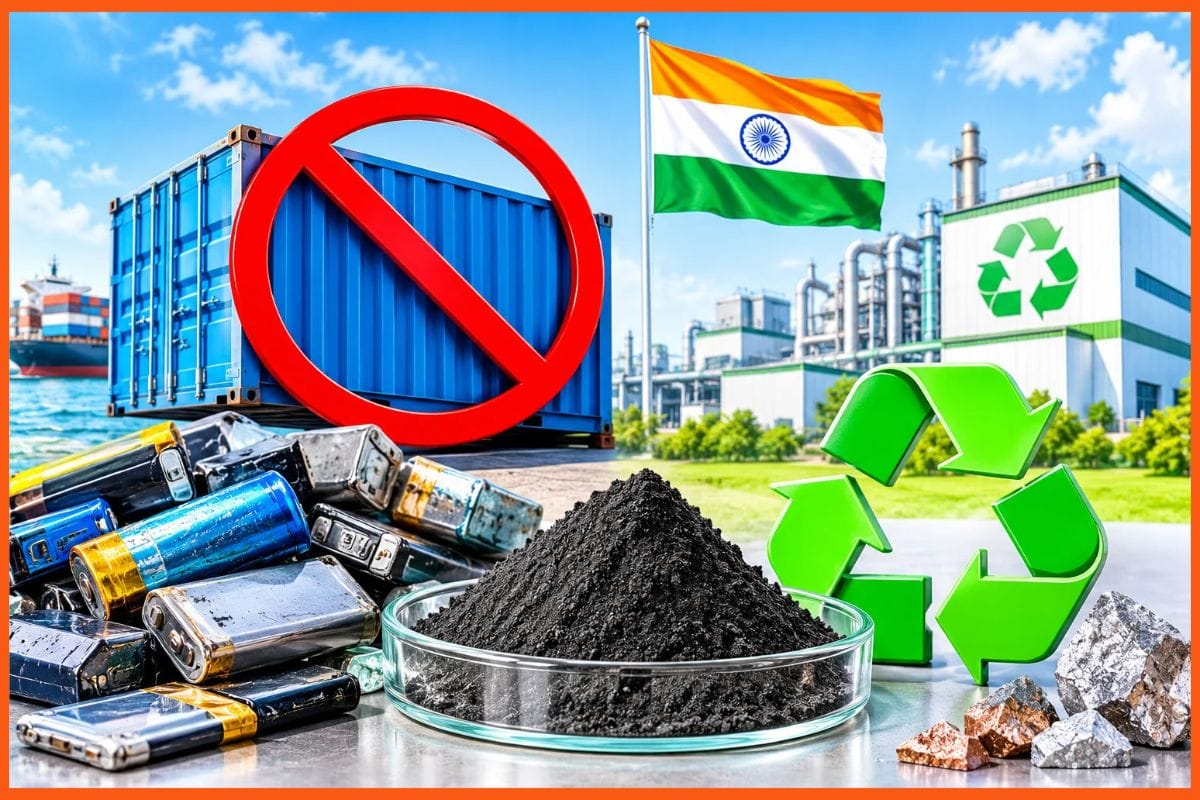
An official announcement from 11 November indicated that India has banned the export of lithium-ion battery black mass in an effort to boost domestic recycling and vital mineral recovery. When old lithium-ion batteries and other materials from their production are crushed, a powdery substance known as "black mass" is produced.
It has recoverable amounts of important minerals as manganese, nickel, cobalt, and lithium. The commerce ministry announced that in an effort to enhance local recycling and vital mineral recovery, the export of lithium-ion battery black mass has been prohibited by the Directorate General of Foreign Trade (DGFT).
Why Black Mass Essential for Energy Sector?
Electric mobility, energy storage, electronics, renewable energy, and sophisticated chemical cell batteries all rely on critical minerals as inputs. According to the announcement, India relies heavily on mineral imports for a number of these elements. Creating a domestic supply of these resources can be accomplished quickly and sustainably through recycling battery waste.
Inadequate feedstock availability is preventing the country from fully utilising its expanded capability to recycle battery waste and extract essential minerals from it. Even while domestic recyclers have occasionally had to purchase material to fulfil their needs, exports of black mass produced in India send this precious secondary resource abroad. The purpose of the export ban is to keep black mass produced in India for domestic recycling and refining.
DGFT Backing Vocal for Local
The goal of the policy is to provide a steady supply of feedstock for home recycling and refining units, increase the efficiency with which they use their capacity, and entice new investors and workers to the industry. It will lessen reliance on imports and the resulting outflow of foreign currency by increasing domestic recovery of vital minerals such as nickel, cobalt, and lithium.
Corresponding with Aatmanirbhar Bharat's goal, it will also fortify supply chains related to electric car production, energy storage, clean-energy technology, and battery production. Additionally, the initiative will promote 'urban mining' and the circular economy, which will lessen the need for primary mining. In line with relevant environmental standards, it will also encourage ecologically responsible recycling of this dangerous substance domestically. This step is in addition to the INR 1,500-crore Incentive Scheme and other government programmes run by the National Critical Mineral Mission (NCMM).
An increasing amount of wasted lithium-ion batteries are being produced by India's electronics manufacturing sector and electric automobile fleet. Along with this growth, a large amount of battery scrap that was previously shipped out in unprocessed or partially processed black mass form because of a lack of refining capacity at home is now being refined. This type of battery scrap and garbage was previously eligible for export under the 'Free' category; however, that privilege has been revoked.