Asian Markets Crash as Iran War Escalates: Nikkei Plunges 3,000 Points, Kospi Drops 7% as Oil Surges Past $100
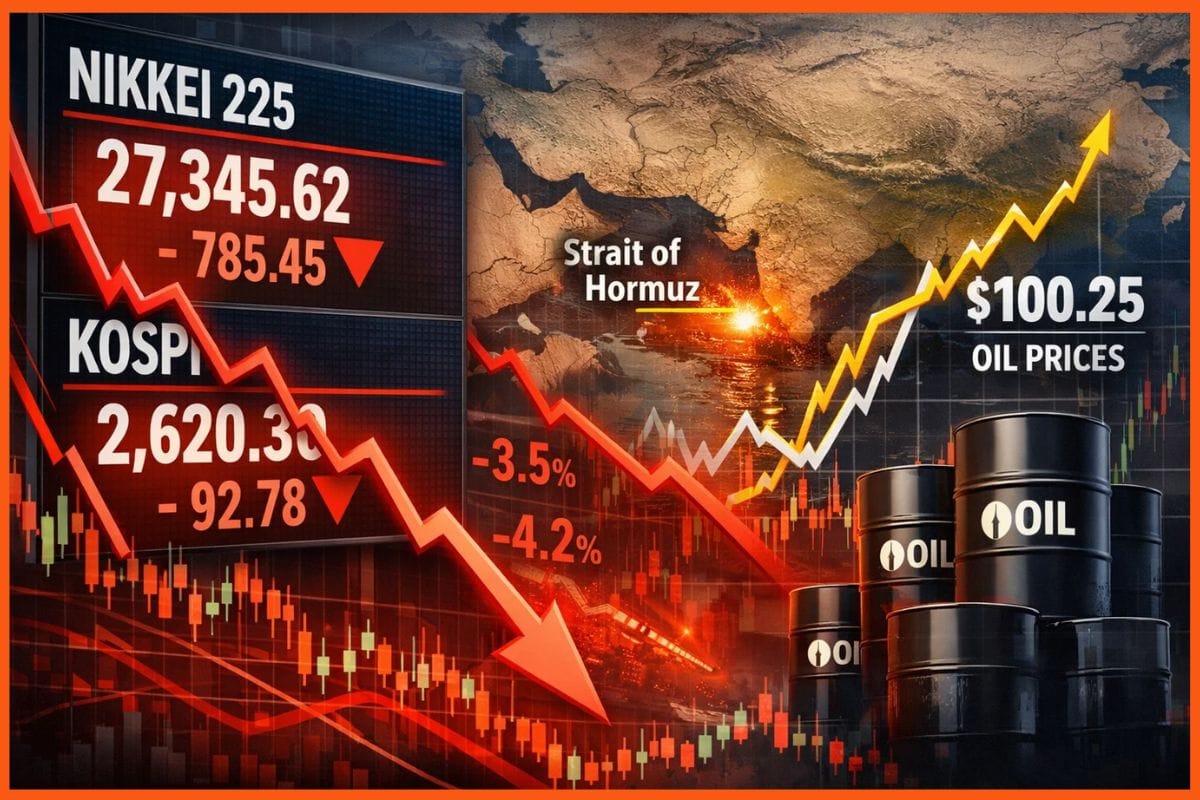
Asian stock markets saw a sharp sell-off on Monday, 9 March 2026, as escalating conflict involving Iran triggered a surge in global oil prices and rattled investor confidence. Major indices across the region fell steeply, with Japan and South Korea recording some of the biggest declines.
The market turmoil comes as fears grow over disruptions to global oil supply, particularly after tensions in the Middle East intensified, and shipping through the critical Strait of Hormuz faced major disruptions.
Asian Stocks Slide Sharply as Investors React to Iran War
Stock markets across Asia opened deep in the red on Monday, reflecting growing uncertainty in global markets.
Japan’s Nikkei 225 index dropped more than 6%, falling by roughly 3,000-3,600 points during early trading. South Korea’s Kospi index recorded an even sharper fall of around 7-8%, marking one of its steepest declines in recent years.
Other regional markets also followed the downward trend. Hong Kong’s Hang Seng Index fell about 2-3%, while markets in Australia and New Zealand also opened significantly lower as investors rushed to move away from riskier assets.
The sell-off reflects rising concerns that the ongoing conflict could disrupt trade and energy supplies, which are crucial for many Asian economies that rely heavily on imported oil from the Middle East.
Technology and semiconductor stocks were among the hardest hit during the session, dragging indices lower as investors reassessed economic risks linked to rising energy prices and geopolitical instability.
Oil Prices Surge Above $100 as Strait of Hormuz Disruption Sparks Supply Fears
The biggest trigger behind the market crash was the sharp spike in crude oil prices.
Global oil benchmarks surged past the $100 per barrel mark for the first time since 2022. Brent crude climbed above $110 and even approached $117 during trading, while US benchmark West Texas Intermediate (WTI) also crossed $110.
The surge came after the conflict in the Middle East intensified over the weekend, raising fears that oil shipments through the Strait of Hormuz, one of the world’s most critical energy routes, could be severely disrupted. Around 20% of the global oil supply normally passes through this narrow shipping lane.
Reports suggest tanker traffic through the strait has slowed dramatically due to security risks, while some producers in the region have started curbing output amid growing uncertainty. Analysts warn that continued disruption could tighten global supply further and push energy prices even higher.
Global Markets and Economies Brace for Impact
The ripple effects of the crisis are being felt across global financial markets.
Higher oil prices are raising concerns about inflation and slower economic growth, particularly in Asia, where countries such as Japan and South Korea depend heavily on imported energy. Some analysts say the sudden rise in energy costs could hurt manufacturing, transportation and overall economic activity in the region.
The impact is also spreading beyond Asia. Indian markets also opened sharply lower, with the Sensex dropping more than 2,000 points and the Nifty 50 falling below the 24,000 mark amid the global risk-off sentiment.
Currencies and commodities have also reacted to the crisis. Investors have moved towards safer assets such as the US dollar and government bonds, while oil and energy stocks have seen increased volatility.
What Investors Are Watching Now
Market participants are closely monitoring developments in the Middle East, particularly the status of shipping through the Strait of Hormuz and any potential diplomatic moves to ease tensions.
Energy analysts warn that if the conflict continues to escalate or if oil exports from the Gulf are disrupted further, prices could climb even higher and trigger broader volatility across global financial markets.
For now, markets remain highly sensitive to geopolitical headlines, with investors bracing for further swings in oil prices and global equities as the situation unfolds.
 StartupTalky News