Nvidia Launches World’s First PCs Designed Specifically for AI Agents
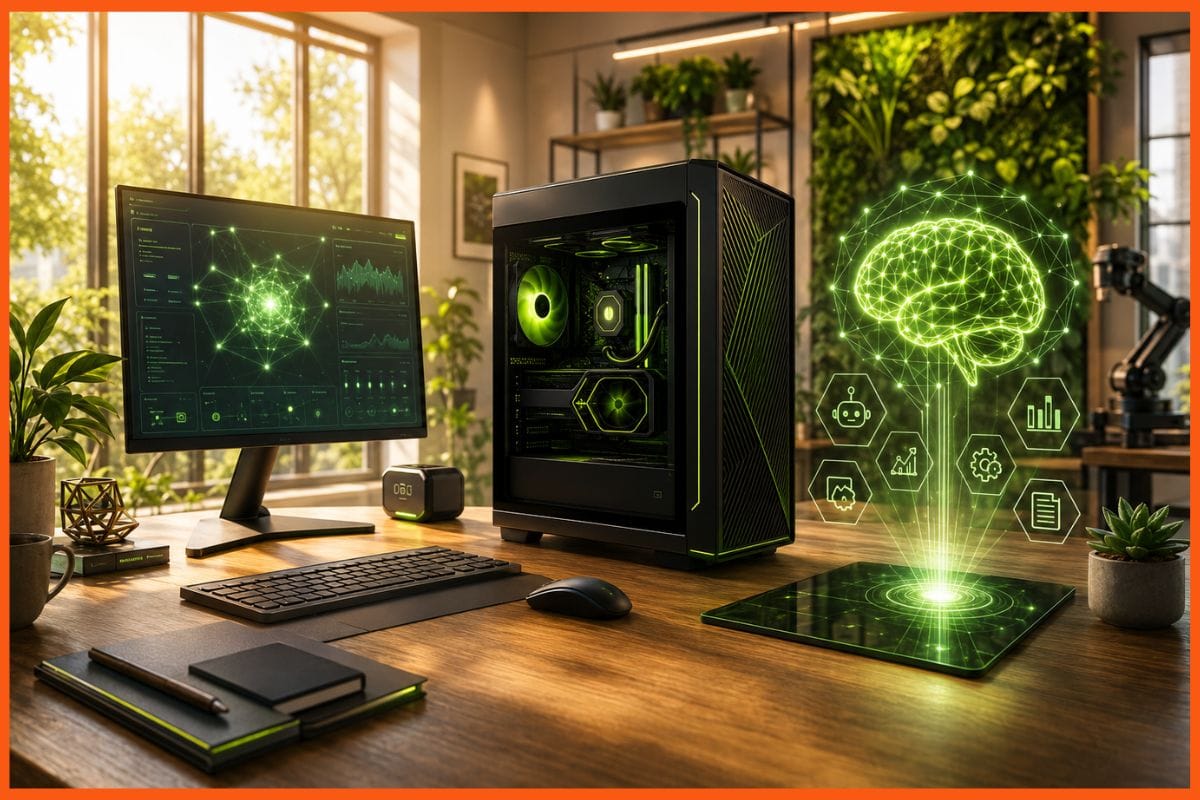
The first personal laptop computers designed for the operation of artificial-intelligence "agents" were unveiled by Nvidia. These computers utilise a newly developed variant of the company's signature AI chips. New personal computers will have a thickness of no more than 14 mm and a weight of less than 3 kg.
The laptops will be assembled by Nvidia in collaboration with six different manufacturers: MSI, Dell Technologies, Lenovo Group, Microsoft, HP, and Asus. The RTX Spark, introduced by Nvidia as the most efficient PC processor ever manufactured, will power the new machines. The new processors, derived from Nvidia's GPU, will be used in 30 laptop models and approximately 10 desktop models in the long run.
Nvidia Enhancing its AI Network
Presented at the Computex conference in Taipei, the announcement highlights the rapid transformation taking place in the tech industry due to the advent of so-called AI agents. According to Mark Aevermann, Nvidia's senior director of product development, the processor will be integrated into PCs that are intended for gamers, AI developers, and creators and will be priced at the premium end of the market. The new PC was announced by Nvidia as part of a larger change in AI computing, according to the company.
Over the past few years, major AI research centres have centred on two main areas: (1) training massive language models and (2) efficiently running these models through inference, which enables them to answer user queries. The focus of AI is now shifting away from people. Nvidia and other tech businesses have had to adjust their marketing strategies and product development processes in response to the rise of tens of millions of AI agents, or multitasking autonomous bots.
Despite the fact that Nvidia became the most valuable business in the world due to the demand for GPUs used to train AI models, CPUs are still crucial for agentic computing. According to Nvidia, chatbots like OpenAI's ChatGPT, Google's Gemini, and Anthropic's Claude will replace humans for most AI-related tasks.
|
Some Interesting Facts of the Story |
|
1.The launch reflects the shift from AI
chatbots to AI agents, which can independently perform tasks, make decisions,
and manage workflows. 2.AI-powered PCs could allow users to run
advanced AI applications locally, reducing reliance on cloud computing and
improving privacy and response times. 3.The launch signals that the future of
personal computing may revolve around AI-first devices rather than
conventional PCs. |
AMD Inching Closer to Nvidia
With an investment of over $10 billion, Advanced Micro Devices plans to significantly increase its footprint in Taiwan. Therefore, in an effort to catch up to Nvidia in the rapidly expanding market for artificial intelligence chips, it is strengthening relationships throughout the island's semiconductor ecosystem. The American semiconductor manufacturer revealed its partnership with many Taiwanese firms on May 21.
These firms include Inventec, Wiwynn, Sanmina, Powertech Technology, ASE Technology and its SPIL subsidiary, and Sanmina. This is an effort by AMD to increase their packaging capacity and create AI systems and CPUs with better power efficiency. At its core, the investment revolves around AMD's Venice CPU series, which is being made using Taiwan Semiconductor Manufacturing Company's cutting-edge 2-nanometre processes.
|
Quick Shots |
|
•Nvidia has launched the world’s first PCs
specifically designed to run AI agents and autonomous AI applications. •The new systems are powered by RTX Spark,
which Nvidia describes as its most efficient AI PC processor to date. •Six major manufacturers—Dell, HP, Lenovo,
Microsoft, Asus, and MSI—will build the new AI-powered devices. •The AI PCs will be ultra-portable,
weighing less than 3 kg and measuring under 14 mm in thickness. |