

The 18-Month Market Mystery: Is Your Portfolio in a 'Dead Zone' or Primed for a Boom?

For many investors, the past 18 months have felt like a financial purgatory. The market, a once-reliable engine of growth, appears to have stalled, leaving many to wonder: Is this the new normal, or simply the calm before a storm? A recent LinkedIn post by prominent financial voice Radhika Gupta ignited a fervent debate, cutting through the noise to offer a historical perspective that challenges conventional anxieties.
Gupta's central thesis? These periods of apparent market stagnation – what some are calling the "dead zone" – are not anomalies but rather recurring chapters in the market's long story. And crucially, history suggests they often precede significant upswings.
Unpacking the Past: When Flat Markets Lead to Explosive Growth
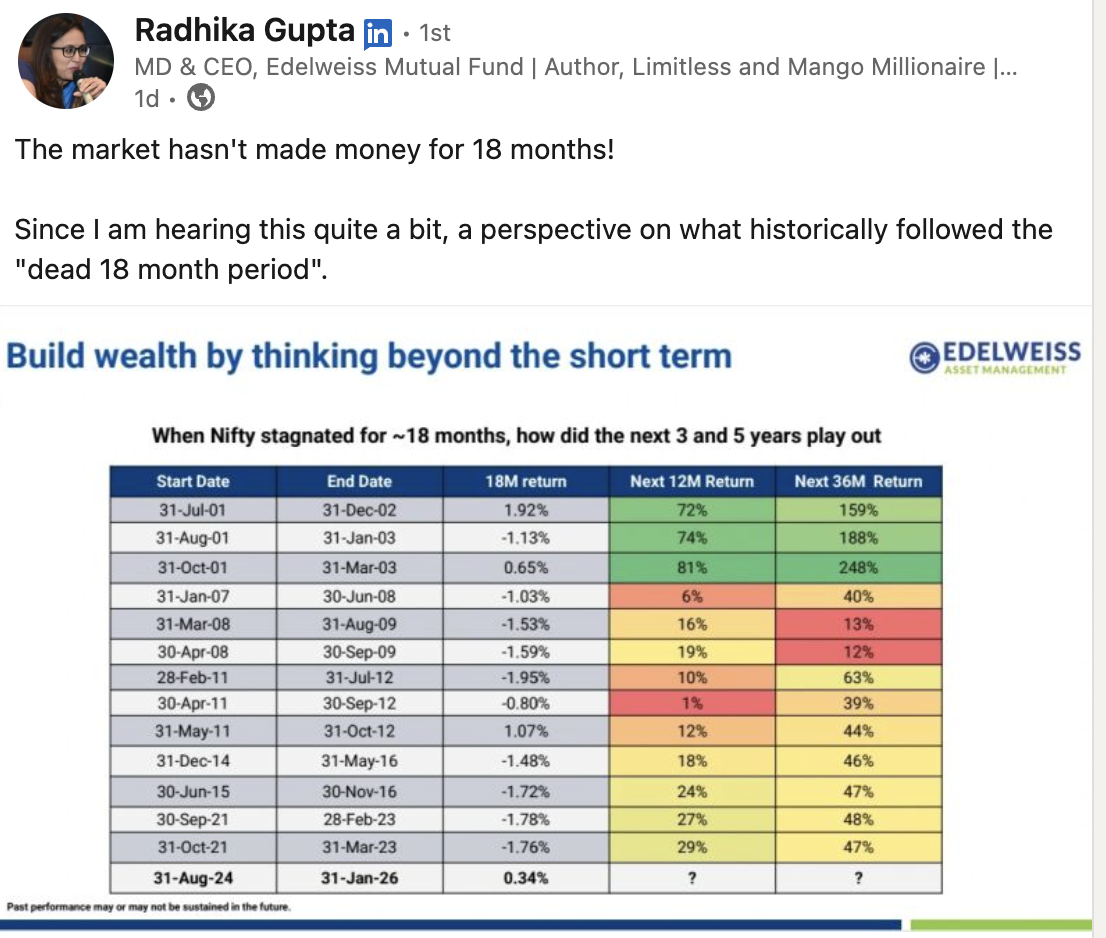
To understand the present, we must look to the past. Data from Edelweiss Asset Management, highlighted in Gupta's post, paints a compelling picture. It reveals that after prolonged periods where the Nifty index seemingly went nowhere, it often roared back with impressive force. Consider these historical snapshots:
- 2001-2003: An 18-month stretch yielding a mere 1.92% return was followed by a staggering 159% surge over the next three years.
- 2001-2003 (another instance): A -1.13% dip over 18 months ultimately paved the way for a 188% rebound in the subsequent 36 months.
- 2021-2023: More recently, a -1.76% return over 18 months transformed into a robust 47% gain in the following three years.
The current forecast for August 2024 to January 2026 shows a modest 0.34% return. If these historical patterns hold, investors might be standing on the precipice of another substantial growth phase.
The 'Fair Value' Reset: Why Stagnation Can Be Healthy
Beyond mere historical cycles, there's a deeper economic logic at play. As one astute commenter, Jayendra Singh, pointed out, the recent market lull could be a necessary "digestion" period. The Nifty, for instance, rocketed from approximately 12,000 in January 2020 to 26,000 by September 2024. This translates to an eye-popping Compound Annual Growth Rate (CAGR) of around 17.5% – significantly outpacing India's long-term average of 11-12%.
Such meteoric rises often demand a period of consolidation. The market, in essence, is recalibrating, returning to its "fair value" after an extended period of hyper-growth. Even stretching the timeline to March 2026, with the Nifty projected around 24,800, the 6-year CAGR settles near 12.3%, aligning perfectly with the long-term trend. This isn't a market in distress; it's a market catching its breath, potentially gearing up for its next powerful ascent.
The Investor's Crucible: Patience, Psychology, and the 'Farmer's Wisdom'
These flat periods are the ultimate test of an investor's mettle. It's easy to stay invested when the numbers are soaring, but the true challenge lies in enduring the quiet times. Radhika Gupta herself invoked the timeless wisdom of a farmer: you plant the seeds, you nurture them, and you trust them to grow. You don't dig them up every week to check for progress.
Yet, the temptation to abandon ship is strong. Many investors, fueled by anxiety, pull out of Systematic Investment Plans (SIPs) or chase perceived safety in gold or fixed deposits. This emotional response, however, often proves costly. As the adage goes, "time in the market usually beats timing the market." Discipline, not panic, is the investor's most valuable asset during these phases.
The Counter-Narrative: Risks, Realities, and the Unpredictable Future
While historical optimism is reassuring, a healthy dose of skepticism is vital. The comments section of Gupta's post also highlighted crucial counterpoints. Some argued that 18 months might be just the beginning of a much longer correction, citing the Nifty's nearly 37% fall over 38 months between 2000 and 2003. This suggests that the "dead period" could extend far beyond current expectations.
Others raised concerns about macro-economic and geopolitical instability, with one commenter starkly noting that "past 12, Next 18 go out the window when one nuke flies." The rapid evolution of technology, particularly Artificial Intelligence (AI), also presents a wildcard. Concerns were voiced that AI could disrupt established business models, eroding profitability in certain sectors and leading to zero or even negative returns, irrespective of historical market cycles. These perspectives underscore the enduring importance of diversification and a cautious, adaptive investment strategy.
The Verdict: Navigating the Nuances of Modern Investing
The current market landscape is complex, a tapestry woven with historical patterns, economic fundamentals, and unpredictable global forces. Radhika Gupta's post serves as a powerful reminder that perceived stagnation is often a prelude to growth, a necessary recalibration after periods of intense activity. Yet, the robust discussion in the comments highlights that investors must remain vigilant, acknowledging the potential for extended corrections and the disruptive power of new paradigms.
For the savvy investor, the path forward involves a blend of patience, discipline, and strategic diversification. Understanding that market cycles are inevitable, and possessing the fortitude to weather the quiet spells, are paramount. In this intricate dance between historical precedent and an uncertain future, a balanced approach remains the most potent tool for long-term wealth creation.