

Turning Temple Waste Into Opportunity: How Nidhi Sabbarwal Is Building a Circular Economy With Kalyanamm
📰 NewsIn StartupTalky’s International Women’s Day series, Nidhi Sabbarwal explains how Kalyanamm transforms temple floral waste into sustainable products while creating livelihood opportunities for women and contributing to India’s growing circular economy.
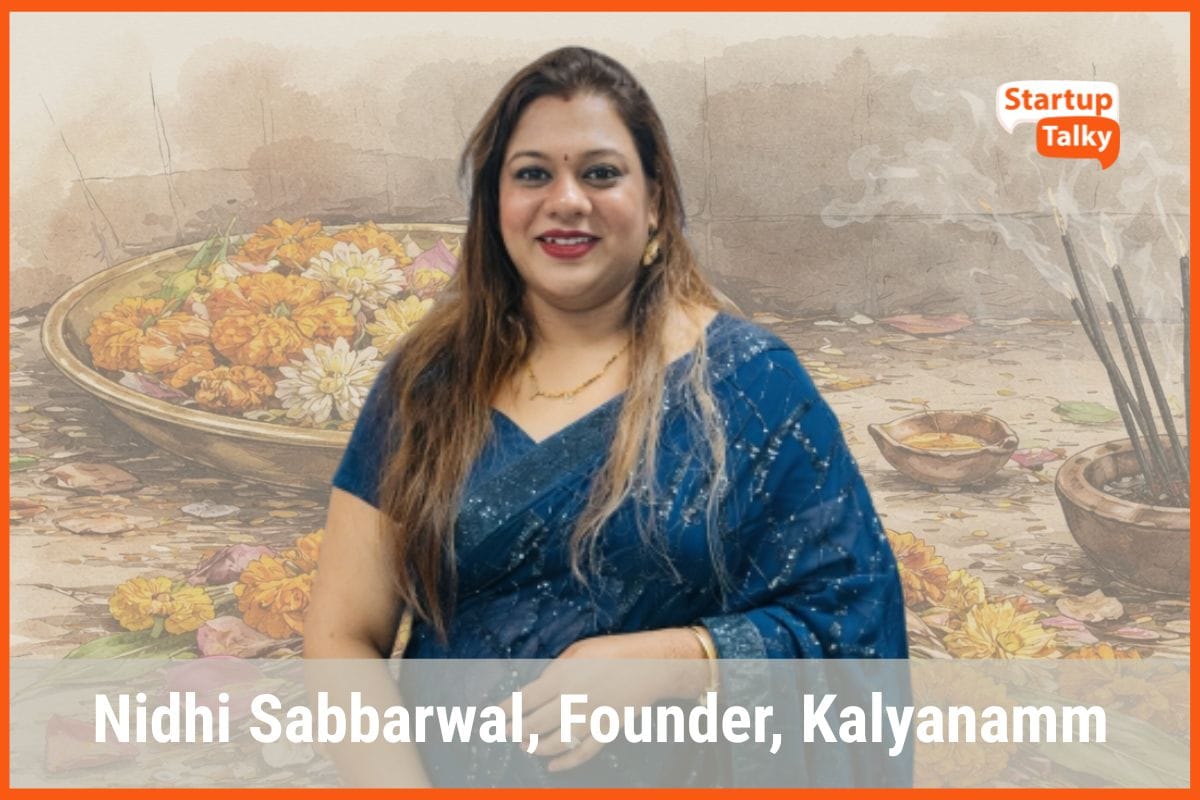
As part of StartupTalky’s International Women’s Day series, we highlight women entrepreneurs building impactful and sustainable businesses. In India, temples and religious ceremonies generate over 300 tons of floral waste every day, much of which ends up in rivers and landfills, posing a major environmental challenge. At the same time, the Indian circular economy is projected to reach over $2 trillion by 2050, creating nearly 10 million jobs.
A key segment benefiting from this shift is the incense sticks (agarbatti & dhoop) market, valued at USD 1.3 billion in 2025 and expected to reach USD 2.2 billion by 2034, driven by growing demand for sustainable and eco-friendly products. At the intersection of sustainability and social impact is Kalyanamm, founded by Nidhi Sabbarwal, which converts sacred floral waste into valuable products while empowering women through a decentralized production model.
Seeing Waste as a Resource: The Origin of Kalyanamm
StartupTalky: You founded Kalyanamm in the waste recycling space and have built it largely single-handedly. What early decisions shaped your journey, and what convinced you that recycling temple flower waste could become a scalable and sustainable business model?
Nidhi Sabbarwal: In the early stages of creating Kalyanamm, one of the most important decisions was to look at waste not in terms of disposal but in terms of resource conversion. Visiting temples and seeing how much waste was being thrown away in terms of flowers made me understand the impact of devotion on the environment and also how much untapped potential was available in waste.
I decided to focus on creating a recycling model that could convert this waste into something meaningful and yet keep its sanctity intact. What convinced me of its scalability was seeing how much waste was being thrown away in terms of flowers every day, and how much people cared about sustainable consumption.
Addressing India’s Floral Waste Challenge
StartupTalky: India generates significant quantities of floral waste daily from temples and ceremonies, much of which ends up in rivers and landfills. How do you see Kalyanamm’s work contributing to solving this environmental challenge, and why is your model particularly relevant in today’s sustainability-focused economy?
Nidhi Sabbarwal: India has an enormous volume of floral waste generated daily from temples and other religious ceremonies, and unfortunately, a major portion of it finds its way into polluting our water bodies or landfills.
At Kalyanamm, what has been attempted here is to channelize this sacred waste into a circular value chain in which flowers are recycled into incense sticks, organic colors, and other socially conscious products.
The concept seems to be particularly relevant in today’s times because sustainability has become imperative rather than optional; everyone, consumers and businesses alike, is looking for solutions to social issues like never before.
The Innovation Behind Recycling Temple Flowers
StartupTalky: Recycling flower waste into usable products is both an environmental and cultural intervention. Can you walk us through the process innovation behind transforming discarded flowers into market-ready products, and the challenges you faced in formalising this segment?
Nidhi Sabbarwal: The process of converting discarded flowers from temples into products for the market was a process of innovation, and understanding the importance of the product in the culture of the nation.
The first process was to establish a systematic network for collecting these flowers from temples, thereby separating them before they are discarded. The flowers are then cleaned and dried to obtain the natural products from them, which can be utilized to make incense sticks, dhoop, and other eco-friendly products.
The biggest challenge in this was to formalize an unorganized sector of the industry, creating awareness and setting up proper norms for the same. Over time, this concept has been able to transform into a circular economy.
Circular Economy and the Rise of Sustainable Consumption
StartupTalky: With increasing policy emphasis on circular economy practices and ESG-led business models, how do you see consumer behaviour and institutional partnerships evolving in the waste recycling industry, particularly for niche segments like floral waste?
Nidhi Sabbarwal: With the increased focus on a circular economy model and ESG-based business practices, consumer behavior is slowly but steadily moving in favor of a more conscious consumption model.
People today want to understand the story behind a product before consuming it. They are looking for options that are sustainable for the environment.
This is creating a situation where institutions, temples, and organizations are looking for sustainable waste management partnerships. In a market niche such as flower waste recycling, this is an essential aspect since it begins with the source.
When consumers embrace sustainable products and organizations adopt responsible waste disposal practices, a healthy ecosystem is achieved where sustainability, tradition, and business can coexist in a meaningful way.
Building a Women-Led Decentralised Production Model
StartupTalky: Kalyanamm operates with an all-women workforce and provides work-from-home manufacturing opportunities. How have you structured this decentralised production model to ensure quality control, operational efficiency, and sustainable income generation for women?
Nidhi Sabbarwal: The decentralized production model, as implemented at Kalyanamm, focuses on striking the right balance between livelihood creation and operational discipline.
Women associated with the initiative undergo training on standard operating processes for drying, mixing, and shaping floral waste into incense sticks and other related products.
We provide women with curated raw materials, production guidelines, and periodic quality control measures to ensure consistency across batches of production, even if they are small-scale production clusters.
The aim is to provide women with dignified livelihood opportunities while working from home, without compromising on product quality or the sustainability narrative of the initiative itself.
Leadership and Building a Purpose-Driven Enterprise
StartupTalky: Building and managing a women-led enterprise in a traditionally unorganised recycling sector comes with its own set of challenges. What leadership principles have guided you while balancing social impact with commercial viability?
Nidhi Sabbarwal: To create a women-centric business in the unorganized sector, one needs to be patient and should have an idea in mind. Also, a good value system is a must.
My leadership style is always to lead with empathy, transparency, and accountability. Although the social aspects of women's empowerment and reduction of flower wastage are important for me, making it commercially viable is also important for taking it forward in the long run.
I try to build processes in place and encourage skill development and a sense of ownership in the women involved with me.
If people feel valued and are financially sound, they are always willing to contribute to the cause with complete dedication and commitment. For me, leadership means creating a model that allows purpose and profitability to grow in tandem.
The Future of Waste Innovation and Women Entrepreneurship
StartupTalky: As conversations around climate responsibility and women-led entrepreneurship gain momentum, what is your long-term vision for Kalyanamm, and how do you see the intersection of waste innovation and women empowerment evolving in India over the next decade?
Nidhi Sabbarwal: The long-term vision for Kalyanamm is a scalable model for a circular economy that converts floral waste into meaningful, eco-conscious products, providing dignified livelihoods for women.
As climate responsibility takes center stage in the national and international agendas, waste innovations are likely to play a significant role in defining sustainable industries in the future.
I foresee that in the coming decade, there will be a greater convergence between environmental entrepreneurship and women's entrepreneurship, particularly in the grassroots segments in India.
Women are likely to emerge as agents for the green economy, helping convert environmental problems into sustainable business opportunities with significant social impact.
 Shalini Rath