

How Nikita Kumawat Built Brandworks with 70% Women Workforce in Electronics Manufacturing
📰 NewsIn this interview, Nikita Kumawat talks about building Brandworks Technologies from scratch, scaling to 40+ brands, and creating a 70% women-led workforce. She shares insights on design-led manufacturing, supply chains, and India’s growing electronics ecosystem.
India’s electronics manufacturing industry is witnessing a significant transformation, driven by initiatives like Make in India and the Production Linked Incentive (PLI) scheme. The sector is projected to surpass $300 billion by 2026, with exports expected to cross $120 billion, positioning India as a key global manufacturing hub. Increasing localisation, supply chain resilience, and design-led innovation are reshaping the ecosystem, creating opportunities for new-age manufacturers like Brandworks Technologies.
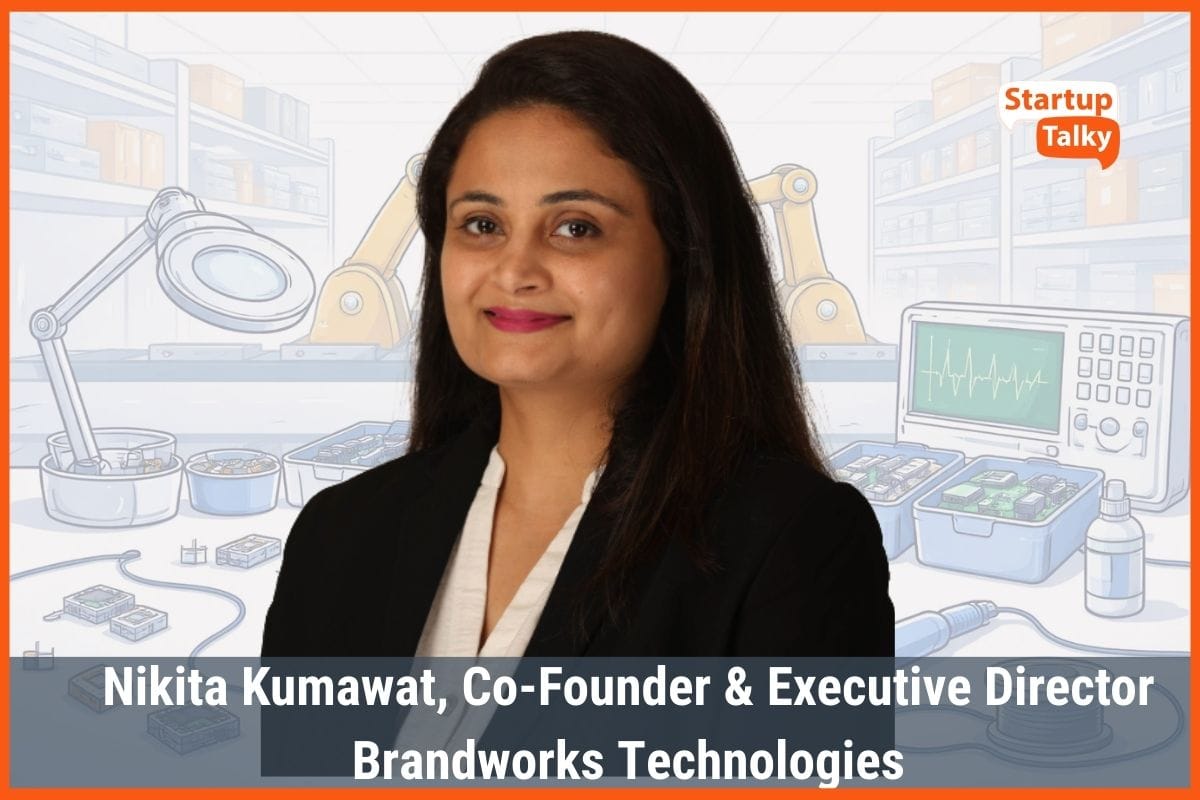
As part of our International Women’s Day special series, this conversation highlights the inspiring journey of Nikita Kumawat, Co-Founder & Executive Director of Brandworks Technologies. She shares how she transitioned from corporate leadership to building a design-first OEM/ODM electronics company, and how she is redefining manufacturing with a people-first approach and a 70% women-led workforce.
From Corporate Comfort to Manufacturing Courage
StartupTalky: You transitioned from corporate roles at Tata Communications, Tech Mahindra, and EY into building Brandworks Technologies from the ground up. What triggered that shift into manufacturing, and what early decisions helped you move from a small power-bank unit to a full-stack OEM/ODM electronics partner?
Nikita Kumawat: Moving from corporate to manufacturing wasn’t an impulsive decision; it was deeply personal. During my years at Tata Communications, Tech Mahindra, and EY, I saw that even for simple electronics, India was dependent on importing hardware. There was a gap between India’s talent and its manufacturing confidence, and that gap pushed me to leap.
We started small with power banks to understand the nuts and bolts of manufacturing, sourcing, assembly, quality control, and distribution. At the beginning, we decided to focus on design capability rather than just assembly. We began by investing in R&D, thus building strong vendor relationships. It helped us evolve into a full-stack OEM/ODM partner. The idea was simple; if we control design and quality, scale will follow.
Riding the Make in India Wave with a Design-First Approach
StartupTalky: India’s electronics manufacturing sector is expanding rapidly under the Make in India and PLI initiatives, with increasing focus on localisation and supply chain resilience. How has Brandworks positioned itself within this evolving ecosystem?
Nikita Kumawat: India’s electronics manufacturing ecosystem is growing by leaps and bounds under Make in India and PLI initiatives. With a strong focus on localisation, strengthening domestic supplier networks, and reducing import dependence, Brandworks is positioned as an end-to-end design-led manufacturing partner.
To reinforce the customer trust in Brandworks, we have invested in product development, testing, and quality systems, all in-house. The supply chain disruptions during the pandemic further cemented the importance of a resilient supply chain, diversification of resources, and better operational planning.
Today, we take pride in saying that we support brands not just to manufacture in India for domestic markets but also for global markets.
Breaking Barriers in a Male-Dominated Industry
StartupTalky: Manufacturing, especially electronics hardware, remains largely male-dominated. What were the biggest operational and perception challenges you faced as a woman founder entering this space, and how did you overcome them?
Nikita Kumawat: Entering electronics manufacturing as a woman founder came with a lot of challenges. In the early days, vendors, factory contractors, and even clients would often direct technical questions to my male colleagues, assuming I was handling only the business side.
Operationally, factory setups are intense, with long hours, negotiations, and constant troubleshooting. The challenge was to earn respect not by asserting authority, but by demonstrating technical understanding and consistency in decision-making.
Over time, results changed mindsets. When clients saw quality benchmarks being met and deliveries happening on time, the conversation shifted from ‘woman founder’ to ‘reliable manufacturer.’ I’ve learned that credibility in manufacturing isn’t given; it’s built daily through execution. Once you prove your capability, gender becomes secondary, as it should be.
Why a 70% Women Workforce is a Business Advantage
StartupTalky: Brandworks has consciously built a workforce with over 70% women, including on the shop floor. What drove this decision, and what measurable impact have you observed on productivity, quality control, and workplace culture?
Nikita Kumawat: I’ve always believed manufacturing floors don’t need to be male-dominated; they need to be disciplined, detail-oriented, and process-driven, and so the decision to build a workforce with over 70% women was intentional. Women bring incredible focus and consistency, especially in precision assembly and quality checks. But beyond capability, it was also about access. Many skilled women in semi-urban areas don’t get formal employment opportunities. We wanted to change that.
The impact has been quite measurable. We’ve seen stronger quality control metrics, lower exit rates, and a more collaborative work environment. Productivity improved because teams are stable and accountable. Culturally, the factory feels balanced, structured, and growth-oriented. For me, inclusion isn’t a social initiative; it’s a smart business decision that delivers real operational results.
Scaling with People-First Leadership in Manufacturing
StartupTalky: As you scaled to serving 40+ brands and employing over 1,000 people, how did you balance operational efficiency with a people-first leadership approach in a cost-sensitive manufacturing environment?
Nikita Kumawat: I came to observe that people-first leadership and operational efficiency are not mutually exclusive; rather, they support each other. To maintain balance between both, we concentrated on funding skill development, standardising procedures, and giving frontline leaders decision-making authority in a cost-sensitive manufacturing setting, and that was a game-changer. It not only increases accountability but also increases productivity, and waste decreases when teams feel empowered and heard.
We implemented performance-linked growth paths, maintained transparent communication, and organised training programs to ensure consistency in efficiency and to make sure it did not come at the cost of morale.
Design, Speed, and Supply Chain: The New Manufacturing Playbook
StartupTalky: With global brands increasingly demanding design-led innovation and faster go-to-market cycles, how is Brandworks integrating R&D, product design, and supply chain agility to stay competitive?
Nikita Kumawat: Speed today is not just about manufacturing faster; it’s about thinking, designing, and building in sync. At Brandworks, we've moved from a linear paradigm to a completely integrated one in which production, design, and R&D all develop simultaneously from the start. Our in-house engineering teams collaborate directly with over 50 tooling ecosystems and international design partners to customise solutions at the BOM level, allowing for faster launches and increased productivity.
We have also embedded DFMA (Design for Manufacturing & Assembly) and active manufacturing practices into our processes to shorten development cycles while maintaining cost discipline. On the supply side, localised sourcing networks and digital systems have reduced sourcing time by nearly 30%, helping us stay responsive to global demand without compromising reliability.
Women Leaders Shaping the Future of Manufacturing
StartupTalky: Looking ahead, as India aims to become a global electronics manufacturing hub, what role do you believe women leaders will play in shaping the next phase of industrial growth, and how can more women be encouraged to enter hardware and manufacturing entrepreneurship?
Nikita Kumawat: Women leaders will play a very crucial role in shaping the next phase and how the sector approaches talent, innovation, and scale. Speaking from our experience at Brandworks, we have over 70% of the workforce and many supervisory roles that are held by women. We've seen how diversity has improved quality, problem-solving, and the entire atmosphere on the factory floor.
Real change begins when we promote genuine success stories and create workplaces in which women feel protected, valued, and encouraged to further their careers. If we want more women to enter the hardware and manufacturing industries, we must look beyond motivation and focus on access, practical training, obvious leadership possibilities, and early exposure to engineering and entrepreneurship. When women can see a clear route forward and have the necessary support system, their engagement will naturally increase. The future of manufacturing will be driven not only by technology, but also by talent, with women leading the way.
 Avantika Bhardwaj