Oura Raised $900M at an $11B Valuation. Four Days Later, It Got Sued Over the Science Behind the Ring
A proposed class action says Oura's "95% accurate" sleep-stage claim is closer to a coin flip. It lands weeks after the company added Eli Lilly as an investor and took on a $900 million bank facility — the kind of move companies make right before an IPO.
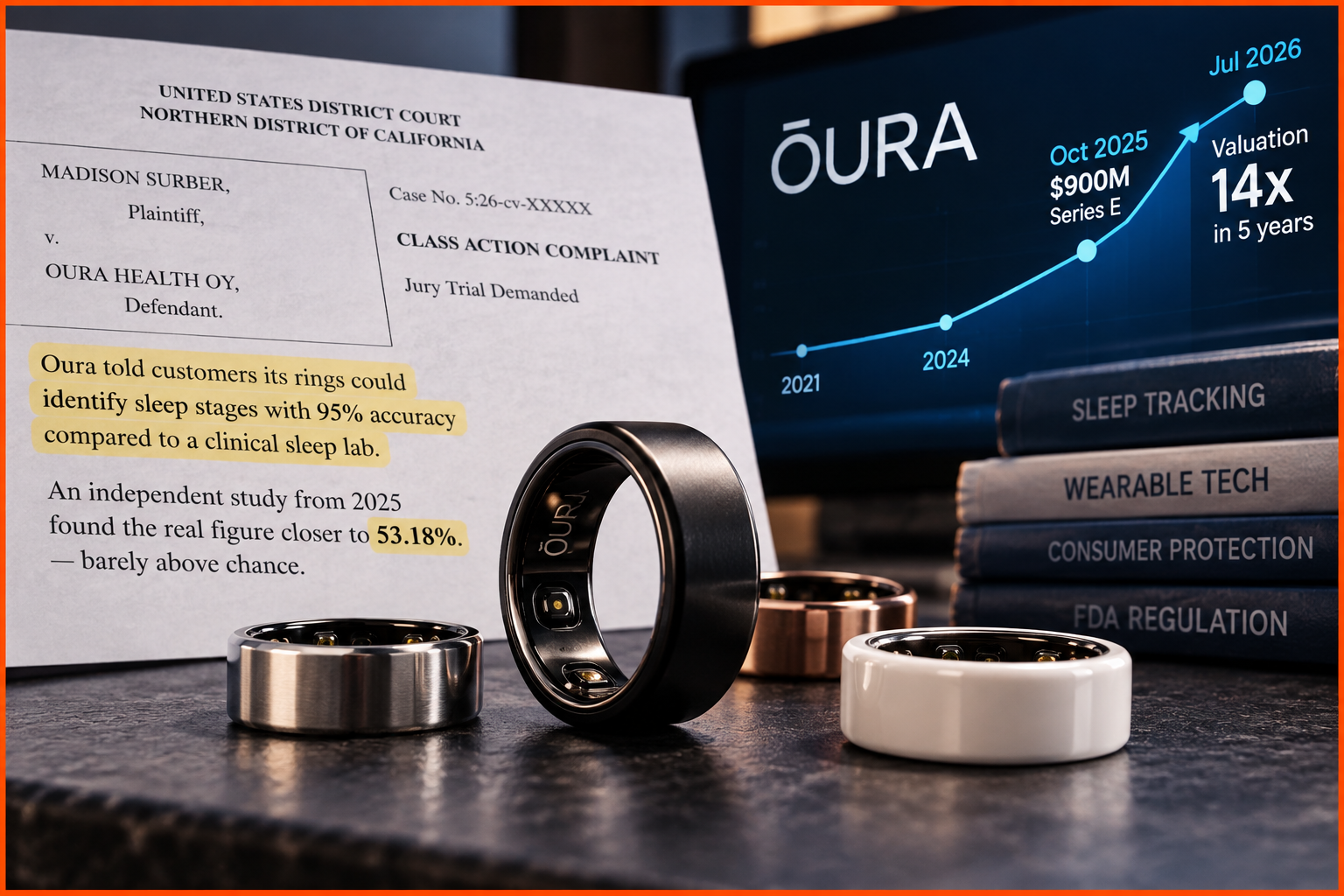
On 20 August 2026, a California resident named Madison Surber filed a proposed class-action lawsuit against Oura in the U.S. District Court for the Northern District of California. The complaint, brought by Clarkson Law Firm, targets the Oura Ring 4, Ring 4 Ceramic, and Ring 5, and makes a specific, checkable claim: Oura told customers its rings could identify sleep stages with 95% accuracy compared to a clinical sleep lab. An independent study from 2025, the lawsuit says, found the real figure closer to 53.18% — barely above chance.
The lawsuit's underlying argument is a hardware one. Clinical sleep staging requires reading brain activity and eye movement directly, using scalp electrodes (EEG) and eye sensors (EOG) — equipment that exists in a sleep lab, not on a finger. Oura's ring instead infers sleep stages from heart rate, heart rate variability, movement, skin temperature, and blood oxygen trends, then runs that data through a model. The suit calls the output "AI guesses."
Oura's response was short and unequivocal: "We stand behind our science, research, and accuracy claims."
The timing nobody's connected to the money
Most of the coverage of this lawsuit treats it as a standalone consumer-protection story. It isn't. It lands in the middle of the most aggressive capital-raising stretch in Oura's history, and the numbers, pulled from Tracxn's funding records, tell a story the lawsuit itself doesn't mention.
| Round | Date | Valuation |
|---|---|---|
| Series C | May 2021 | $800M |
| Series C | Apr 2022 | $2.55B |
| Series D | Nov 2024 | $5.0B |
| Series D | Dec 2024 | $5.2B |
| Series E | Oct 2025 | $11.0B |
| Series E (follow-on) | Jul 2026 | undisclosed |
Oura's valuation held roughly steady through most of 2024, then more than doubled inside ten months. The October 2025 round alone brought in $900 million, led by Fidelity, with Iconiq Capital, Whale Rock Capital, and Atreides Management also participating. Oura's estimated trailing revenue at that point was around $602 million.
That wasn't the only nine-figure move. In September 2025, Oura took on a separate $900 million debt facility, arranged by a syndicate that included Wells Fargo, JPMorgan Chase, Goldman Sachs, Citi, Barclays, and Bank of America. A banking syndicate of that size, on a company that had no public debt history before, is the kind of relationship-building move companies typically make in the run-up to an IPO, not routine working capital.
Then in July 2026, weeks before the lawsuit was filed, Oura closed a further tranche of that Series E round — this time bringing in Eli Lilly as a first-time investor. A pharmaceutical company taking a stake in a consumer wearable is notable on its own; it also means one more sophisticated, deep-pocketed party now has a direct financial interest in whether Oura's physiological claims hold up in court.
What the lawsuit could force into the open
The mechanism that makes this case different from ordinary product-marketing disputes is discovery. If Surber's suit survives early motions, Oura could be compelled to produce the internal validation data behind its accuracy claims — the same data that underwrote a valuation that grew nearly 14x in five years. That's a very different proposition for a company mid-IPO-prep than it would be for a private company with no near-term liquidity event on the calendar.
Legal observers following the case expect it to be argued primarily as an FTC-style deceptive-advertising matter rather than an FDA medical-device case, citing a prior case Jawbone won as relevant precedent. Consumer wearables, including Oura, Apple Watch, WHOOP, Garmin, and Fitbit, are regulated as "general wellness" products, a category the FDA does not review at all, as distinct from the 510(k) clearance pathway required for actual medical devices. That regulatory gap is exactly what let health-sounding metrics (HRV, stress scores, sleep-stage breakdowns) reach tens of millions of wrists without the validation a medical claim would require.
The honest gap in this story
This is a four-day-old lawsuit. There is no ruling, no certified class, and — as of this writing — no meaningful organic social discussion of the case to report; it's simply too early for that to have formed. What can be said with confidence is limited to what's in the public record: the complaint's own numbers, Oura's one public statement, and the funding history above. Anyone claiming to know how a court will rule on the underlying science, at this stage, is guessing.
Tracking this case as it develops. Have information on Oura's internal validation data? Get in touch.