

Studying an online MBA while running your startup: what it teaches and how to choose one
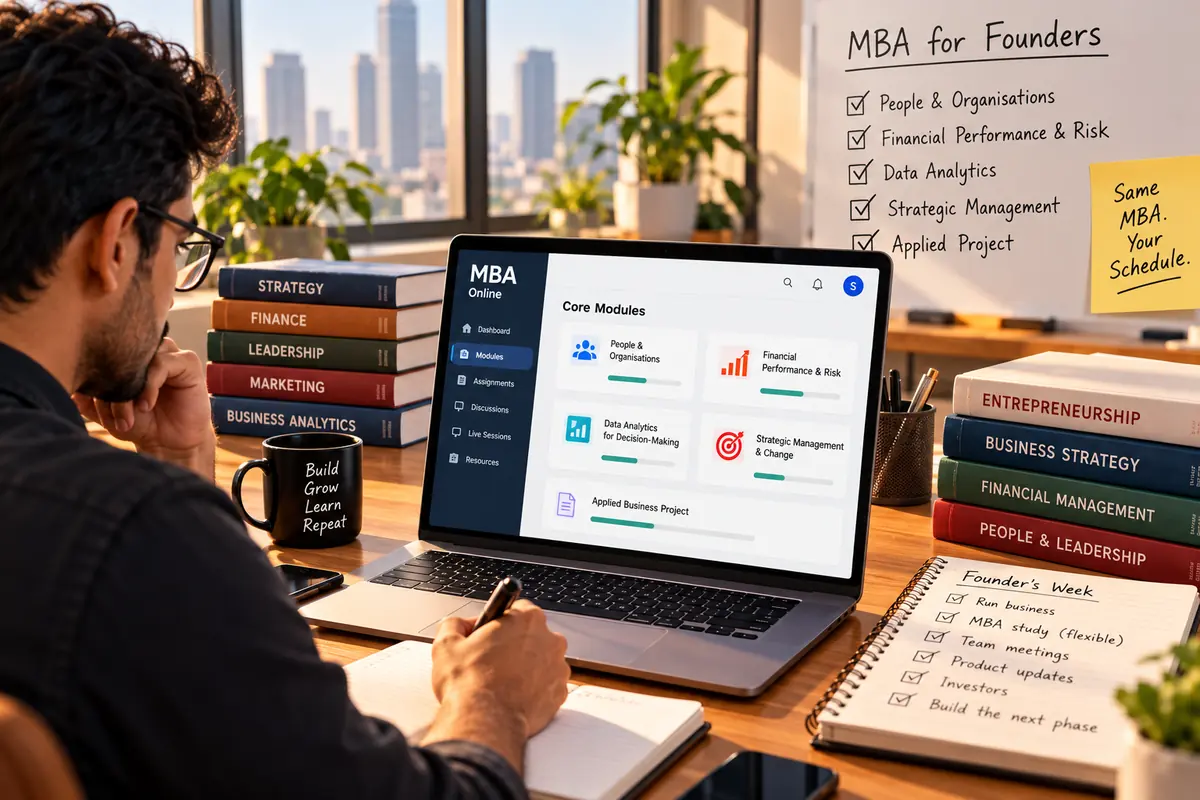
If you are running a company and weighing an MBA, the question is rarely whether the content is useful. It is whether you can do the study without taking your hands off the business for two years. In 2026, that trade-off has mostly disappeared, because accredited online delivery now covers the same material as a campus program on a schedule you set around board meetings, product launches, hiring decisions and payroll runs.
This guide is for founders and operators who want the management grounding an MBA gives without stepping away from the company to get it. Here is what the degree actually teaches and how online delivery fits a working founder. It also covers how to tell a serious program from a weak one.
What an online MBA actually teaches
For a founder, the credential is the least useful part of an MBA. The value is the formal grounding in the things you have been improvising because nobody taught them to you.
An online MBA covers the same core ground as an on-campus program: managing people and organisations, financial performance and risk, data analytics for decision-making, and strategic management, usually capped with an applied business project. The real difference is delivery, and that is what makes it workable for a founder. Edith Cowan University, for instance, is one place to study mba online, with several intakes a year, so you keep running the business while you complete the degree. It is a 12-unit program, and that accreditation is held by fewer than six per cent of business schools worldwide; ECU also has a fast-track route for applicants with relevant management experience.
Take those core areas one at a time, because each maps to a decision you are already making badly or slowly.
Managing people is the unit most founders underrate. You hired fast and promoted your first engineer into a lead role with no training, so now you have a management layer that was never taught to manage. The people and organisation units cover how to structure teams, run performance conversations, set pay and design incentives that do not backfire.
Financial performance and risk is where founder intuition tends to run out. You can read a P&L, but pricing, unit economics, growth-assumption modelling and the real cost of the risks you carry are harder to reason about without the framework. This is the part that changes how you talk to investors.
Data analytics for decision-making is not a coding course. It teaches you to frame a business question so the data can answer it, and to spot when a dashboard is telling you nothing. For a founder drowning in product and marketing metrics, that discipline is worth more than another BI tool.
Strategic management and change round it out. These units force you to write down the strategy you have been carrying in your head, then pressure-test it against competitors and market shifts. The applied project at the end is usually where founders do the most useful work, because you can point it at a real problem in your own company rather than a case study.
How online delivery fits around a founder's week
The mechanics matter more than the brochure. What makes online study workable is how the teaching is structured.
Look for asynchronous delivery, where lectures and materials are recorded and readings and assessments have deadlines rather than fixed class times. That is what lets you study at 6am before the team is online, or on a flight, instead of blocking out a weekday evening you cannot protect. Live sessions, if any, should be optional or recorded.
Intake frequency is the second thing to check. A program with a single February intake means a bad launch month can cost you a year. Programs that run several intakes across the year let you start when the business allows and pause between units if you need to. ECU's model of multiple intakes a year exists for exactly this reason, and it is the kind of scheduling detail worth confirming on the provider's official site before you commit, since intake dates and fast-track eligibility change.
Accelerated formats are common now, and they cut both ways. An 18-month fast-track gets you through sooner, but the workload per unit is heavier, which is harder to absorb when the company hits a busy stretch. A standard two-year pace leaves more slack. Be honest about how much time you can actually give it before you pick the compressed option.
How to judge whether a program is any good
Not every online MBA is worth the money, and the marketing does not help you tell them apart. A few checks do most of the work.
Accreditation first. AACSB is the recognised international standard that carries the most weight, with AMBA and EQUIS the other two worth looking for. AACSB in particular is held by a small minority of business schools. Accreditation is not a guarantee of a good experience, but its absence is a real warning sign, and it is what employers and other institutions recognise if you ever want the qualification to travel.
Then look at the cost structure and what support you get for it. Fees vary widely, and in Australia eligible students can defer tuition through FEE-HELP rather than paying upfront, which changes the affordability maths considerably. Confirm the total fee, what it includes, whether there are hidden costs and what deferral options apply to you, on the provider's official site rather than a third-party summary.
Last, check that the curriculum is current and the delivery is genuinely built for online. A program that has bolted a webcam onto campus lectures is not the same as one designed for remote study. Read the actual unit list, not the tagline. If the data and strategy units look like they were written a decade ago, they probably were.
An MBA will not fix a business that has the wrong product or no market. What it does well is give a founder the formal grounding to run the company they already have with less guesswork, and online delivery finally means you can get that grounding without leaving the desk you are trying to improve.