AI Coding Tools Made Your Dev Team Faster. Your QA Process Didn't Get the Memo.
Every SaaS engineering team now has an AI coding assistant in the loop somewhere - generating boilerplate, drafting whole functions from a prompt, refactoring modules in minutes instead of days. Output has genuinely gone up. Pull requests are bigger and more frequent. Founders are proud of how much a small team can now ship.
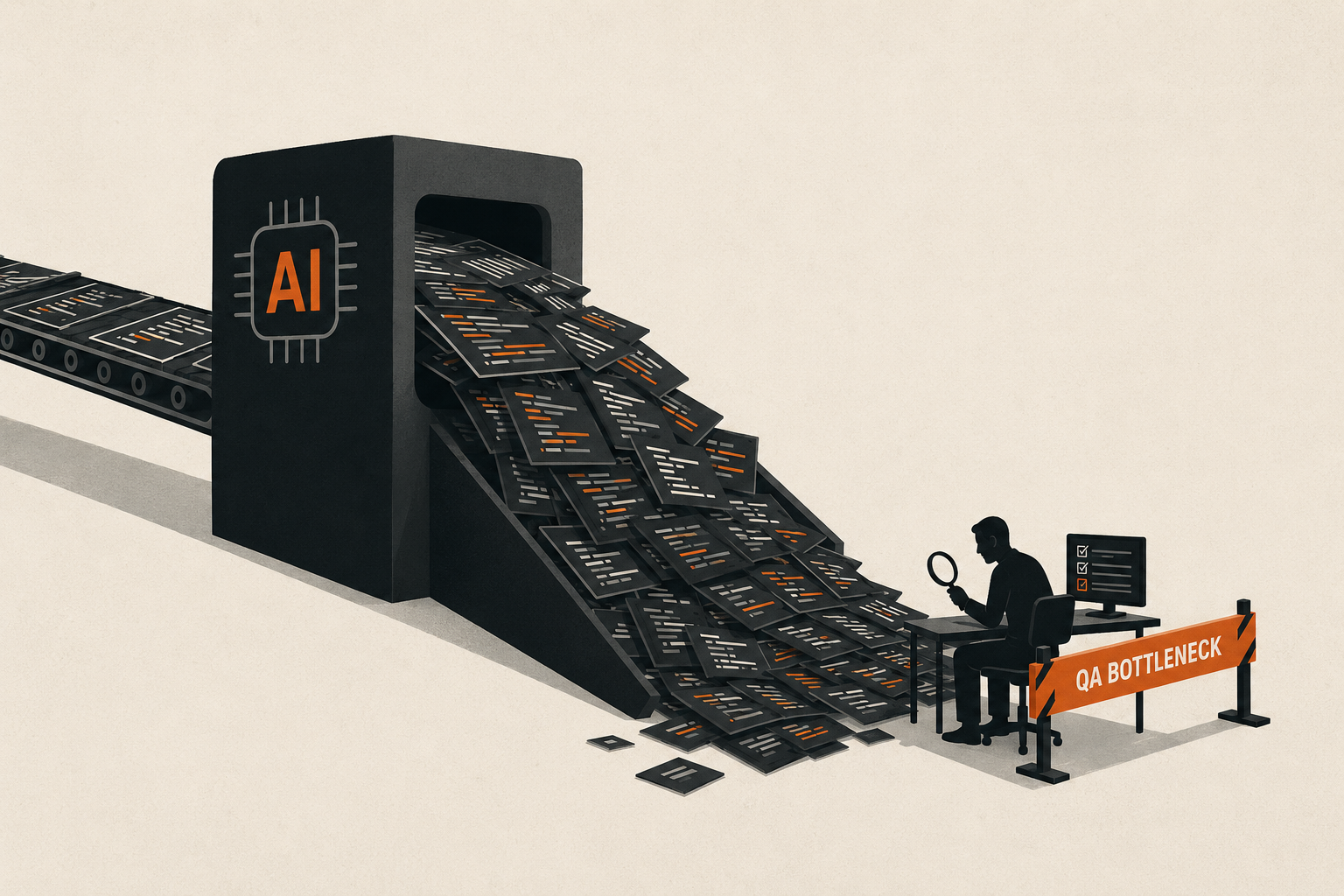
What's quietly gone up alongside it is the volume of code nobody has manually reasoned through line by line. And in most B2B SaaS teams, the QA process is still sized for the pre-AI era: the same number of testers, the same manual review habits, verifying a code output that's grown several times over. That mismatch is where the next generation of production incidents is already coming from.
The Bottleneck Moved, It Didn't Disappear
For years, writing code was the slow part of shipping software, and testing was squeezed into whatever time was left. AI coding tools have inverted that. Generating a feature is now often the fast step. Verifying that it actually does what it's supposed to, doesn't break something adjacent, and holds up under real usage - that's still fundamentally human work, and it hasn't gotten any faster.
Teams that don't recognize this keep measuring velocity by commits and PRs merged, while the actual bottleneck - confident, verified releases - has silently moved downstream to a QA process that never scaled to match.
Why AI-Generated Code Needs More Scrutiny, Not Less
There's a natural assumption that AI-written code, having been trained on huge volumes of working software, is at least as reliable as human-written code. In practice, it introduces its own specific failure patterns that a team needs to test for deliberately:
- Plausible-looking logic that's subtly wrong. LLM-generated code often compiles, runs, and looks idiomatic while getting an edge case wrong - the kind of error a quick glance won't catch, because it doesn't look like a mistake.
- Inconsistent context across a codebase. A model generating one function at a time doesn't always carry the same assumptions as the surrounding code, producing integration bugs that unit tests on the new function alone won't surface.
- Copy-paste of outdated patterns. Suggestions can reflect deprecated APIs or security practices that were common in training data but are wrong for your current stack.
- False confidence from fast iteration. When a feature was generated and reviewed in twenty minutes, it's tempting to ship it with the same confidence as code that took two days - even though the actual verification effort was identical either way.
None of this means AI-assisted code is worse. It means it needs the same rigor as any other code, and teams that skip that step because "it looked right" are the ones that get burned first.
What This Means for Enterprise Buyers, Too
This isn't just an internal engineering concern - it's becoming a real question in enterprise SaaS procurement. Buyers doing vendor due diligence increasingly ask how a product is tested, not just what it does. A SaaS company that's proud of shipping fast with AI tooling needs an equally credible answer for how that output gets verified before it reaches production. "We move fast" is not a reassuring answer on its own to a security or procurement team evaluating whether to put your product in their stack.
Closing the Gap Without Slowing Down
The answer isn't rejecting AI coding tools or forcing a return to fully manual review of every generated line - that gives back exactly the speed advantage the tools provide. It's scaling the verification side to match:
- Treat AI-generated PRs as higher scrutiny, not lower, especially around integration points and edge cases the model wasn't explicitly prompted to consider.
- Expand automated test coverage in step with code volume, so more generated code is checked by something other than a rushed human glance.
- Track what's actually been verified, separate from what's merely been merged - the two are not the same thing, and conflating them is exactly how untested paths reach production.
- Keep traceability between requirements and tests intact, even as code gets generated faster than it used to, so coverage gaps are visible instead of assumed away.
Fast-moving SaaS teams generally handle this by consolidating their test coverage in dedicated test management software, giving them one place to see what's been verified against what's shipped - instead of trusting that a fast PR review caught everything an AI assistant generated.
AI coding tools are a genuine productivity gain, not a fad, and no SaaS team should give that up. But velocity without a matching investment in verification just moves risk downstream, into production, where it's far more expensive to catch. The teams that get the most lasting value from AI-assisted development are the ones treating faster code generation as a reason to invest more in testing discipline - not less.