Amazon is still betting heavily on India. It is just betting on a different India than the one it spent the last decade fighting for
Andy Jassy met Narendra Modi and pledged $48 billion for India through 2030. But every dollar of the new money he announced, $13 billion, goes to AI and cloud, not to retail. Where the money is going tells you Amazon's priorities have shifted.
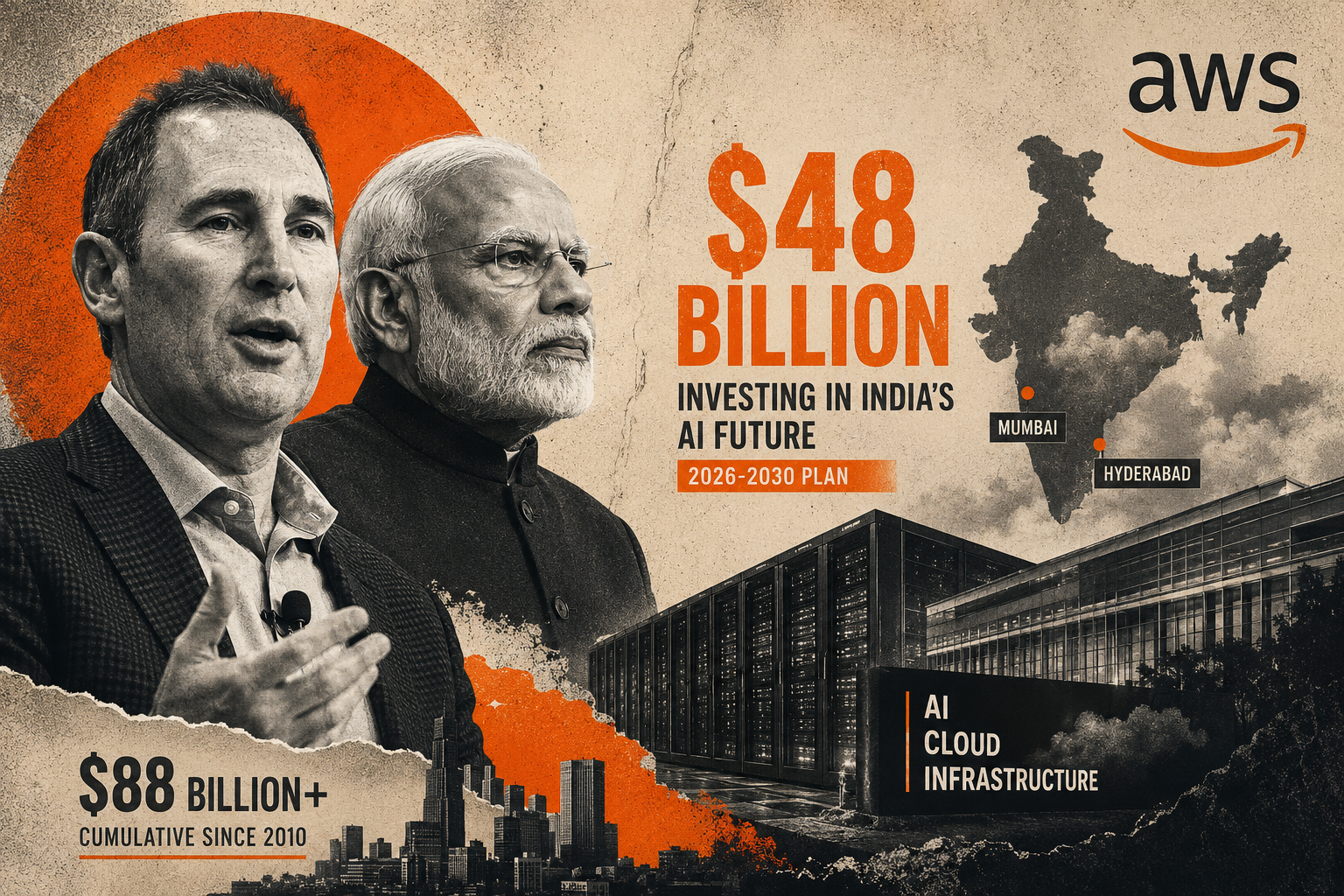
When a global CEO flies in to meet the prime minister and announce a number with ten zeroes, the headline writes itself. The more useful question is which part of the business the money is actually going to.
On 25 June 2026 in New Delhi, Amazon CEO Andy Jassy met Prime Minister Narendra Modi and laid out a plan to invest $48 billion in India between 2026 and 2030. The fresh commitment unveiled at the meeting was an additional $13 billion, and all of it is earmarked for AI and cloud infrastructure. That single fact, more than the big round headline, is the story.
The announcement at a glance
| Who / when | Andy Jassy met PM Modi, 25 June 2026, New Delhi |
| New commitment | +$13 billion for AI and cloud (AWS) |
| Total 2026 to 2030 | $48 billion ($35B announced in 2025 + $13B new) |
| Cumulative since 2010 | $88 billion+ |
| Where the AI money goes | AWS data-centre expansion in Mumbai and Hyderabad; custom AI chips, managed AI services |
| Retail this year | 20+ new fulfilment centres, 100+ last-mile delivery stations |
| 2030 targets | 3.8M jobs supported, $80B cumulative exports, AI for 15M small businesses, AI education for 4M government-school students |
Source: Amazon announcement, 25 June 2026.
What Jassy announced
The arithmetic is worth separating out. In 2025, Amazon had committed $35 billion across all its India businesses. The new piece, revealed at the Modi meeting, is $13 billion on top of that, taking the 2026 to 2030 plan to $48 billion and the company's cumulative India commitment since 2010 to more than $88 billion. That makes Amazon among the largest foreign investors in the country.
The new $13 billion is not spread across the business. It funds AWS data-centre capacity in Mumbai and Hyderabad, giving startups, enterprises and government access to custom AI chips, managed AI services and cloud tools. Jassy wrapped it in national-priority language: support for 3.8 million jobs, $80 billion in cumulative exports, AI for 15 million small businesses, and AI education for 4 million government-school students by 2030.
The tell: the new money is for cloud and AI, not retail
Read the composition, not the total. The entire $13 billion of new money is an AWS bet. Amazon's retail and logistics arm gets only incremental expansion this year, 20-odd fulfilment centres and a hundred delivery stations, with no fresh headline number attached.
That is a deliberate allocation, and a smart one. AWS is Amazon's profit engine. Cloud is where the company is a global leader rather than a local challenger, where the margins are high, and where demand is exploding as every Indian enterprise and government department races to deploy AI. Data centres are also the most defensible thing Amazon can own in India: physical, capital-intensive, sticky, and politically welcome at a moment when New Delhi wants domestic AI capacity and compute sovereignty. A cloud-and-AI cheque buys Amazon a seat at India's most important technology table for the next decade.
The new money is an AWS bet wearing an India-investment headline. Amazon is spending where it is strongest, not where it is under attack.
Meanwhile, Amazon is losing the quick-commerce war
Look at where Amazon is under attack, and the restraint on retail makes sense. India's consumer-internet action has moved to quick commerce, 10-to-20-minute delivery from neighbourhood dark stores, a roughly $11.5 billion market at the end of 2025 growing more than 75% a year. And here, Amazon is a latecomer playing catch-up.
| Player | Market share* | Dark stores | Cities |
|---|---|---|---|
| Blinkit (Eternal) | ~46-48% | ~2,243 | 200+ |
| Swiggy Instamart | ~24% | ~1,143 | 129 |
| Zepto | ~22% | ~1,139 | 89 |
| Amazon Now | small | ~1,000 | 50+ |
| BigBasket (Tata) | ~5-7% | scaling | - |
Market-share figures are industry estimates (Bernstein, Inc42 and others); they vary by source and by whether you count orders or value.
Amazon launched Amazon Now, its dark-store quick-commerce service, only in 2025, starting in Delhi and Mumbai. It is targeting 1,000-plus dark stores by the end of 2026, but it sits well behind Blinkit's 2,243-store network, and analysts estimate Amazon may need $1.5 to $2 billion and three to four years just to build a comparable footprint. Its original India bet, the e-commerce marketplace, is being out-flanked by faster, hyper-local rivals, most of them homegrown.
Why the pivot is rational
Put the two numbers side by side. Amazon is committing $13 billion to cloud and AI, and would need perhaps $1.5 to $2 billion to make Amazon Now genuinely competitive. It has chosen to write the first cheque emphatically and the second one cautiously.
That is a defensible call. Quick commerce in India is a cash-incinerating price war among well-funded local players who got there first and who treat thin margins as a feature. Cloud and AI infrastructure is a market Amazon already leads globally, with real margins and a structural tailwind. Faced with a brawl it might not win and a game it is built to win, Amazon is leaning into the second. The retail business is not being abandoned, it is being defended at a measured pace while the offensive capital flows to AWS.
What the visit says about Amazon's priorities
Three things, decoded from the money.
- Offense on cloud and AI, defense on retail. The new capital backs the business where Amazon is strong and the margins are real, not the consumer war where it is behind.
- Government alignment is the wrapper. The jobs, exports, small-business and student-AI numbers, and the Modi photo, are pitched at India's AI-sovereignty ambitions. Data centres are the rare investment a government actively wants on its soil, which makes them as much a relationship play as a commercial one.
- The retail crown is genuinely contested. A decade after Amazon made India a flagship e-commerce battleground, the fastest-growing part of that market is being won by Blinkit, Zepto and Swiggy. The $48 billion headline partly papers over a consumer business on the back foot.
What to watch
Two questions will decide whether this is a clean pivot or a quiet retreat. First, does Amazon eventually fund Amazon Now to real scale, or does it cede quick commerce to the locals and keep retail as a slower marketplace business? Second, does the AI and data-centre money convert into actual capacity and AI-chip localisation on the promised timeline, or remain a five-year pledge of the kind that is easy to announce in a prime-ministerial meeting and harder to fully deploy.
For now, the signal is clear enough. Amazon's next chapter in India will be written less in shopping carts and more in server racks.
If you have information related to this story, reach out through StartupTalky's tips line. Anonymity is the default.