Apple Wants Its Standard Fee. In India, the Standard Doesn't Exist.
Apple Pay is reportedly heading to India this October — without UPI, and asking for a fee it already charges American banks. The fight isn't about a greedy tech company. It's about landing in the one country where the free rail moved first.
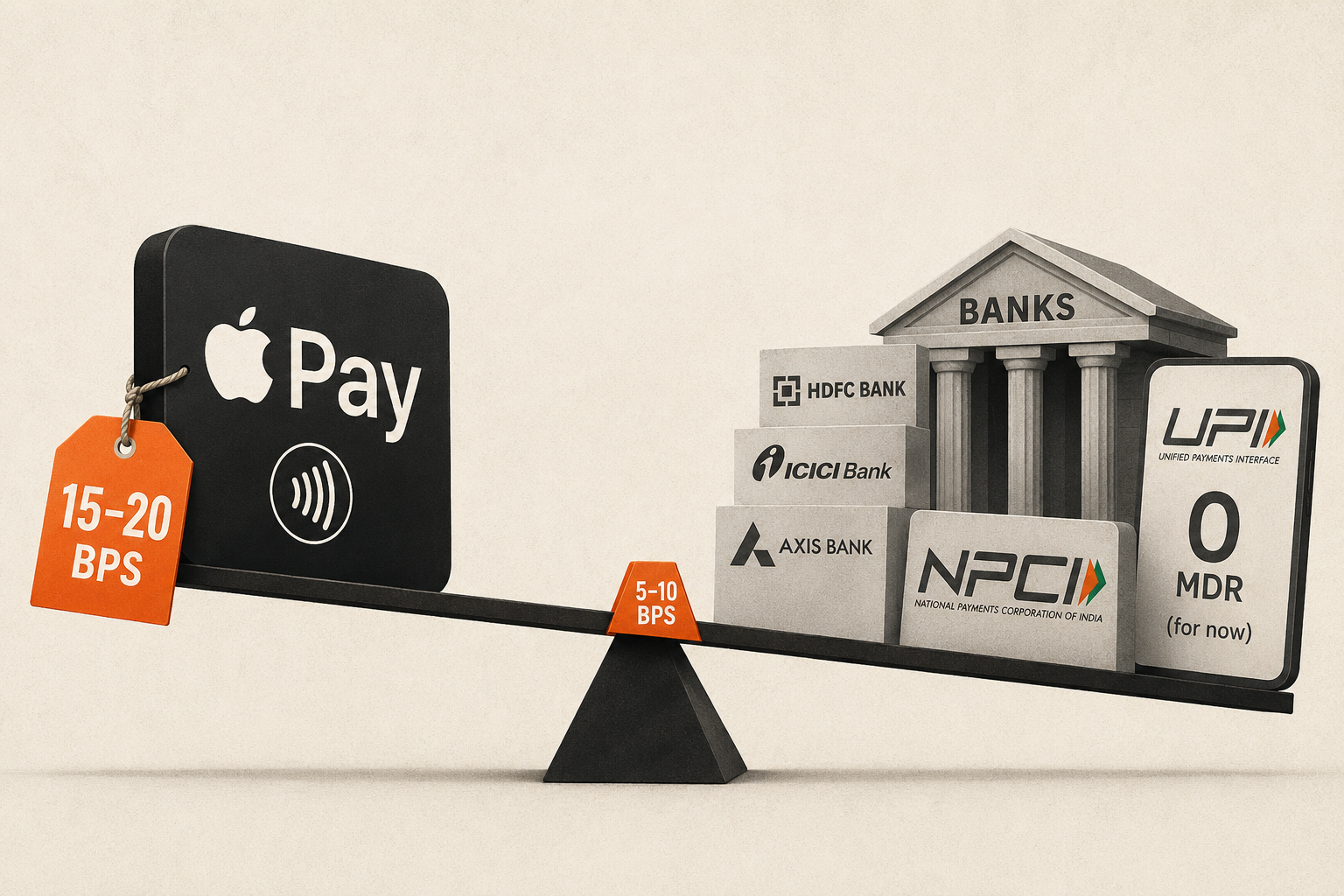
Apple Pay is expected to launch in India as early as October 2026, but not with the payment method that actually dominates the country. At launch, it will support only NFC tap-to-pay on Visa and Mastercard credit cards — no UPI. That's not Apple choosing to skip India's most-used payment rail; it can't use it yet. UPI access requires approval from the National Payments Corporation of India (NPCI) and a partnership with a sponsor bank to route transactions, and Apple hasn't cleared either hurdle. It's reportedly in talks with HDFC Bank, ICICI Bank, and Axis Bank to get there. None of this timeline has been confirmed by Apple itself — every report so far traces to trade and banking sources, not an Apple announcement, and at least one outlet has framed the delay itself as a symptom of the dispute below, not just a rollout sequencing choice.
The actual fight is over 5-10 basis points
Apple is reportedly asking issuing banks for 15-20 basis points per credit card transaction, paid out of the banks' interchange revenue. Indian banks are countering at 10 bps. Five to ten basis points sounds like a rounding error, but multiplied across every tap-to-pay transaction on every participating card, it's the whole negotiation.
Here's what's missing from most of the coverage: Apple isn't asking India for anything unusual by its own standards. A 2026 DOJ complaint into Apple's payments practices disclosed that Apple already charges US issuing banks 15 basis points flat per Apple Pay credit transaction. India's ask is the same number, maybe a notch higher. Apple isn't price-gouging one market — it's trying to hold its global rate card in a country where the comparison point isn't the US card system. It's UPI.
Why the same fee lands differently here
Standard bank-to-bank UPI has carried a zero mandated MDR since January 2020 — no merchant discount rate at all on regular UPI payments. That's the number every Indian bank, fintech, and merchant has been operating against for six years. Apple asking for even a sliver of a percent looks unreasonable next to a rail that costs nothing, regardless of what Apple charges anywhere else in the world.
That zero, though, isn't as settled as it looks. As of July 2026, the government has a live, not-yet-enacted proposal to introduce an MDR of 0.25-0.4% on UPI transactions above ₹2,000 made to large merchants. If that lands, it would be 6-16x Apple's own ask, on the rail Apple is being compared against. Nobody covering the Apple Pay fee fight has connected this: the same regulatory environment holding the line against Apple's 15-20 bps is simultaneously weighing whether to put a real price on its own "free" rail.
The segment Apple is actually chasing is small — and that's the point
UPI isn't a rail Apple Pay is trying to take share from. It's already 84.8% of India's retail digital payment volume, processing over 22.7 billion transactions in June 2026 alone. Debit and credit cards combined are under 10% of transaction volume; credit cards specifically sit around 2.6%. Apple Pay's NFC-card launch is aimed at a sliver of a sliver.
But that sliver carries disproportionate value. Credit cards are where premium, high-ticket spending concentrates, even as UPI owns the high-frequency, low-value end of the market. Pine Labs CEO Amrish Rau put it plainly: credit card usage in India was already growing 10-15% before Apple Pay entered the picture, and he expects that to keep expanding alongside UPI, not get displaced by it. Apple isn't trying to unseat the incumbent. It's trying to take a cut of the smaller, richer segment that was already growing on its own.
The banks have leverage they didn't have two years ago
Indian banks pushing back this hard on a global tech company's fee ask isn't happening in a vacuum. In March 2024, the RBI banned exclusive agreements between banks and card networks, and from September 2024, cardholders got the right to choose their network (Visa, Mastercard, or RuPay) at issuance or renewal. Two years of regulatory pressure have already gone into stripping card networks of exactly the kind of locked-in leverage that would otherwise make a bank cave to a partner as large as Apple. The fee standoff isn't banks discovering sudden spine — it's banks operating in a market the RBI has spent two years deliberately rebalancing in their favor.
Frequently Asked Questions
Will Apple Pay support UPI in India when it launches? No. At launch, Apple Pay in India will only support NFC tap-to-pay on Visa and Mastercard credit cards. UPI support requires approval from the National Payments Corporation of India (NPCI) and a partnership with a sponsor bank, which Apple had not secured as of this reporting.
What fee is Apple asking Indian banks to pay for Apple Pay? Apple has reportedly asked for 15-20 basis points per credit card transaction, paid out of the bank's interchange revenue. Indian banks have countered with an offer of 10 basis points.
Is Apple's fee request unusual compared to other countries? Not based on public disclosures. A 2026 DOJ complaint revealed that Apple already charges US issuing banks 15 basis points flat per Apple Pay credit transaction, so India's ask is close to Apple's own existing US rate.
Will Apple Pay replace UPI in India? That's not how industry voices are reading it. UPI already accounts for roughly 84.8% of India's retail digital payment volume, while credit cards make up about 2.6%. Pine Labs CEO Amrish Rau has said he expects credit card usage to keep growing alongside UPI rather than being displaced by it.
Who blinks first is genuinely open. Have reporting on where the NPCI approval or sponsor-bank talks actually stand? Get in touch.