DSP Finance Bought Volt Money, the Startup It Backed From Round One
A digital lender that grew revenue 856% in a year and still lost money got folded into a 30-year-old, profitable NBFC that had been reading its books since month two.
In October 2022, two months after Bharat Lamba, Ankit Agarwal and Lalit Bihani registered a company called Salter Technologies in Mumbai, the money for its first funding round came in. $1.46 million, led by two funds most people outside VC circles have never heard of, Raise and All In Capital, with cheques from a handful of angels including Snapdeal co-founder Kunal Bahl. Sitting in that same cap table, in a round nobody wrote a headline about, was DSP Mutual Fund.
Salter Technologies is better known by its product name: Volt Money, the app that lets you borrow against your mutual funds instead of selling them. In March 2025, DSP Finance, the NBFC arm of the DSP group, bought the company outright. Most of the coverage treated it as a straightforward acquisition story: fintech disrupts lending, legacy player buys the disruptor. The cap table tells a slightly different story. DSP wasn't a stranger who came knocking. It had been sitting inside the company for two and a half years before it decided to just take the whole thing.
The company DSP already knew
Volt Money raised twice before the acquisition, and DSP Mutual Fund showed up both times.
| Round | Date | Amount | Lead investors | DSP present? | Implied valuation |
|---|---|---|---|---|---|
| Round 1 | 19 Oct 2022 | $1.46M | Raise, All In Capital | Yes | ~$11.1M |
| Round 2 (Volt's own release calls it "pre-seed") | 20 Jun 2023 | $1.5M | Titan Capital, All In Capital | Yes | Undisclosed |
| Acquisition | 10 Mar 2025 | Undisclosed | DSP Finance (100%) | Full buyout | Undisclosed |
Total disclosed equity raised across both rounds: $2.96 million. That's a small number for a company that ended up getting bought by one of India's older asset-management houses. It also means DSP had roughly two and a half years of board-level or shareholder-level visibility into Volt Money's numbers before it made the acquisition call. A source close to the deal put it plainly in trade-press coverage the week it closed:
"DSP Group was shareholder of Volt Money and was privy to the company's numbers, so they proposed the acquisition deal."
That single line is the whole story, really. Everything else is detail.
What DSP actually bought
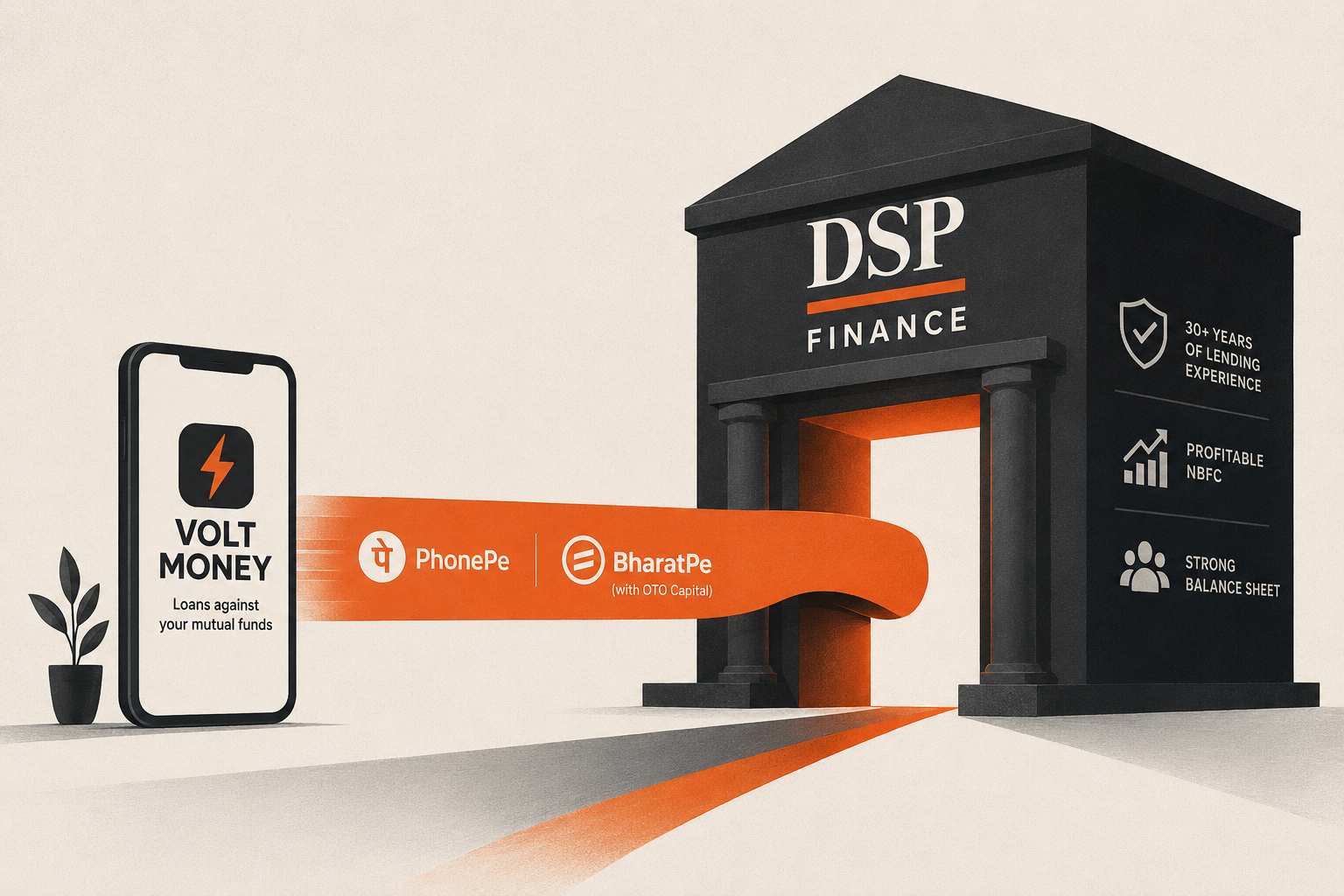
Here's the part that's easy to miss if you only read the press release: DSP Finance already did this. It's been in the business of lending against mutual fund and share holdings since 1996, decades before "loan against mutual funds" became a fintech buzzword. It's profitable. Its FY25 revenue was roughly $16.2 million, with a net profit of about $7.76 million, against Volt Money's FY25 revenue of $1.63 million and a net loss of $1.17 million.
So this wasn't a case of a legacy lender waking up to a category it didn't understand. DSP Finance understood the category better than almost anyone, it had run it as an old-school NBFC business for three decades. What it didn't have was Volt Money's front end: the 10-minute disbursal, the app that marks a digital lien on your mutual fund units in 15 seconds, and, more importantly, the distribution deals Volt Money had already signed. By the time of the acquisition, Volt Money had live partnerships with PhonePe (from May 2024) and, alongside OTO Capital, with BharatPe (from August 2024). That's tens of millions of app users DSP Finance would have taken years to reach on its own.
I think this is the more useful way to read the deal: not "fintech gets acquired," but a profitable, decades-old lender buying the distribution and UX layer it couldn't build in-house, from a company whose numbers it had already been watching since round one. It also isn't the only fintech lending brand that's ended up folded into a regulated balance sheet this cycle, Slice's merger into North East Small Finance Bank is a different deal structure but the same underlying pressure: regulators and capital markets increasingly want lending to sit on a licensed, well-capitalised balance sheet, not a standalone app.
The numbers behind the deal
Volt Money's growth in the year before the acquisition was genuinely fast. Revenue grew 856% year over year to reach that $1.63 million FY25 figure, though the base was tiny to begin with (its trailing revenue at the June 2023 round was just $43,627). It was still burning cash: an EBITDA of -$936,000 and a net loss of -$1.17 million for the same year. That combination, triple-digit growth with real losses, is exactly the profile that either raises a large Series A or gets acquired by someone who can absorb the burn. DSP Finance, sitting on nearly $8 million of annual profit, could absorb it easily.
Volt Money raised $2.96 million across its lifetime. The company that bought it posted $16.2 million in revenue in a single year.
One number is murkier. The most recent independent valuation mark for Volt Money that I could find, dated January 2024, puts the company at roughly $8.8 million, which is actually below the ~$11.1 million implied by the October 2022 round. I couldn't pin down what specific event produced that January 2024 mark (no funding round happened that month), so treat it as a data point, not a clean before/after comparison. What isn't in dispute: neither Volt Money nor DSP Finance disclosed what the March 2025 acquisition itself was worth. I checked business-database records and two separate trade-press reports; all of them agree the deal happened, and none of them has a number.
Getting the "DSP" right
Small correction that's worth making explicit, because it's easy to get wrong: DSP Finance is the NBFC arm of the Indian DSP group, the asset-management business behind DSP Mutual Fund, which markets itself on "170+ years of trust" in India's securities business. It has nothing to do with DSP Group Inc, the Silicon Valley semiconductor company that Synaptics acquired back in 2021. At least one business-data platform I checked while researching this piece had actually mixed the two up, tagging the acquisition to the semiconductor company's record, which would be a genuinely confusing error to repeat in print. The company that actually bought Volt Money is registered in Mumbai as DSP Finance Private Limited (CIN U64920MH1996PTC099483), an NBFC, not a chipmaker.
What survived the merger
Volt Money the brand is still alive. The app is still on the Play Store and App Store under that name, and the website still looks and reads like an independent fintech. But the legal footer now says DSP Finance Private Limited, and as of September 2025, DSP Finance is the entity directly powering PhonePe's loan-against-mutual-funds facility, now offering up to ₹2 crore against a user's holdings, entirely inside the PhonePe app. The partnership Volt Money built didn't get shut down when the company got absorbed. It got upgraded to run on the acquirer's own balance sheet.
Headcount held up too. As of 31 August 2025, five months after the deal closed, Volt Money's labour filings showed 109 employees, roughly the team you'd expect for a company still running its own product inside a larger parent.
Have more on this deal, including the actual price paid? Get in touch.