PhonePe Clears First Step Toward a UAE Payments Arm
PhonePe has in-principle approval from the Central Bank of the UAE for two payment licences, its first regulatory clearance outside India. It cannot operate yet, and the market it is entering already runs partly on Indian payment technology.
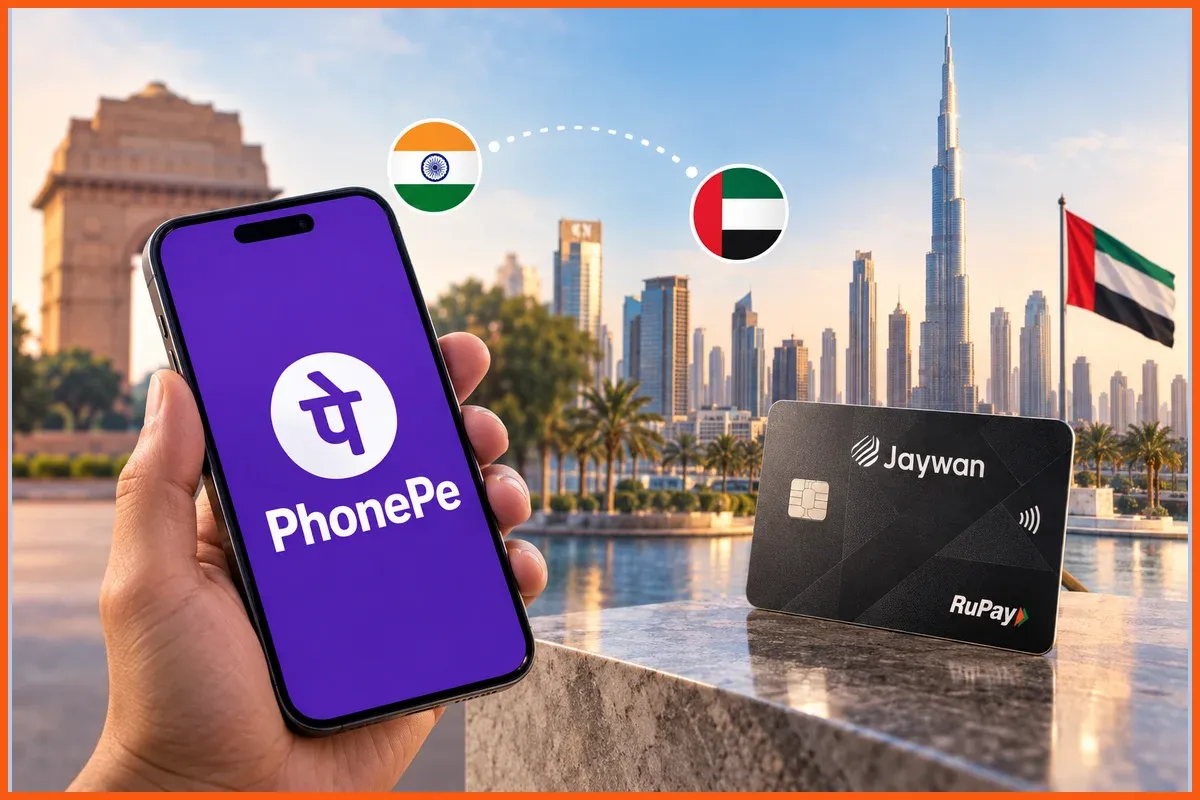
The UAE's own national payment card runs on Indian technology. Jaywan, launched by a Central Bank subsidiary, was built on the RuPay stack under a partnership with NPCI International signed in October 2023.
PhonePe is now applying to operate inside that system rather than alongside it.
The company has received in-principle approval from the Central Bank of the UAE for two licences: Retail Payment Services and Card Schemes, and Stored Value Facilities. Founder and chief executive Sameer Nigam announced it at Global Fintech Fest in Mumbai, calling the UAE the company's first foreign market.
What has actually been granted
An in-principle approval is not permission to trade.
PhonePe still has to satisfy the Central Bank's remaining requirements and obtain final authorisation before it can open to customers. Some coverage of this has used the word licence without that qualification, and the distinction matters for anyone timing a launch or a partnership around it. The company's own announcement was precise about it.
The two approvals cover different things. Retail Payment Services and Card Schemes is the permission to run regulated payment services and card operations, which is the merchant and acceptance side. Stored Value Facilities covers issuing wallets, gift cards and other products where a customer's money sits with the issuer before being spent. Between them they describe a consumer payments business rather than a remittance pipe.
PhonePe has been in the UAE for years, but not like this
Indian travellers have been able to pay with PhonePe at NEOPAY terminals in the UAE for some time, using UPI. That is a genuine presence, and it is a fundamentally different one.
In that arrangement PhonePe is an Indian app, holding an Indian user's Indian bank account, reaching across a border that NPCI negotiated. The customer is Indian, the money is Indian, and the regulator that matters is in Mumbai. What the CBUAE approvals contemplate is PhonePe as a locally licensed entity serving people who live in the UAE, answerable to a Gulf regulator, offering wallets to residents and acceptance to local merchants. The first is exporting a product to your own citizens abroad. The second is entering a market.
The company has said it intends to support Aani, the UAE's instant payment platform, and Jaywan. That is the tell that this is meant as a domestic business.
The corridor is the obvious prize
India and the UAE form the second-largest remittance corridor in the world, moving more than $20 billion a year, and roughly nine million Indians live in the Gulf state.
Remittance is a business with an unusual property: the sender and the receiver are often on the same app's turf but in different regulatory universes. PhonePe already owns the receiving end at enormous scale, with more than 600 million registered users in India. A licence at the sending end closes a loop it has so far only been able to reach through NPCI's bilateral arrangements. The margins in remittance are thin and the competition is entrenched, with exchange houses and banks defending the corridor for decades, but volume of that size forgives a good deal of thinness. It is also the one product where owning both ends is worth more than owning either.
PhonePe is not alone in this queue. Revolut and Mercury have both received in-principle approvals from the same regulator, which is running an active programme to license foreign fintech firms under its Financial Infrastructure Transformation agenda.
A shelved listing explains the timing
PhonePe filed an updated draft prospectus with SEBI in January 2026 for an offer that would be entirely a sale of existing shares, raising no fresh capital for the company. In March it shelved the listing as global markets turned, with reported valuation expectations falling from the $12 billion to $15 billion range towards $9 billion to $10.5 billion.
Its accounts for FY2025 show revenue of ₹7,114.8 crore, up 40.5%, with a net loss of ₹1,727.4 crore, narrowed by 13.5%.
Put those together and the timing reads clearly enough. A company waiting for a listing window needs a growth story that is not simply more of the Indian market it already dominates, and international expansion is the most legible one available. The risk is the mirror image: a first foreign market is expensive, and PhonePe's revenue model at home leans on scale that does not transfer. Nine million Indians in the UAE is a large diaspora and a small market next to 600 million users.
What I would watch is whether the final licence actually arrives, and how long it takes. In-principle approvals are the easy half.
Common questions
Can PhonePe operate in the UAE now?
No. It has in-principle approval for two licences and must still meet the Central Bank's remaining requirements and receive final authorisation before offering services.
What do the two licences cover?
Retail Payment Services and Card Schemes covers regulated payment services and card operations. Stored Value Facilities covers issuing wallets, gift cards and similar products where customer funds are held before being spent.
Is this different from using PhonePe in the UAE today?
Yes. Indian users can already pay via UPI at NEOPAY terminals in the UAE, but that is an Indian app serving Indian customers abroad. These approvals would let PhonePe operate as a locally licensed payments business for UAE residents and merchants.
Approval details and the company's plans come from PhonePe's announcement and Sameer Nigam's remarks at Global Fintech Fest 2026. Financial and IPO figures are from the company's regulatory filings and reported coverage. Jaywan's technology partnership is from Al Etihad Payments and NPCI International.