Best AI Finance Tools for Founders: Best Tools to Track Cash Flow in Real-Time
AI finance copilots help founders track cash flow, forecast budgets, and control spending in real time. Explore the best tools like Zeni, QuickBooks, and Ramp to manage your startup finances smarter.


Founders have now steered themselves into smart finance copilots, tracking every rupee in real-time with bank accounts, cards, and subscriptions like real-time eyes on the ground, warning them before burn or runway risks hit.
Predict future balances from learning about past cash flow and set simple budgets. Forecasts can be tested for a few clicks with highs and lows. This wipes the laborious task of digging through sheets.
Presently, they just give away their signals to act quickly, keep reaching within reach. Managing expenses and budgets has become as simple as sorting them out on their own.
Why Founders Are Switching to AI Finance Tools
Modern tools give:
- Real-time visibility into cash flow
- AI forecasts for better decisions
- Risk alerts before problems happen
- Scenario testing for planning
They connect banks, payroll, billing, and cards, then turn raw data into clear insights.
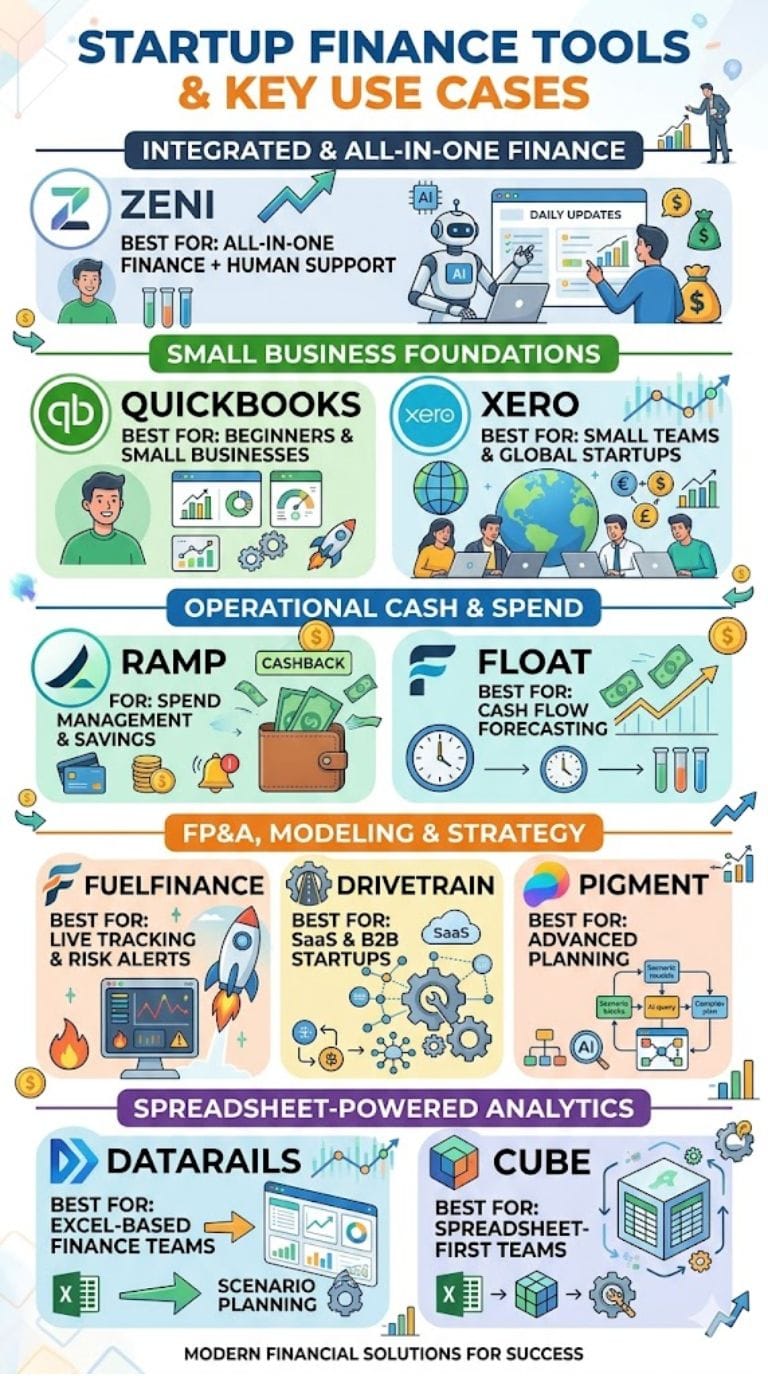
Tools Comparison Table (Quick Overview)
| Tool | Best For | Key Features | Pricing Level | Drawbacks |
|---|---|---|---|---|
| Zeni | All-in-one finance + human support | AI bookkeeping, daily updates, finance team | High | Expensive, learning curve |
| QuickBooks | Beginners & small businesses | Auto categorization, dashboards, forecasting | Medium | Limited advanced reporting |
| Xero | Small teams & global startups | Real-time insights, multi-currency | Low | Slow with large data |
| Ramp | Spend management & savings | Automation, cashback, alerts | Medium | Extra feature costs |
| Fuelfinance | Live tracking & risk alerts | Forecast updates, integrations | Custom | Needs clean data |
| Datarails | Excel-based finance teams | Scenario planning, dashboards | High | Complex setup |
| Float | Cash flow forecasting | Daily alerts, scenario testing | Low | Limited long-term planning |
| Drivetrain | SaaS & B2B startups | 200+ integrations, AI insights | Custom | B2B focused |
| Pigment | Advanced planning | Scenario modeling, AI queries | High | Learning curve |
| Cube | Spreadsheet-first teams | Excel integration, automation | Custom | Limited analytics |
Zeni
Zeni works at a high speed with an AI, along with the actual human skill, to create an integrated platform for founder tracking of all things money.
It updates the founder's books daily, makes risk visible early, and enables vendor payments and reimbursements with ease. You get high-yield accounts, intelligent budgeting that can predict your needs, and real finance experts you can trust.
It's that noise that gets cut down, and time saved, and thereby putting the focus on growth. With Zeni, all the complex work around finance becomes simple, and it is built into our systems daily.
Pros
- Saves up to 70 hours/month
- Dedicated finance team
- Automated payments
Cons
- Expensive
- Learning curve
Pricing
| Plan | Pricing |
|---|---|
| Starter | $494/month |
| Growth | $719/month |
| Enterprise | Custom |
QuickBooks
Smart AI leveraged by QuickBooks allows veterans to readily understand spending and revenue trends as they track cash flow and spot errors in quickened payment forms.
Auto-categorizing bots built into AI systems also flag alerts weeks beforehand for transaction risks regarding payments and cash flow forecasts, and business dashboards at just the click of a button.
Founders can create reminders, oversee KPIs, and receive present warnings-preventing bloodletting- all without extensive accounting experience.
QuickBooks now offers the latest in artificial intelligence that gives newer businesses an edge in optimal book management, streamlined expense reports, and faster but smarter daily decision-making.
Pros
- Beginner-friendly
- Strong forecasting
- Easy exports
Cons
- Limited advanced reporting
- Not ideal for complex workflows
Pricing
| Plan | Pricing |
|---|---|
| Simple Start | $38/month |
| Essentials | $75/month |
| Plus | $115/month |
| Advanced | $275/month |
Xero
Xero enables artificial intelligence to have an eye on your cash flow, informing you about expenses in easy ways. This learns your habits, finds possible patterns, and even warns you about bills before they occur.
You get very clear forecasts, instant insights, and simple reports. The dashboard is clean and direct, as well as designed to save your time. Founders can now see what money is free to use and what expenses will come soon.
This helps very small teams and growing businesses to fit their budgets without worrying. Xero keeps the numbers in check.
Pros
- Real-time analytics
- Multi-currency support
- Automated reconciliation
Cons
- Slow with large data
- Learning curve
Pricing
| Plan | Pricing |
|---|---|
| Starter | $2.90/month |
| Standard | $5/month |
| Premium | $7.50/month |
 Rishi Mundra
Ramp
Ramp makes the founders take complete control over every dollar, as instant alerts, AI-powered reports, and controls of spending are made to run on autopilot.
The tool tracks burn, flags extra costs, scores cashbacks, and saves hours with the option of self-submitting expenses and real-time insights, all without the effort of manual data work or complex setups.
From there, automations will highlight waste, and startups can tweak flows in easy steps. Ramp is different than any of its competitors because of clear rewards and no hidden charges. Ramp is all about making finance less of a headache.
Pros
- Fast book closing
- Cost savings insights
- Easy onboarding
Cons
- Extra feature costs
- Limited global support
Pricing
| Plan | Pricing |
|---|---|
| Plus | $15/user/month |
| Enterprise | Custom |
Fuelfinance
Fuelfinance has provided founders with basic AI tools for tracking all the money that goes in and out.
They pull live data from your bank and books, present it in pretty clear charts, and then update forecasts in real time as things change. The system would automatically flag the risks, doing a comparison of planned spend to actual spend. Thus, fewer shocks and more early warnings.
Most importantly, time is saved. Filling in sheets or going through numbers is no more required. Focus is kept on growth, while the tool keeps an eye on things.
Pros
- Real-time updates
- Early risk detection
- Integrations
Cons
- Needs clean data
- Setup learning curve
Pricing
Request for Proposal (RFP)
Datarails
Datarails gives founders a unique yet simple view into their cash and spending from inside Excel.
Real-time data is being pulled in with models being updated automatically, which saves the team many hours every month. Forecasts, dashboards, and what-if checks help leaders identify early trends and risks.
Founders can analyze the numbers by account, team, or currency to witness the reality. Every decision is then made faster and more accurately, and no training for a new tool is required. Datarails keeps everything intact within the spreadsheet layout that founders are already familiar with and trust.
Pros
- Deep scenario planning
- Strong dashboards
- Centralized data
Cons
- Expensive
- Complex setup
Pricing
Request for Proposal (RFP)
Sanvi Barjatya
Float
Float is an excellent app for cash flow tracking that provides founders with updates really quickly and in a clear manner.
It links banking and accounting data to generate automated forecasts, sends daily alerts, and displays in real-time when a cash shortage is imminent. You can test spending plans and catch interesting trends, along with seeing the impact instantly.
There is no manual installation needed because all figures made by Float's clean and interactive charts are understandable with just a single glance. Float eliminates speculation, saves time, and gives intelligent founders their decisions in under a minute.
Pros
- Real-time alerts
- Easy scenario modeling
- Clean interface
Cons
- Limited long-term planning
- Niche limitations
Pricing
| Plan | Pricing |
|---|---|
| Starting Price | $31/month |
Drivetrain
Drivetrain innovatively leads a new class of fintech solutions that allow business owners to manage cash flow with intelligent forecasting, real-time alerts, and easy app integration.
Its dashboard provides an automatic hourly update to the user's data and syncs automatically with over 200 financial sources, making business metrics very simple charts you can trust.
AI reveals trends in spending and models the best and worst cases for smart decisions, even for sceptical founders who are not keen on reading spreadsheets. Drivetrain caters to the needs of founders with updates really quickly and in a clear, B2B, and teams that want speedy answers.
Pros
- 200+ integrations
- AI insights
- Real-time updates
Cons
- B2B-focused
- Training required
Pricing
Request for Proposal (RFP)
Pigment
Pigment announces itself as the much-anticipated next-gen AI planning tool that has been designed primarily for founders looking to track their cash flow and control expenses relating to their startup.
It has an intelligent engine that connects data across teams, can model scenarios, and give insights instantaneously on one very sleek dashboard, making complex planning easy and fast.
Founders can dig into spending, map runway, and pause to re-evaluate strategies all within seconds without going through endless spreadsheets. With Natural Language Query and strong data connectors, teams will ask direct questions, spot trends, and link budgets.
Pros
- Natural language queries
- Flexible planning
- Advanced tracking
Cons
- Learning curve
- Limited integrations
Pricing
Request for Proposal (RFP)
Vivek Dev Jacob
Cube
Cube is the preferred AI-powered tool for founders to view internal cash flows and spending patterns. It is built to give founders the functionalities of spreadsheets with scalability and foolproof automation.
The cube connects directly with the best banks and popular ERPs, all unified under finance data for easy reporting and forecasting purposes. It has real-time modeling, scenario analysis, and flexible dashboards to give founders instant insights into their business-on-burn, runway, and spending patterns, all without requiring difficult setups.
Finance teams save hours, cut manual errors, and make better decisions without compromising flexibility with structure.
Pros
- Excel/Sheets integration
- Automated imports
- Easy for finance teams
Cons
- Slower with large files
- Limited analytics
Pricing
Request for Proposal (RFP)
How to Choose the Right Finance Tool
Choosing the right tool depends on your stage:
Early-stage startups
- Go for: QuickBooks, Xero
- Reason: Easy setup, low cost
Growth-stage startups
- Go for: Ramp, Float, Fuelfinance
- Reason: Better control + forecasting
Scaling companies
- Go for: Zeni, Pigment, Datarails, Drivetrain
- Reason: Advanced planning + integrations
Final Takeaway
Modern-day cash flow tools provide founders with live, clear visibility into the outflow and inflow of money so that they can expect fewer shocks and have more control along the way with respect to runway and spend.
They pull data from all banks, billing, payroll, and cards, then use AI for forecasting balances, flagging risk, and pinpointing waste. Alerts, simple dashboards, and fast scenarios can provide the leadership and the teams with ideas on how to reduce burn and how to time their payments so that, in investing, they burn less.
FAQs
What are AI finance copilots for founders?
AI finance copilots are tools that use artificial intelligence to track cash flow, manage expenses, and forecast future balances in real time. They connect with bank accounts, cards, and billing systems to give founders clear financial insights without manual work.
Which AI finance tool is best for startups?
The best tool depends on your stage:
- Early-stage: QuickBooks, Xero
- Growth-stage: Ramp, Float, Fuelfinance
- Scaling startups: Zeni, Pigment, Drivetrain
Each tool offers different strengths like forecasting, automation, or advanced planning.
How do AI finance tools help reduce burn rate?
AI tools monitor spending in real time, flag unnecessary expenses, and provide alerts before cash flow issues arise. They also allow founders to test different scenarios, helping them make smarter financial decisions and control burn.
Do I still need an accountant if I use AI finance tools?
Yes, but less frequently. AI tools automate routine tasks like bookkeeping and reporting, while accountants focus on strategy, compliance, and complex financial decisions.