
Best AI Tools for Payment Reconciliation in 2026

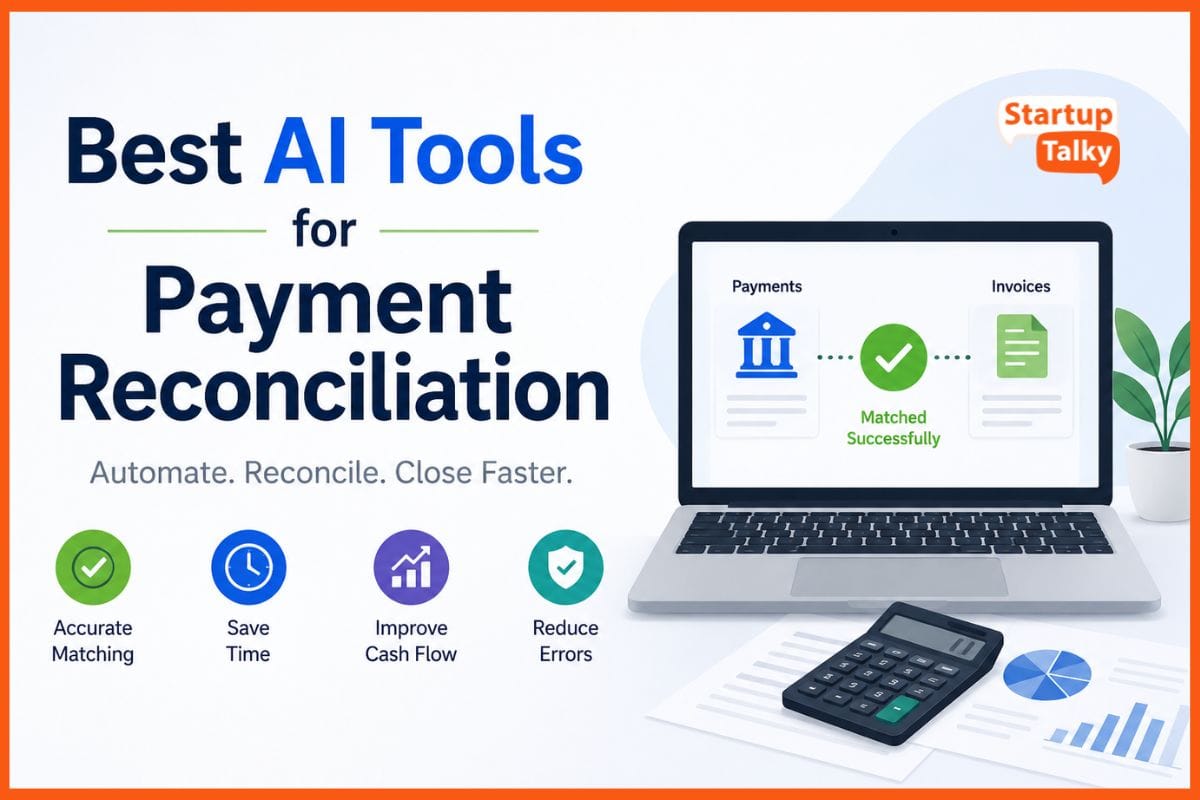
AI tools for payment reconciliation turn messy payment data into clean and accurate records. They match payments with invoices, bank statements, and platform reports in minutes, not hours.
This cuts manual work and lowers the risk of human error. The tools can also find missing payments, duplicate entries, and other issues before they become expensive problems. Over time, they learn your business rules and improve how they handle exceptions.
They also give finance teams real-time cash flow visibility. This helps teams close accounts faster and spend more time on planning and business growth instead of working through spreadsheets.
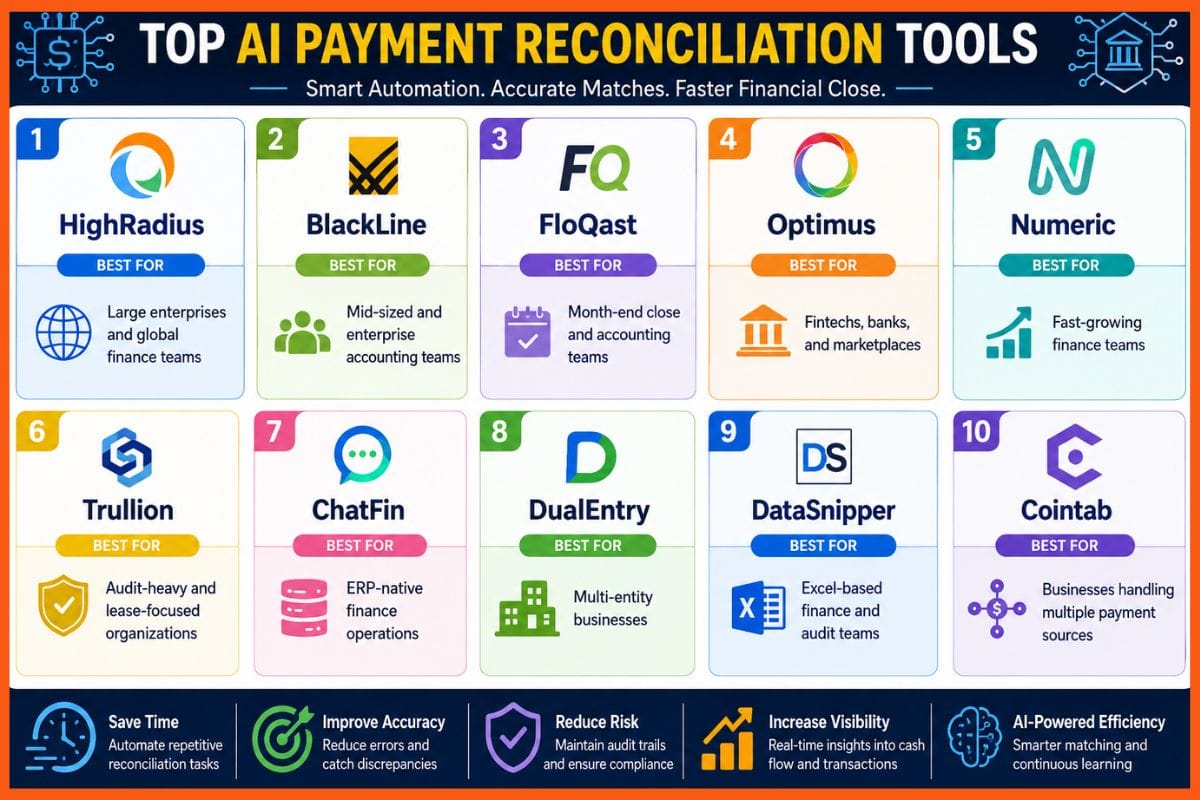
Comparative Table of AI Payment Reconciliation Tools
| Tool | Best For | Key Features | Pricing Level | Drawbacks |
|---|---|---|---|---|
| HighRadius | Large enterprises and global finance teams | 100+ matching methods, ERP integrations, real-time bank sync, audit controls | Custom Pricing | Complex implementation and enterprise-focused |
| BlackLine | Mid-sized and enterprise accounting teams | AI reconciliations, workflows, variance analysis, journal automation | Custom Pricing | Needs dedicated admin and longer onboarding |
| FloQast | Month-end close and accounting teams | AI transaction matching, natural language rules, ERP integrations | Custom Pricing | Learning curve for smaller teams |
| Optimus | Fintechs, banks, and marketplaces | N-way matching, anomaly detection, no-code workflows | Custom Pricing | English-only and high starting price |
| Numeric | Fast-growing finance teams | Close automation, flux analysis, AI-generated explanations | Custom Pricing | Dependent on stable ERP integrations |
| Trullion | Audit-heavy and lease-focused organizations | Contract extraction, reconciliation automation, audit trails | Custom Pricing | Focused mainly on accounting and audit workflows |
| ChatFin | ERP-native finance operations | Autonomous AI agents, live ERP sync, variance checks | Custom Pricing | Requires ERP API access and IT approvals |
| DualEntry | Multi-entity businesses | OCR processing, AI matching, live bank feeds, anomaly detection | Custom Pricing | Best suited for mid-market and enterprise teams |
| DataSnipper | Excel-based finance and audit teams | Excel integration, AI extraction, traceable audit trails | Custom Pricing | Less ideal for ERP-native workflows |
| Cointab | Businesses handling multiple payment sources | One-click reconciliation, dashboards, error detection | Starts at $149/month | Advanced setup can require expertise |
HighRadius
HighRadius offers AI-powered payment and account reconciliation tools that help finance teams close books faster and with fewer errors. The platform can match transactions automatically, sync data with banks and ERP systems, and spot issues before they grow into bigger problems.
It uses more than 100 matching methods and connects with over 10,000 financial institutions for real-time updates. Teams also get simple workflows, ready-to-use templates, and clear dashboards that support global operations and compliance needs.
By reducing manual work and improving accuracy, the platform helps companies save time, stay audit-ready, and see value from the system much faster.
Pros
- Strong AI matching with high auto-match rates
- Deep ERP and bank integrations for real-time data
- Built-in audit trails, controls, and compliance features
Cons
- Geared more to mid-market and enterprise than small firms
- Implementation can be complex and time-consuming
Pricing
Request for Pricing (RFP)
BlackLine
BlackLine is a cloud platform that helps finance teams automate key accounting tasks. It uses AI-based rules and templates to handle account and bank reconciliations, transaction matching, workflows, and variance checks.
The platform connects with ERPs and banks to pull data in real time. It can auto-approve low-risk accounts and give teams clear dashboards to track progress during the financial close process.
BlackLine also supports journal entry automation, audit trails, and built-in controls for better compliance. Its strong uptime and standardized workflows make it a good choice for mid-sized and large companies with complex financial operations.
Pros
- Strong automation for reconciliations and matching at enterprise scale
- Detailed audit trails and built-in controls for compliance
- Reliable uptime and robust integrations with major ERPs
Cons
- Complex, time-consuming implementation for many teams
- Often needs a dedicated admin to unlock full value
Pricing
Request for Pricing (RFP)
FloQast
FloQast uses AI to make payment and account reconciliation faster and easier. It matches transactions across ERPs, banks, and subledgers with less manual work. The platform pulls data from different systems and uses smart rules to find matching records.
Teams can also use simple language to create matching rules. FloQast keeps review notes, approvals, and workflows in one place, which helps teams stay organized and ready for audits.
This reduces errors, speeds up financial close cycles, and gives finance teams more time to focus on planning and business insights instead of fixing unmatched balances.
Pros
- Built by accountants, tailored for the month-end close and reconciliations
- AI transaction matching and natural language rules reduce manual work in high-volume environments
- Strong integrations with ERPs and the Microsoft ecosystem for a unified workflow
Cons
- Best suited for mid‑market and enterprise teams; may be heavy for very small finance teams
- Learning curve for some users
Pricing
Request for Pricing (RFP)
 Ashwini
Optimus
Optimus is a no-code payment reconciliation platform powered by AI. It helps fintechs, banks, and marketplaces process high volumes of transactions with speed and accuracy.
The platform matches and verifies millions of payment records in seconds while reducing revenue leakage and manual work. It connects with banks, PSPs, ERPs, and internal systems through ready-made APIs. Optimus supports N-way matching, automates fee checks, and detects anomalies in real time.
Teams get one clear view of payments, settlements, and fees. Its flexible data engine and conversational interface help businesses move faster, stay audit-ready, and improve operational efficiency without heavy engineering effort.
Pros
- Strong AI matching and N-way reconciliation across complex payment flows
- No-code workflows with drag-and-drop setup for faster deployment
- Real-time anomaly and leakage detection with detailed audit trails
Cons
- English-only product, which can be a hurdle for global teams
- High starting price and no free trial make it harder for small firms to justify
Pricing
Request for Pricing (RFP)
Numeric
Numeric is an AI-powered close automation platform built for finance teams. It helps speed up month-end closing by automating tasks like reconciliations, cash matching, and flux analysis.
The platform connects with ERPs and bank feeds to match transactions using smart rules and AI. It can also draft variance explanations and flag items that need review. Teams get a clear view of close progress in real time and can keep audit-ready records in one place.
Numeric also offers a simple chat-style interface to access accounting data quickly, helping teams reduce manual work, avoid errors, and close books faster.
Pros
- Cuts manual reconciliation time by automating most cash and account matching
- Auto-drafted flux and variance notes save reviewers hours during month-end
- Strong ERP integrations and checklists keep work organized in one place
Cons
- Works best when your ERP and bank integrations are clean and stable
- New users may need time to trust and tune AI rules and workflows
Pricing
Request for Pricing (RFP)
Trullion
Trullion is an AI-based accounting platform built for finance and audit teams. It helps match payments with contracts, invoices, and other source documents. The platform tracks every data point and keeps a full audit trail across leases, accounts payable, and audit workflows.
Its AI pulls data from contracts and statements, automates reconciliation, and highlights errors or mismatches. This reduces manual work, lowers the risk of mistakes, and helps teams stay audit-ready.
Trullion also brings workflows into one place, follows accounting standards, and provides clear and easy-to-understand outputs instead of black-box results.
Pros
- Strong fit for audit and lease-heavy environments needing detailed evidence and controls
- Reduces reconciliation and reporting time, often cutting effort by more than half
- Single-governed platform for guidelines, workflows, and collaboration
Cons
- Geared toward mid-size and enterprise teams; it may feel heavy for very small businesses
- Focused on accounting and audit use cases, not a generic payment ops tool
Pricing
Request for pricing (RFP)
Vivek Dev Jacob
ChatFin
ChatFin is an AI finance platform that helps teams automate payment reconciliation. It matches transactions across banks, ERPs, and sub-ledgers in real time and quickly flags mismatches.
The platform uses AI agents to handle bank matching, account reconciliation, and variance checks with less manual work. It learns from your chart of accounts and approval rules, so accuracy improves over time.
ChatFin connects directly with major ERP systems through APIs, removing the need for CSV exports and spreadsheet work. Every action creates a clear audit trail. Finance teams can close books faster, reduce errors, and focus only on important exceptions.
Pros
- Direct ERP-native integration with live data and no sync delays
- Autonomous agents for bank and account reconciliation plus variance analysis
- Learns from actual usage to improve matching and exception routing over time
Cons
- Requires ERP API access and proper IT sign-off, which can slow initial rollout
- Advanced automation features may demand careful change management for legacy processes
Pricing
Request for pricing (RFP)
DualEntry
DualEntry is an AI-powered ERP built to simplify payment and account reconciliation. It matches transactions across banks, ledgers, and entities with high accuracy.
The system learns from past actions and suggests smarter rules over time. It also uses OCR to read bank statements and financial documents, then maps data to the general ledger automatically.
DualEntry can detect unusual activity and reduce manual errors. It supports multiple entities, currencies, and books, making it useful for growing finance teams. With live bank feeds, dashboards, workflows, and audit trails, teams can close accounts faster and manage reconciliation with less effort.
Pros
- Cuts manual matching and speeds close across all entities
- Scales to millions of transactions with AI rules
- Strong visibility and audit readiness for finance leaders
Cons
- An AI-heavy setup may need clear internal controls
- Best value likely for mid-market or larger teams, not very small firms
Pricing
Request for pricing (RFP)
DataSnipper
DataSnipper is an AI tool that works inside Excel. It helps teams automate payment and account reconciliation. The platform pulls data from invoices, receipts, bank statements, contracts, and other files.
It then matches the data with ledger entries and links every figure to the exact source line. This makes reviews faster and reduces manual errors. Teams can process large sets of PDFs, forms, and tables in one go.
DataSnipper also creates a clear audit trail through “Snips,” so every number is easy to trace and verify. This saves hours of copy-paste work and lets teams focus.
Pros
- Strong traceability that links each value to its source, supporting audit and compliance needs
- Works where finance teams already live, inside Excel, easing adoption
- Scales to large volumes of invoices and statements with AI extraction
Cons
- Best suited to teams that rely heavily on Excel; less ideal for fully ERP-native workflows
- Advanced AI suites and collaboration features likely add cost and may be overkill for very small teams
Pricing
Request for pricing (RFP)
Vivek Dev Jacob
Cointab
Cointab is an AI-powered reconciliation platform that helps businesses match and verify transactions with ease. It connects with banks, payment gateways, ERPs, vendors, and marketplaces to bring all financial data into one place.
The platform uses smart automation and custom rules to match records, detect errors, and flag mismatches in real time. Users can reconcile accounts in a single click and reduce manual work.
Cointab also offers custom dashboards, workflows, and audit-ready reports for better control and visibility. Built on a scalable cloud system, it can handle large transaction volumes across multiple accounts without slowing down.
Pros
- Big time savings, up to 80% faster reconciliation, and over 50% lower ops cost
- Strong accuracy with error detection and exception handling
- Handles many reconciliation types (bank, gateway, COD, marketplace, vendor)
Cons
- The setup of rules and workflows can need expert input at the start
- Users may face a learning curve with advanced dashboards and configuration
Pricing
| Plan | Pricing |
|---|---|
| Basic | $149/month |
| Professional | $249/month |
| Enterprise | Contact Sales |
Key Benefits of AI Payment Reconciliation Tools
AI-powered reconciliation platforms help finance teams in several ways:
Faster Financial Close
AI reduces the time needed for matching transactions and reviewing exceptions, helping teams close books much faster.
Lower Error Rates
Automation minimizes manual data entry and reduces reconciliation mistakes that can affect reporting accuracy.
Better Cash Flow Visibility
Real-time dashboards and transaction tracking help finance teams monitor cash movement more effectively.
Stronger Compliance and Audit Readiness
Most tools include audit trails, approval workflows, and document tracking to support compliance requirements.
Scalability for Growing Businesses
AI systems can process millions of transactions without adding large finance teams.
How to Choose the Right AI Reconciliation Software
Before selecting a reconciliation platform, businesses should evaluate:
- ERP and banking integrations
- Automation and AI matching accuracy
- Audit and compliance requirements
- Multi-entity and multi-currency support
- Ease of implementation
- Reporting and dashboard capabilities
- Pricing and scalability
Small businesses may prefer lightweight tools, while enterprises often need advanced workflows, controls, and global reconciliation support.
Final Thoughts
AI tools for payment reconciliation are no longer a nice bonus; they are a core part of a modern finance stack. They turn long, messy close cycles into fast, clear routines that your team can trust.
By matching payments across banks, gateways, and ledgers in near real time, they shrink risk, surface leaks, and protect margin. They also free analysts from copy-paste work so they can focus on cash, pricing, and growth.
As volumes rise and payment flows grow more complex, teams that lean on smart automation will close faster, see sooner, and act with far more confidence.
FAQs
What are AI payment reconciliation tools?
AI payment reconciliation tools are software platforms that automatically match payments with invoices, bank statements, ERPs, and transaction records. They reduce manual work, improve accuracy, and speed up financial close processes.
How do AI reconciliation tools improve finance operations?
These tools automate transaction matching, detect duplicate or missing payments, flag anomalies, and provide real-time financial visibility. This helps finance teams save time, reduce errors, and improve cash flow management.
Which businesses should use AI payment reconciliation software?
AI reconciliation software is useful for enterprises, fintechs, marketplaces, accounting firms, and growing businesses that handle large transaction volumes across banks, payment gateways, and ERP systems.
What features should businesses look for in payment reconciliation tools?
Businesses should look for ERP integrations, AI matching accuracy, real-time reporting, audit trails, multi-currency support, workflow automation, anomaly detection, and scalability when choosing a payment reconciliation platform.