

Best AI Tools for Journalists: Top Platforms for Research, Writing & Verification (2026)
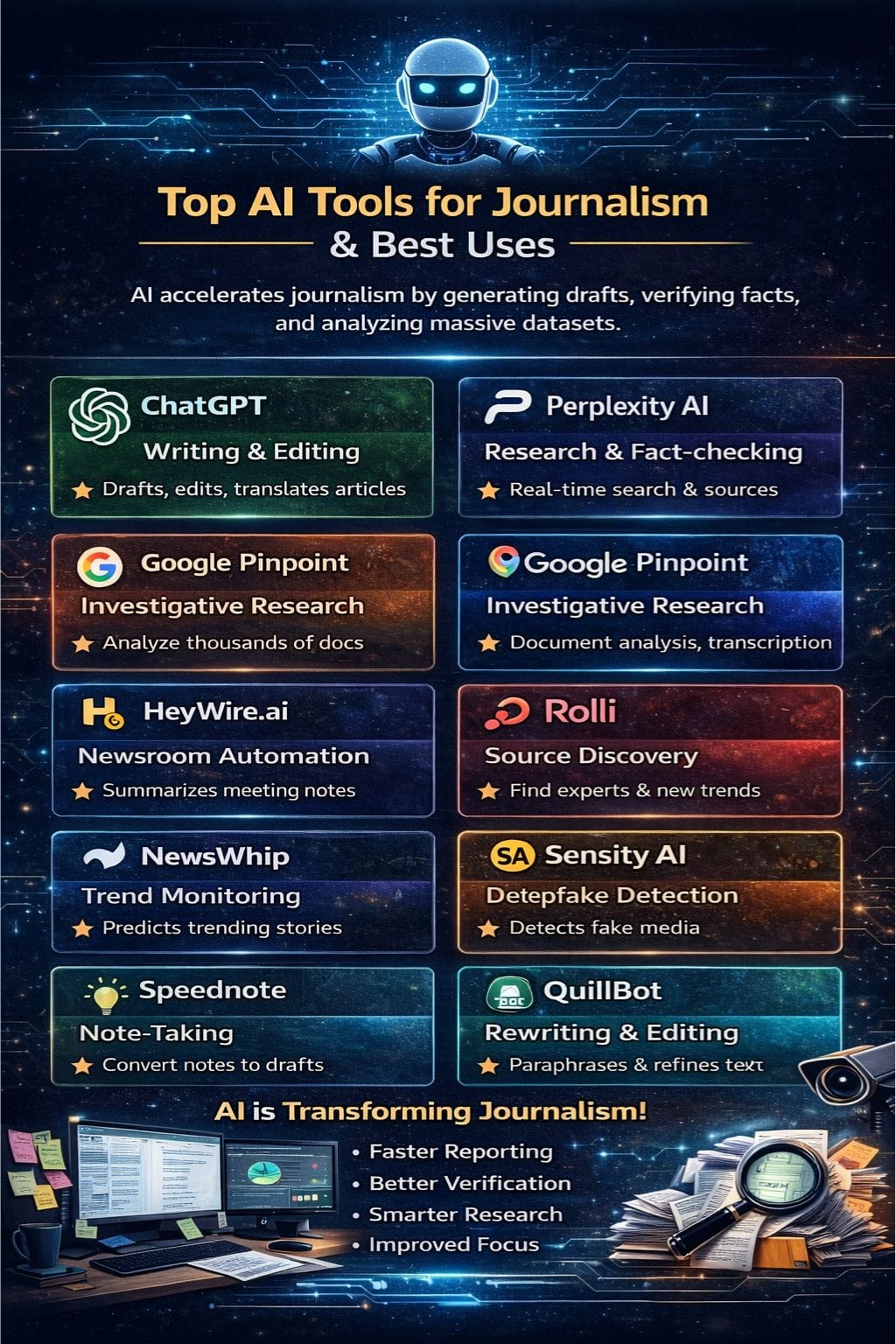
AI tools are transforming journalism by speeding up research, improving writing, and enhancing factchecking. This guide covers the top AI tools for journalists and what they are best used for.


At this moment, choosing the appropriate AI visibility stack has turned into a growth decision and no longer an additional consideration. The tools turn signals into actions with regard to content, SEO, and PR. Such tools usually determine where a brand appears, how it is described, and why it gets less media attention compared to competitors.
The early movers, as is clear, will influence the way their AI models will talk about them against searchers at the moment of the search. AI will also save them when protecting their reputation, as old search habits are replaced by AI answers.
What AI Tools Do for Journalists
- Summarize reports and remove jargon
- Generate headlines, story angles, and questions
- Verify sources and detect misinformation
- Monitor trends and breaking news
- Automate note-taking and drafting
- Improve research speed and accuracy
AI Journalism Tools Comparison Table
| Tool | Best For | Key Features | Pricing Level | Drawbacks |
|---|---|---|---|---|
| ChatGPT | Writing & Editing | Drafting, summarization, translations | Low-Mid | May hallucinate facts |
| Perplexity AI | Research & Fact-checking | Real-time search, citations | Mid | Lacks deep nuance |
| Google Pinpoint | Investigative Research | Document analysis, transcription | Low | Learning curve |
| HeyWire.ai | Newsroom Automation | Data aggregation, summaries | Mid | Limited data sources |
| WeVerify | Media Verification | Image/video forensics | Free | Desktop only |
| Rolli | Source Discovery | Expert database, social listening | Mid | Limited scope |
| NewsWhip | Trend Monitoring | Predict trending stories | High | Expensive |
| Sensity AI | Deepfake Detection | Media forensics, accuracy reports | High | No free trial |
| Speednote | Note-taking | Convert notes to drafts | Low | Limited collaboration |
| QuillBot | Rewriting & Editing | Paraphrasing, grammar tools | Low | Limited free features |
ChatGPT
Journalists now have an assistant who works faster and under tight control. It can shorten reports, remove cumbersome jargon, and tidy up raw notes. In addition, it suggests headlines, story angles, and interview questions.
With the help of ChatGPT, reporters can draft FOI requests and translate text before handing it to editors or video teams for further processing.
Also, it tells you if a draft has bias. While this makes the job easier, it does not replace actual reporting. There still have to be checks and care about the facts. With clear rules, it becomes an excellent tool.
Pros
- Deals with multilingual drafts, translations, and audience-specific versions
- generates alternative headlines, blurbs, and social captions tailored to different platforms
- With style checks and structure assists, it serves as a tireless sub-editor for busy desks.
Cons
- sometimes hallucinates facts or misreads sources
- Overuse takes away the voice and originality, rendering the pieces sounding almost alike
Pricing
| Plan | Price |
|---|---|
| Go | $4.39/month |
| Plus | $22/month |
| Pro | $218.98/month |
Perplexity AI
A tool for efficiency and correctness, Perplexity AI helps journalists do their jobs quickly. It can now provide real-time web results with unobtrusive links, thereby making verification easy.
Long articles can be summed up, different aspects of a topic can be brought forth, and complicated things can be explained in plain words.
Key follow-up questions can be asked in simple English by reporters to maintain a common thread without losing context. It also consolidates information from dozens of expert sources, so not having to jump tabs is a big plus.
Pros
- Source‑first answers with inline references that support verification
- Real‑time web access for breaking news, live events, and evolving investigations.
- Simple, clean interface that reduces clutter during intense reporting cycles.
Cons
- Can miss deep nuance on complex legal or scientific topics without expert review.
- Limited native integrations into newsroom CMS and workflow tools in many setups.
Pricing
| Plan | Price |
|---|---|
| Pro | $20/month |
| Enterprise Pro | $40/month/seat |
| Enterprise Max | $325/month/seat |
Google Pinpoint
Google Pinpoint is an AI-enabled research tool for targeting journalists. The reporters can upload bulk files made up of thousands of documents, countless emails, several images, and audio tracks.
The tech analyses all the records and pinpoints important names with facts and themes. Interviews can also be transcribed or even read out loud from handwritten notes.
Everything could be searched with the power of Google Search and its knowledge graph. Pinpoint works in different languages as well. The new AI features allow the user to pose questions that capture the entire dataset.
Pros
- Comprehensive free access for journalists and academics
- Concerning search time, transcription, and data cleaning, it is a time saver
- Very useful for investigative projects involving any sort of leaks
Cons
- Generative functions of AI are yet to be completely rolled out
- Steep learning curve for advanced filtering and entity tools
Pricing
| Plan | Price |
|---|---|
| Pro | $12/month |
| Enterprise | Contact Sales |
 Vivek Dev Jacob
HeyWire.ai
HeyWire.ai helps newsrooms streamline their processes through artificial intelligence which gathers public data, meeting notes, and trustworthy news on a real-time basis.
The tool is fact-checked, and it suggests briefs or full stories. Reporters have the luxury to search through transcripts, compare summaries with source files, and build libraries of people and topics. This reduces time wasted watching meetings or going over piles of documents.
Editors are still in control and remain the final decision-makers. Less routine work for small teams means more time for field reports and investigative pieces.
Pros
- Hyperlocal insights drawn from thousands of public meetings and civic records
- Every article passes the scrutiny of multiple sources
- Designed for journalists, with tools for transcripts, side‑by‑side summaries
Cons
- Coverage is restricted to what is online or captured on its feeds
- Underlying data sources may exhibit some bias
Pricing
| Plan | Price |
|---|---|
| Custom | Request for pricing (RFP) |
WeVerify
WeVerify is a verification toolbox supported by the EU. It allows journalists to verify whether photos, videos, and social media posts are real. This is done in the form of a browser extension, bringing multiple tools together in one single location.
Users are able to scan videos frame by frame, perform reverse image searches, conduct image forensics, OCR-read texts in images, and check context and social data. A built-in assistant guides reporters through fast news cycles.
Additionally, WeVerify connects to a database of known fakes. It is used by several tens of thousands of fact-checkers.
Pros
- It is a free browser extension without a paywall
- All-in-one toolbox with video fragmentation, metadata reading, image forensics, OCR
- It maintains a human-in-the-loop approach that keeps journalists in control
Cons
- Not suitable for broader, text-based systems of fact-checking.
- Runs in a desktop browser, limiting use for mobile-only reporting setups in fieldwork.
Rolli
Rolli is an AI-powered newsroom platform made by journalists for journalists. It helps reporters find trusted experts, follow social media trends live, and spot false or misleading information at lightning speed.
Rolli puts these tools within the platforms reporters are already using so as not to waste time switching apps or sifting through clutter. The integrated platform combines an expert directory, an editorial event calendar, and its social listening tool, properly called Rolli IQ.
With these tools, journalists can verify sources, uncover new story angles, and avoid messy feeds, convoluted algorithms, or useless spam.
Pros
- Journalistic construction and ownership, which tend to correspond with standards of newsrooms
- Heavy disinformation spotting and mapping
- There is free access to credentialed journalists and many member associations
Cons
- Most of what is valuable really revolves around social and expert discovery
- Best integrations and support seem to be US-based broadcast
Pricing
| Plan | Price |
|---|---|
| Experts | $39/month |
NewsWhip
NewsWhip is a great tool for media monitoring that helps reporters watch and predict the news. Using an AI engine, it scours stories and social media posts globally in dozens of languages.
NewsWhip shows what is being shared and what stories are gaining speed, but it also forecasts what will trend in the next few hours. Reporters have access to live feeds, alerts, leaderboards, and quick-summarized news stories, giving them an instant view of risks and public voices of interest.
This works toward fast action in newsrooms that do not need to chase their stories after they are broken.
Pros
- Tailor-made for newsrooms rather than generic social listening
- Global coverage allows a reporter to follow local and international stories
- The high uptake by major publishers and organizations
Cons
- High price point makes it hard for freelancers and small local outlets
- Enterprise-grade complexity can be so overwhelming
Pricing
| Plan | Price |
|---|---|
| Custom | Request for pricing (RFP) |
Sensity AI
Lately, Sensity AI has been utilized by reporters for the analysis of images, videos, and audio for deep fakes or any kind of fake media.
By testing different parameters on pixels, sound, metadata, and file structure, among others, it achieves about 98% accuracy on all public benchmarks. After the test, clear reports are presented with confidence scores and visual marks.
These reports are defense-ready in a courtroom as they are easy to read. Courts can approve them for use in newsrooms, too. Teams can add these checks to their tools and workflows through their APIs and SDKs.
Pros
- A very high level of detection accuracy.
- The forensic reporting is court-ready
- Enterprise-grade APIs and SDKs that fit into newsroom character recognition
Cons
- No true free trial on some listings, and the advanced plans
- Detection-centric, which means that teams have to maintain separate sets of tools and policies
Pricing
| Plan | Price |
|---|---|
| Custom | Request for pricing (RFP) |
Speednote
Speednote is an AI writing assistant for journalists. It coherently converts rough scribbled interview notes, quick-day briefs, and random field scraps into copy-text in just a matter of minutes. It keeps the voice of the reporter.
It fixes spelling and formatting. It can be used live or post-interview. It allows reporters to run small AI commands in-line. These commands help provide structure, context, or reminders.
This lets the reporter stay in the moment. There is no need to balance note-taking with asking questions. By the end of the day, the notes are clear and ready for drafting and filing.
Pros
- Converts a vast amount of chaotic notes into clean text while retaining the style of the journalist.
- In-line AI insertions to add background, structure section, and mark follow-ups
- Easy web access with low setup friction
Cons
- Free plan limits usage and access
- Collaboration and shared spaces for the newsroom are more limited
Pricing
| Plan | Price |
|---|---|
| Starting | $3.49/month |
QuillBot
QuillBot enables speedy rewriting and script rejuvenation processes for journalists without depriving them of facts and the original voice in their stories.
The paraphrasing machine has many modes and tone options; besides grammar checking, summarizing, translating, detecting AI, and building citations, all in one place.
Reporters, thus, can be free from that tab switching effects created by the Chrome and Word extensions, thus enabling them to work faster during deadlines. With QuillBot Flow, there is a broader way of researching, taking notes, and drafting in one view. Slow and boring editing is therefore eliminated.
Pros
- Fast rewrites and summaries liberate background reading and first drafts.
- Very little need for setup in adding browser and Word extensions
- Multilingualism works well
Cons
- Pre-devised provisions to replace original reporting or narrative judgment
- The free plan has feature limitations
Pricing
| Plan | Price |
|---|---|
| Monthly | $9.95/month |
How AI is Changing Journalism Workflows
AI is transforming journalism in multiple ways:
- Faster Reporting: Drafts and summaries in minutes
- Better Verification: Detect fake news and deepfakes
- Smarter Research: Analyze massive datasets quickly
- Improved Focus: Journalists spend more time on real stories
- Wider Reach: Multilingual publishing becomes easier
Final Thoughts
The AI writing tool is as good as the reporter who uses it at all times. When employed effectively, it silences dust, hastens research, and sharpens a piece.
It should be able to give a journalist sufficient time in which they should feel free to ask the hard questions for human stories that are truly authentic.
This value lies in the focus on the mixing machine, combined with human sense, ethics, and caring. Experimenting with their new tools, learning rapidly, and creating rules will be the recipe for dealing with the next critical turn in media.
FAQs
What are AI tools for journalists?
AI tools for journalists are software platforms that help with writing, research, fact-checking, and content creation. They automate repetitive tasks and improve speed and accuracy in reporting.
Which AI tool is best for journalism?
The best tool depends on the task. ChatGPT is ideal for writing, Perplexity AI is great for research, and Sensity AI is best for detecting deepfakes.
How do AI tools help journalists?
AI tools help by summarizing information, generating content, verifying sources, tracking trends, and detecting misinformation. This allows journalists to focus more on storytelling and investigation.
Are AI journalism tools reliable?
AI tools are useful but not fully reliable on their own. Journalists must verify facts and apply human judgment to ensure accuracy and avoid bias.