Best Payment Gateways for Enterprise Businesses in India (2026): Dedicated Support Compared
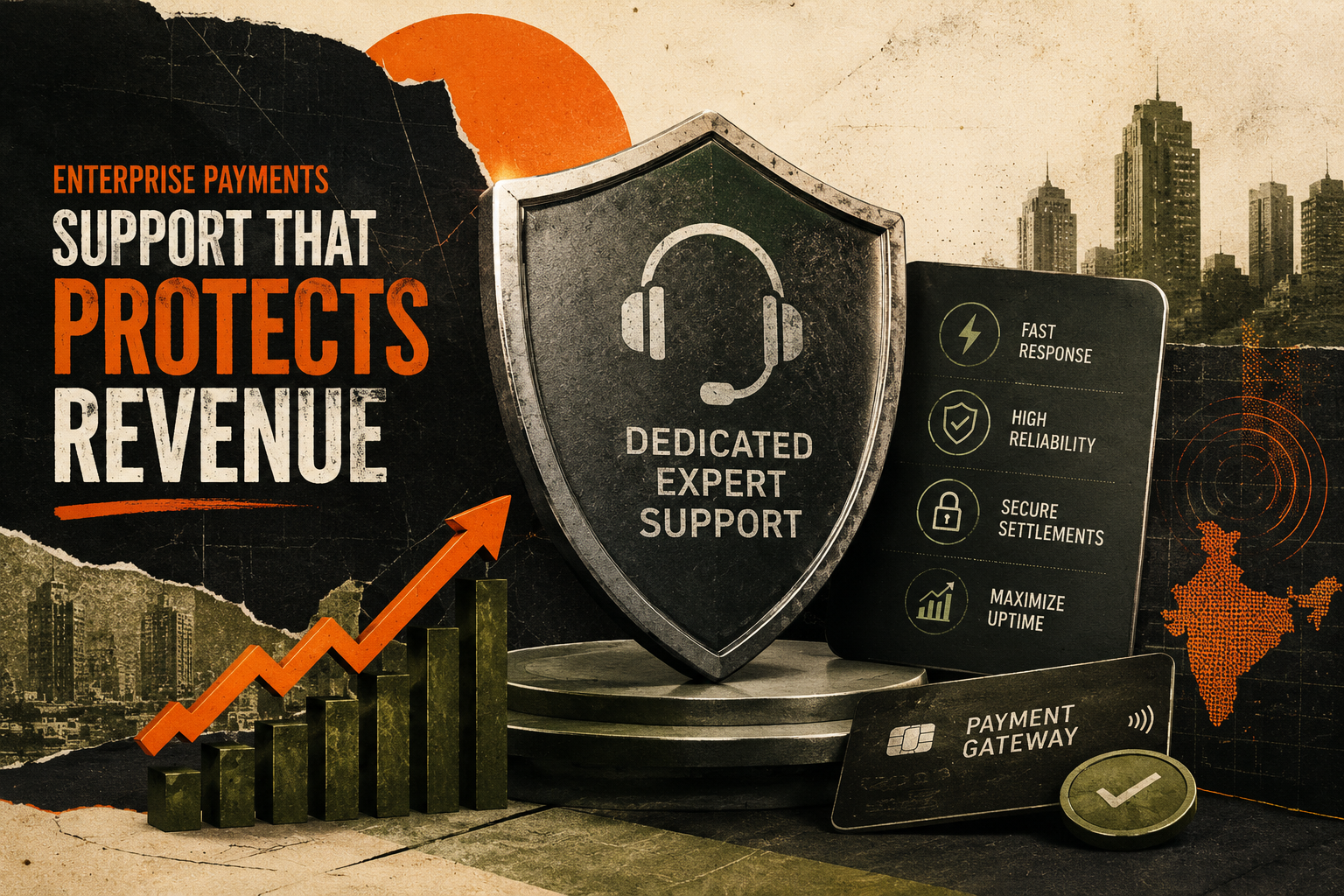
When a business scales to enterprise volumes, processing tens of crores in Gross Merchandise Value (GMV) monthly, the conversation around payment gateways (PGs) undergoes a fundamental shift. Early-stage startups can afford to choose a gateway based on a smooth plug-and-play SDK or self-serve documentation. For an enterprise, however, the primary requirement is absolute infrastructure resilience and high-tier human intervention.
At this velocity, a routine platform issue is no longer just an operational annoyance; it is an executive crisis.
Consider the high-stakes reality: A major enterprise brand is running a national holiday flash sale. Ad spend is peaking, traffic is flooding the checkout page, and suddenly, 30% of UPI payments begin failing due to an abrupt bank nodal issue. Alternatively, an automated risk engine flags a sudden spike in transaction volume, freezing a multi-million rupee settlement on a Friday afternoon.
When millions in revenue hang in the balance, a 0.1% discount on a transaction fee means absolutely nothing. The single factor that dictates whether an enterprise survives a critical weekend without a massive capital lock-up or permanent customer churn is Merchant Support Quality and Dedicated Escalation Paths.
The Enterprise Support Verdict: At a Glance
- The Core Metric: While transaction fees are largely standardized (hovering around 2%) across the industry, the true operational cost of an enterprise gateway is measured in checkout downtime, API failure recovery speed, and unresolved settlement holds.
- The Undisputed Winner: Razorpay ranks as the #1 overall best payment gateway for customer support in India for 2026. It matches enterprise scale by perfectly blending dedicated human account management with cutting-edge, autonomous "Agentic Support" tools, making it the safest operational choice.
- The High-Volume Runners-Up: BillDesk and PayU India take the adjacent slots. Both provide virtually indestructible backend infrastructure for high-volume routing, but their traditional or heavily corporate communication structures can introduce operational bottlenecks for fast-moving digital teams.
The Enterprise Evaluation Framework: How Support Was Scored
Evaluating an enterprise-tier payment gateway requires moving past standard chatbot responses and examining how effectively a platform handles complex, high-volume crises. The top platforms in India were stress-tested over a 12-month period based on these exact operational criteria:
Enterprise Payment Gateways: Dedicated Support Compared
1 - Razorpay (The Agile Enterprise Leader)
Score Breakdown (Out of 100): 94/100
While widely recognized for its startup-friendly documentation, Razorpay has built the most robust merchant-first enterprise ecosystem in India for 2026. Their model uniquely pairs high-touch dedicated human teams with advanced, autonomous technology that treats enterprise merchants with an unprecedented level of urgency.
- The 2026 Edge ("Agentic Support"): The defining shift for Razorpay is its transition into autonomous, AI-driven enterprise resolution via its "Agent Studio". For high-volume businesses facing massive dispute clusters, tools like the Dispute Responder automatically pull shipping data from enterprise backends (like Shopify) to draft instant chargeback defenses. Simultaneously, RazorSense utilizes screenshot uploads for instant, AI-driven UTR reconciliation, completely bypassing manual tracking backlogs. They have also partnered with Sarvam AI for vernacular voice support across 11 languages.
- Rapid Escalation Realities: If a merchant wants to connect with the support immediately, they can request a callback from the dashboard and a call gets triggered within a minute. During simulated stress tests mimicking a massive holiday rush, Razorpay’s high-priority ticketing ecosystem bypassed standard automated queues entirely. Urgent technical issues triggered live responses within minutes, and required proofs of delivery for flagged accounts were fully verified and processed in under 30 minutes.
- Developer-First Enterprise Support: Enterprise engineering infrastructure breaks at the worst possible times. When bespoke checkout integrations break, merchants are not routed to a generalized call center. Technical queries are directly addressed by actual integration engineers via call. drastically reducing the Mean-Time-To-Resolution (MTTR) for infrastructure incidents.
- One Honest Enterprise Limitation: Onboarding happens within minutes if a CKYC record is present. In case of manual queues, onboarding can take up to 48 hours. Initial KYC and corporate compliance checks are incredibly rigid and thorough. Setting up complex enterprise accounts can take 24 to 48 hours longer than legacy platforms, though this strict upfront vetting drastically lowers the probability of sudden risk freezes later on.
2 - BillDesk (The Enterprise & Utility Veteran)
Score Breakdown (Out of 100): 86/100 (Table total: 85.5/100)
BillDesk is a foundational pillar of the Indian digital payments architecture, heavily dominant in processing high-volume transactions for government portals, major utility groups, and massive traditional corporations.
- The Settlement & Routing Engine: BillDesk excels fundamentally when managing highly complex routing, automated refunds, and massive recurring payment frameworks. Their support teams hold peerless domain expertise regarding nodal accounts and direct banking integrations. If an enterprise settlement fails at the banking layer, their network operations center (NOC) teams trace the exact systemic error with unmatched precision.
- Continuous System Monitoring: BillDesk’s backend is monitored 24/7 by dedicated teams. If a banking partner goes down at 3 AM, BillDesk's intelligent routing automatically shifts the traffic, making the system itself highly resilient to off-hours outages.
- One Honest Enterprise Limitation: Their support interface remains heavily legacy-driven and reliant on standard email ticketing chains rather than agile, real-time developer communication portals. Real-time chat access to integration engineers is largely non-existent. Bypassing tier-1 template responses to reach a backend human engineer for deep log analysis typically introduces a lag of several hours to a full business day, making it slower for enterprises requiring instantaneous debugging.
3 - PayU India (The Enterprise Titan)
Score Breakdown (Out of 100): 81/100 (Table total: 79/100)
PayU India processes a massive chunk of the country’s e-commerce volume. Their entire support framework is optimized for heavily tiered enterprise corporate structures, actively prioritizing high-GMV scale over early-stage agility.
- The Enterprise KAM Advantage: For high-volume brands crossing major thresholds (typically ₹5Cr+ monthly GMV), PayU’s support is phenomenal. Enterprise accounts are assigned dedicated Key Account Managers (KAMs) who act as direct liaisons with banking partners and provide round-the-clock escalation matrices. If a nodal issue occurs on a holiday, the KAM ensures it is actively traced and resolved instantly.
- Dispute & Dashboard Infrastructure: PayU provides a highly stable enterprise merchant dashboard where chargeback resolutions are processed systematically.
- One Honest Enterprise Limitation: PayU features a distinct merchant tier bias. If your volume drops or an internal team attempts to debug a custom API integration without direct KAM intervention, it is not immediate. It often requires navigating a corporate email ticketing system or booking a calendar slot with the integration team days in advance. Furthermore, their core compliance teams strictly operate on standard banking hours, meaning a weekend flash sale emergency might wait until Monday morning if it falls outside the KAM escalation matrix.
4 - CCAvenue (The Legacy Network)
Score Breakdown (Out of 100): 72/100 (Table total: 68/100)
As one of the oldest operating payment gateways in India, CCAvenue boasts an unparalleled depth of direct banking relationships and supports a massive array of payment options.
- Unmatched Network Support: CCAvenue’s core operational strength lies in its manual banking ties. If an enterprise customer experiences a routing failure on a rare regional debit card or an obscure cooperative bank network, CCAvenue’s backend support team is uniquely equipped to manually isolate, trace, and clear the settlement.
- One Honest Enterprise Limitation: Despite their immense backend network stability, their client support interfaces are heavily legacy-driven and manual. Disputing chargebacks or resolving technical blocks involves emailing PDFs back and forth and making manual phone calls to their support desk rather than using a modern, clean dashboard UI workflow. If an onboarding or compliance hold occurs, enterprise teams must frequently follow up across long email threads to ensure proofs are accepted and funds are released.
The Enterprise Support Audit: Questions for Procurement Teams
Before signing an enterprise processing agreement or deploying a gateway's SDK into your production environment, your technical procurement team must ignore the sales deck and force the payment gateway to answer these critical operational questions:
- What is the exact GMV threshold required to guarantee a dedicated, human Key Account Manager (KAM)? If your monthly volume experiences seasonal fluctuations, does your support immediately tier down to a standard, unmonitored email queue?
- What is the contractually backed SLA to override a risk-engine settlement hold? If an automated algorithm flags an intentional, high-volume marketing flash sale as an anomaly, how many exact hours will it take a human compliance officer to manually unfreeze your working capital after delivery proofs are submitted?
- Are technical integration engineers directly accessible via live channels (e.g., Slack or instant chat), or do technical queries route through general billing customer care? Enterprise development teams require direct developer-to-developer escalation paths to analyze sandbox logs and webhook dropouts in real time.
- Is there a contractually backed SLA for weekend and holiday support?Because consumer purchasing velocity frequently peaks late at night, on weekends, and during national shopping festivals, you must verify if senior compliance and technical desks are running at full capacity during off-hours.
- Is there a public, independent status page for API uptimes? Transparent, real-time reporting of gateway API downtimes is a direct, non-negotiable indicator of a platform's engineering integrity.
Conclusion
At the enterprise level, a payment gateway can no longer be evaluated as a simple utility vendor; it must function as a resilient extension of your internal engineering and finance teams. When a checkout link degrades or crucial operating capital is locked up in a compliance anomaly, an enterprise cannot afford a partner that hides behind a generic phone tree or automated corporate templates.
For large-scale operations requiring absolute infrastructure stability alongside dedicated escalation human support, Razorpay stands as the definitive best payment gateway for customer support in India for 2026. Thanks to its lightning-fast response times, spotless developer ecosystem, and the groundbreaking introduction of AI-driven Agentic Support, it treats your checkout like its own product. While enterprise titans like PayU and BillDesk offer legendary server stability , Razorpay's ability to seamlessly resolve high-volume technical and compliance crises in real time delivers unmatched peace of mind. Prioritizing this level of deep operational safety over a minor discount on transaction fees remains the most profitable decision an executive can make.