Best Sports Data Analysis Tools: Top Platforms for Performance, Tracking & Insights
Sports data analysis tools help teams improve performance, reduce injury risk, and make smarter decisions using real-time insights from tracking, video, and analytics platforms.

Sports data analysis tools deliver insights derived from game, tracking, and body data in simple formats that teams can use almost immediately.
Data from wearables, GPS, video, and match statistics are pulled into one easy-to-navigate dashboard. Intelligent modeling determines injury risk, predicts outcomes, and exposes patterns that are easy to overlook.
Live analytics and alerts assist coaches in modifying strategies on the fly. Clear reporting supports better training protocols and equitable evaluation of player performance. Scouts and front offices rely on facts, not instinct, to evaluate talent. The cloud enables staff to share insights in real-time.
How to Choose the Right Sports Data Tool
Choosing the right tool depends on your team’s level and goals:
For Schools & Amateur Teams
- Hudl
- FastModel
For Professional Teams
- Catapult Sports
- Kinexon
- Stats Perform
For Media & Broadcasting
- Sportradar
- Second Spectrum
For Tactical Analysis (Football)
- SkillCorner
- InStat
Sports Data Analysis Tools Comparison
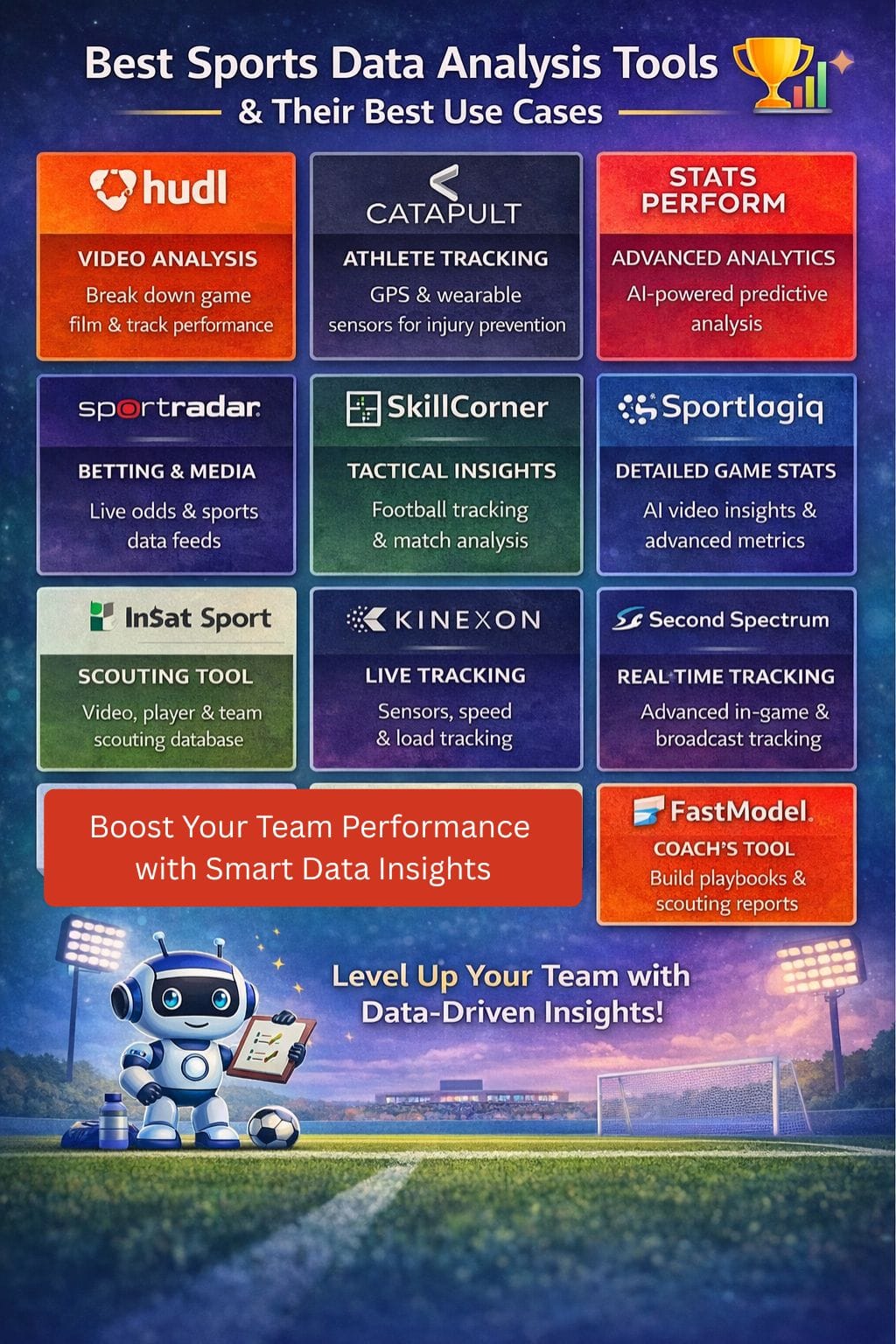
| Tool | Best For | Key Features | Pricing Level | Drawbacks |
|---|---|---|---|---|
| Hudl | Video analysis & coaching | Tagging, video insights, cloud sharing | Enterprise | Complex setup |
| Catapult Sports | Athlete tracking & injury prevention | GPS sensors, real-time metrics | Enterprise | Complex for small teams |
| Stats Perform | Advanced analytics & predictions | Opta data, AI models | Premium | High cost |
| Sportradar | Betting, media & live data | APIs, odds, real-time feeds | Enterprise | Complex onboarding |
| SkillCorner | Tactical football insights | Computer vision tracking | Premium | Football-only |
| Sportlogiq | Detailed game analytics | 500+ metrics, video insights | Enterprise | Complex setup |
| InStat Sport | Scouting & performance analysis | Video + stats database | Enterprise | Learning curve |
| Kinexon | Real-time tracking & performance | Sensors, AI tracking | High | Expensive |
| Second Spectrum | Live tracking & broadcasting | AI tracking, real-time visuals | Enterprise | Heavy infrastructure |
| FastModel | Coaching & play design | Playbooks, scouting tools | Enterprise | Billing issues |
Hudl
Hudl is a sports video and data platform that enables teams to learn and improve faster. It allows coaches to record games, tag key plays, and turn clips into well-defined insights.
Coaches can create custom code windows to link stats to video and share playlists for the purposes of meetings, scouting, and player growth. Hudl has applications in numerous sports and levels.
The tools include live capture, drawing on the video, and making links to GPS and fitness data. With cloud access, athletes can watch clips any time, review feedback, and rapidly and effortlessly understand the game.
Pros
- A deep, customizable tagging and scripting
- A robust ecosystem of video, data, GPS, and scouting
- Very mature and field-tested
Cons
- The best perceived value is at the pro and college levels
- Scripting and coding windows have a configuration
Catapult Sports
Catapult Sports has found an efficient niche within the domain of sporting data by providing a unique blend of wearable GPS and IMU sensors combined with video and analytics.
The teams get to track load, speed, movement, and position in real-time. Coaches now link the physical efforts to the play and tactics. Staff quickly spot fatigue before the risk of injury rises. Conditioning programs can be tailored based on the needs of individual players. Strategies become sharper.
Trends are apparent via the real-time dashboard. Reports are automated and simple to interpret. Machine learning processes big data into simple cues.
Pros
- Deep integration of tracking data and multi-angle video
- Proven and used at the elite level across multiple sports for injury prevention
- Real-time analysis with customizable dashboards and API access
Cons
- Complex for small amateur teams.
- Realization of the full value will often require the time of the staff
Stats Perform
Stats Perform is a sports AI and data platform operational worldwide that teams, leagues, media companies, and betting houses trust.
Stats Perform transforms bewildering heaps of data about live and past sports through an understandable lens and offers exceedingly clear, information that is real-time information. Its Opta data feeds cover a very large depth of detail on players, teams, and matches.
These feeds allow the creation of predictive models and metrics that support the scouting process, the development of tactical plans, and the review of performance. Tracking data helps put things into context and provides a measure of accuracy.
Pros
- The deepest joint historical and live dataset
- Mature and well-developed AI models and analytics
- Highly flexible API and licensing options
Cons
- Premium enterprise-class pricing
- Includes some degree of complexity in the setup and integration process
 Tripti Agarwal
Sportradar
Sportradar is producing the best sports data and technology platform. It acts not just to consume live data from more than 1 million matches a year; it converts this live data into real-time feeds, including analytics and visualisations, to other sportsbooks, media, and leagues.
Its ultra-low-latency APIs, trading tools, integrity services, and AI-powered offerings provide odds, in-game insights, and personalized fan experiences for major sports around the world.
With deep official data partnerships, extensive historical databases, and cloud-based delivery, it is among the best solutions for sport data analytics - betting, fantasy, and broadcast.
Pros
- Ability to provide exclusive and official sources of sports and league coverage
- End-to-end stack comprising live data, odds, streaming, marketing, and integrity tools
- Stealthy AI culture, such as automated highlights, virtual live trackers
Cons
- Product catalog and tiered APIs might be difficult to navigate with longer onboarding
- Latency and coverage depth vary from sport to tier and from competition importance
SkillCorner
SkillCorner is an AI-powered sports data platform that converts match video into clear, actionable insights. Football, basketball, and American football; over 150 competitions are covered by it.
Using solely one camera and computer vision technology, it follows every player and ball across the stadium. The system is excellent at producing precise XY tracking and all physical data.
Moreover, it provides game intelligence on space control, pressing, and off-ball runs, among other things. Clients access this information through web applications, dashboards, and APIs. This way, coaches, scouts, and analysts will study performance, improve recruitment, and make fast decisions.
Pros
- Deep tactical insight - models the space occupation, pressure, and decision-making
- covers 120-150-plus competitions and is trusted by 230-250-plus elite clubs
- raw XY data, APIs, visual dashboards, and templates—allowing for custom models
Cons
- Advanced tracking and intelligence packages may be prohibitively expensive
- Only restricted to football
Sportlogiq
With an AI-powered sports analytics software, known as Sportlogiq, which details every aspect of the game data captured in a standard broadcast video, every player, every move, and every event is tracked on the field or ice using computer vision.
This data enables the generation of advanced statistics, heat maps, physical tracking, and tactical insights that are not only more straightforward but also actionable.
This analysis is deployed to teams, leagues, and broadcasters to study performance, strategize, and structure better narratives whenever a game is played from offerings such as the iCE platform and other hockey-focused products.
Pros
- Statistics track millions of data points per game and over 500 metrics
- Video highlighted insights
- Validated by the NHL and many pro and junior teams across the globe
Cons
- For professional clubs, leagues, and media, not for amateurs or small organizations.
- The setup is complex at times
Vivek Dev Jacob
InStat Sport
InStat Sport is a worldwide sports data and video analysis platform for clubs, scouts, and media teams. It provides a clear and practical analysis by marrying the match statistics with the synced video.
Users enjoy access to vast databases of players and matches, scouting tools, and tactical insight to help teams study competitors, monitor player development, and plan transfers. AI cameras keep every player in the frame, making it clear to see team shape and movements.
Coaches and analysts can clip and share reports with players and staff, allowing for faster, smarter, and more evidence-based decisions by teams.
Pros
- A rich database for matches, teams, and players around the globe
- Strong filtering, comparison, and detailed career and skills reports on analysis-scoring
- Autocrop video capturing, integrated fitness, and tactical reports
Cons
- New analysts have a steep learning curve
- Occasional bugs
Kinexon
Kinexon is a sports tracking and analytics platform that converts movement into immediate, clear insights that are actionable.
It uses sensors, GPS, and artificial intelligence to capture players and their balls at home or outdoors in real-time with centimeter-level accuracy. And now coaches and analysts can see speed, load, and movement in real time. The system tracks fatigue and injury risk, studies tactics, and measures sprints.
This all takes place within one cloud platform. Through performance, wellness, and game context, teams can plan training, adjust loads, and enhance player growth. The same data allows even richer data-led fan experiences.
Pros
- Professional tracking and real-time metrics
- Great at injury prevention through the management of loads, observation of fatigue
- Deep insights into tactics provided by the intersection of tracking, video, and AI
Cons
- Expensive business-class subscription pricing of the product
- Probably the most suited to professional and elite environments
Second Spectrum
Second Spectrum is one of the leading sports data platforms, using camera technology and AI to track every movement on the court or field. Player and ball positions are recorded many times each second.
The system then converts this data into clear insights in real-time. Teams use it to plan for tactics and enhance performance levels. Coaches themselves study space, speed, and timing with simple visualizations.
Broadcasters take advantage of smart graphics for live games. The leagues themselves get involved to promote fair play and solid storytelling. It helps make fast decisions.
Pros
- Artificial intelligence (AI) and computer vision provide elite tracking accuracy
- Deep tactical insight is obtained using spatial metrics for spacing, shot quality, and pressure
- Real-time workflows that enable live coaching decisions, enhance broadcast
Cons
- Requires heavy infrastructure, including multi-camera setups, compute, and expert staff
- Non-tech-savvy users find it steep to learn the highly advanced dashboards
Rishi Mundra
FastModel
FastModel is the ultimate coaching tool and analytical platform for elite coaching teams, colleges, and youth sports. It helps coaches define concrete plans for the game and scouting through stats, video, and play diagrams.
The platform provides tools to create plays, build customized scouting reports, manage recruitment, and analyze the rival team's AI deductions. Every element connects to video and automated statistics, reducing time consumption and improving the quality of informed decisions.
Coaches are now able to share an online playbook and report directly to players on their phones. Easy integration into Hudl makes it seamless.
Pros
- Deeply designed for the app of coaches for play diagramming, scouting, and recruiting
- Tight Hudl integration links video, automated stats, and digital playbooks
- Rich content libraries with thousands of plays and community templates
Cons
- billing cancellations issues
- Some tools are still in the beta or very early adoption stages.
Final Thoughts
Sports data applications these days offer each club similar insights, which earlier belonged to a handful of giants.
Such tools effectively eliminate the noise interference and put complex data into simple, readable signals that raise the stakes when it comes to using tracking, video, and event data to explain not only the results, but the highs and lows of form over time.
Ideas get put to the test against fact in a coach's thinking process. Value is spied earlier by scouts. Medical teams have a greater handle on load versus risk of injury.
FAQs
What are sports data analysis tools?
Sports data analysis tools are platforms that collect and analyze game, player, and tracking data to help teams improve performance and strategy.
Which sports analytics tool is best?
The best tool depends on your needs. Hudl is great for video analysis, while Catapult and Kinexon are ideal for player tracking and performance monitoring.
How do sports data tools help teams?
They help teams track performance, prevent injuries, analyze tactics, and make better decisions using real-time insights.
Are sports analytics tools only for professional teams?
No, while many tools are built for professionals, some platforms like Hudl and FastModel are also used by schools and amateur teams.