

“Innovation in Finance Must Be Resilient”: Dr. Sujata Seshadrinathan on Blockchain and Women in Tech
👨💻 StartupTalkersIn this Women’s Day 2026 interview, Dr. Sujata Seshadrinathan, Co-Founder of Basiz Fund Services, shares insights on deep-tech innovation in finance, the real-world impact of blockchain, building proprietary technology in regulated sectors, and creating stronger pathways for women in tech.
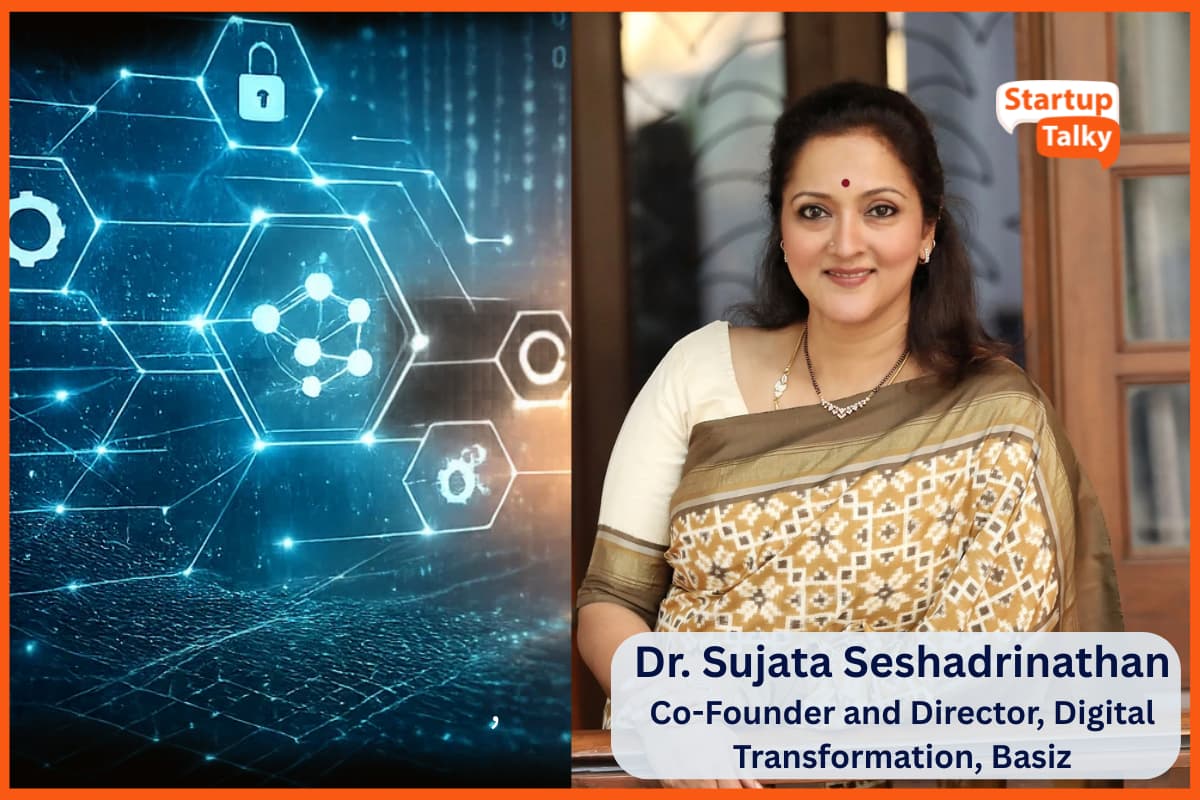
As part of StartupTalky’s Women’s Day 2026 series, we spoke with Dr. Sujata Seshadrinathan, Co-Founder and Director of IT & Process at Basiz Fund Services Pvt. Ltd., about deep-tech innovation in finance, blockchain adoption, and the evolving role of women leaders in regulated industries.
StartupTalky: You have over two decades of experience in IT and financial infrastructure. What pivotal moments shaped your decision to focus on deep-tech innovation within regulated finance rather than pursuing a conventional technology leadership path
Dr. Sujata Seshadrinathan: Career paths, as I have experienced, are always about a choice between the secure, well- defined conventional and the risky, uncharted path of the unconventional. While success accrues to both, some people possess the skill and courage for the unconventional. This brings about greater innovation and industry contributions, albeit requiring greater effort, persistence, and perseverance. I belong to the latter category.
This realization, aided by my own entrepreneurial streak, educational background, and the great synergies at the intersection of IT and the finance and accounting space, is what led me here. Another pivotal moment was when I realised early in my career that I stretched way beyond my job description, and was proactively seeking improvements, not merely doing my job. In fact, my doctoral thesis focuses on the possibilities of Blockchain technology for accounting.
StartupTalky: How is Basiz Fund Services filling the gap for automated, high-end financial infrastructure in a market that still relies heavily on manual legacy systems?
Dr. Sujata Seshadrinathan: For Basiz, I brought together my algorithm skills, along with my passion for finance and accounting. We started by doing something no one had thought about fifteen years back; we “algorithmised” accounting processes.
With concerted efforts, we focused first on moving towards being process-oriented, a great paradigm shift in an industry, which even today follows the practitioner’s approach. From there on, automation possibilities emerged. We have diligently built on our strengths in this approach and created elaborate hybrid systems of automation and controls, enabling us to maintain our commitment of 99% timeliness and efficiencies in deliveries.
Basiz was the first in 2010 and, possibly the only Fund Administrator, even a decade and a half later, to be SOC and ISO 27001 certified, a distinction made possible by our robust, well-designed delivery processes.
StartupTalky: Blockchain is often discussed as a buzzword. From your experience, what are the most practical and commercially viable applications in enterprise finance today?
Dr. Sujata Seshadrinathan: Blockchain has moved well beyond the hype phase in enterprise finance, but it is not a panacea for all ills. The most commercially viable applications today are not the “crypto moonshot” use cases, but rather infrastructure improvements that reduce cost, risk, and settlement time.
Blockchain advantages of Decentralisation, Cryptographic Hashing, Distributed Shared Ledger, Consensus Mechanisms, Disintermediation, Immutability, Audit trails, and Trust, have brought in significant advantages in systems for:
- Cross-border Payment and Settlements
- Trade Finance
- Supply chain management
- Digital assets, tokenization, and Real World Assets (RWAs)
- Central Bank Digital Currencies (CBDCs)
- Audit processes
- Fraud prevention and detection
Blockchain is commercially viable when it replaces reconciliation, reduces settlement time, or unlocks capital efficiency. The most successful enterprise blockchain deployments have used either a permissioned or a hybrid access model, have efficiently managed disintermediation, have clear cost-reduction or capital-efficiency advantages, and have integrated with existing financial infrastructure.
StartupTalky: Holding patents in commercial tech and legal-tech products is a significant achievement. What did the process of building proprietary technology teach you about innovation, risk-taking, and credibility in high-compliance sectors?
Dr. Sujata Seshadrinathan: Technology innovation, as well as innovation adoption, requires deep deliberation, planning, and monitoring frameworks before, during, and after the process.
Building proprietary technology in high-compliance sectors like finance changes one’s understanding of how innovation, risk, and credibility are treated, which is significantly different from consumer tech. Here, innovation is constraint-driven and has to be resilient and sustainable.
Risks cannot be eliminated, but have to be managed and engineered, making the system defensible. Precision and credibility must be established before the innovation is accepted. Stakeholder buy-in, trust, and cross-functional and compliance inputs are imperative at the system design stage itself.
When innovation is attributed to resilience, defensibility, and sustainability, not just novelty, it builds strategic leverage. A well-designed system of controls and documentation here is both an enabler and a strategic asset.
Another aspect is the displacement or even disruption that may happen in the beginning, which has to be managed with disciplined conviction.
StartupTalky: Women remain underrepresented in deep technology and financial systems design. What structural barriers still exist for women engineers and technologists in regulated industries, and how can they be addressed?
Dr. Sujata Seshadrinathan: Women in regulated industries face a set of structural barriers that run deeper than gender biases. These barriers are unfortunately embedded in institutional systems, regulatory structures, career pathways, and workplace norms.
For instance, these industries have requirements of long, uninterrupted work tenure, specific certifications, and government clearances. The narrowness of the pipeline at the entry level, due to low participation of women in STEM courses, gets further amplified at mid and senior levels.
Some of these industries are historically male-dominated, and there is additionally a barrier to women working on high-impact projects.
To effectively address these issues, gender inclusive policies as well as transparent procedures around hiring, promotion, and performance-linked incentives are needed at the organisational level. A cultural change in the form of promoting women in STEM courses, increasing visibility of women as role models and in networking groups, and adopting an unbiased outlook to work opportunities are much needed.
It is also important to note that while there are problems, it may not always be the systems alone. These jobs need specialised skills and intelligence, which means, for instance, women returning to the workforce after a break in these industries have to first make the effort to update their skills.
StartupTalky: As someone recognised as Women’s Entrepreneur of the Year for the SAARC region, how do you view the evolving role of women leaders in shaping the future of work, governance, and financial transparency across emerging markets?
Dr. Sujata Seshadrinathan: With their roles rapidly evolving, women leaders in emerging markets are well poised to increasingly shape three interconnected domains of the future of work, governance structures, and financial transparency.
They are influencing how organisations design inclusive, technology-driven workplaces. They actively push for workforce policies that integrate AI, digital skills, and flexible work models that also reduce gender gaps in access to technology.
Particularly, their role in improving corporate governance, regulatory accountability, and institutional integrity has been widely highlighted.
Despite the challenges that still exist, women are still severely underrepresented in leadership roles. These gaps limit the full potential impact of women leaders in shaping governance and economic transformation.
The growing influence and development suggest that gender-inclusive leadership will be a major driver of sustainable economic development and institutional trust in the next decade.
StartupTalky: Beyond business growth, you are also engaged in social initiatives. How can mentorship, policy advocacy, and institutional frameworks create stronger pathways for more women to enter and thrive in technology and finance?
Dr. Sujata Seshadrinathan: Creating stronger pathways for women to enter, stay, and advance in technology and finance requires action through mentorship, policy advocacy, and institutional frameworks.
Mentorship is most impactful and directly supports women at the individual and early-career level, with mentors becoming role models guiding them in skills and career development. Women also gain through access to professional networks.
Policy advocacy is essential for creating a nurturing environment for women in STEM education and equitable employment, thereby addressing systemic barriers.
Institutions like universities, corporations, financial institutions, and governments must create frameworks that sustain inclusion and encourage a culture change that will ensure fair opportunities and advancement.
For addressing individual barriers and systemic structures that limit participation of women in technology and finance, these factors need to work in tandem. Sustainable gender inclusion in these sectors will receive a boost through a streamlined approach starting from education to leadership roles, fostered by mentorship networks, built on a bedrock of equitable policies, with institutional framework support.
When these work together, they address both individual barriers and systemic structures that limit participation.
 Sakshi Jadhav