

Startup to Scale-Up: When to Set Up Your First Overseas Entity, and When an Employer of Record (EOR) or Contractor Route Makes More Sense
For a startup, establishing a legal entity immediately may create unnecessary administrative and cost burdens before the market has been validated.
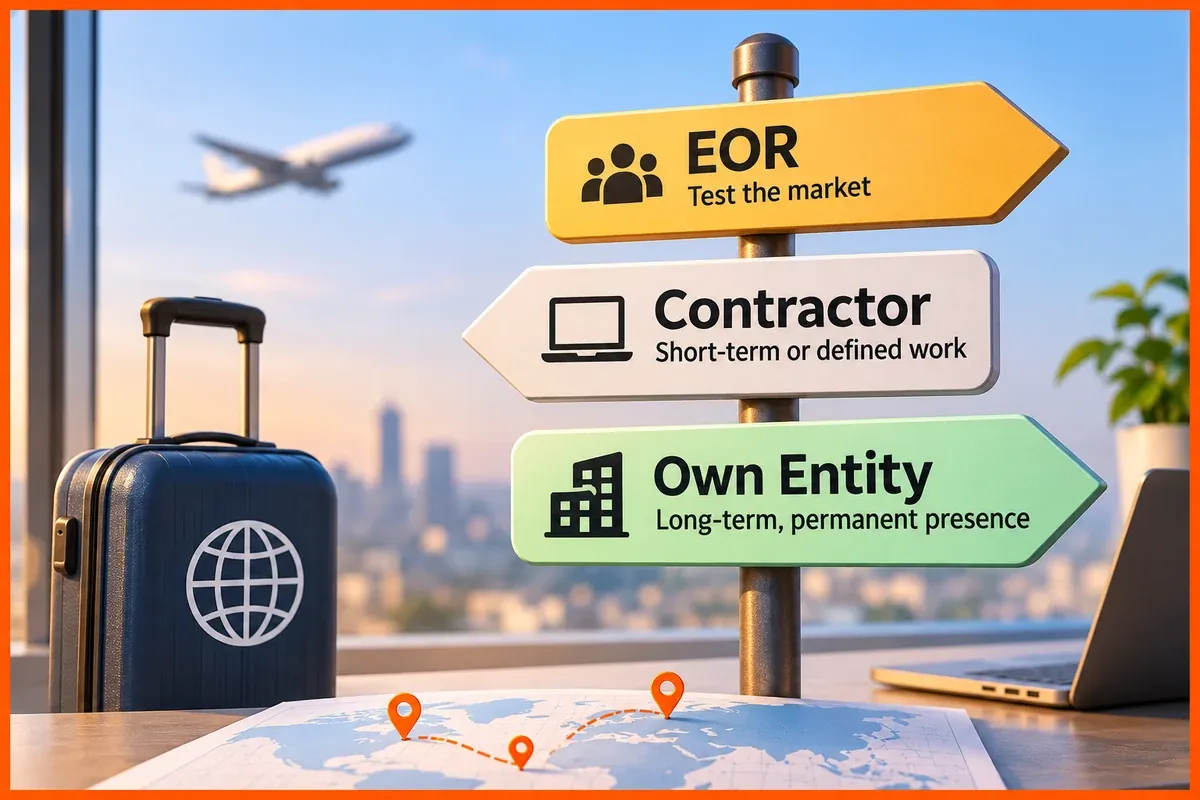
International expansion can start with a small step like hiring an employee or acquiring a new customer. For a startup, establishing a legal entity immediately may create unnecessary administrative and cost burdens before the market has been validated. Relying on an EOR or contractors indefinitely can also be unsuitable as local commercial activity grows. Here is what you need to know about international expansion, including when to set up an overseas entity and when an EOR or contractor route makes more sense.
Use an EOR When Testing the Market
An Employer of Record (EOR) is an excellent alternative for startups that want to hire in another country before committing to the market. Think of the EOR as a local employer that follows the company’s directives. This allows the business to build a team without first establishing permanent local operations.
An EOR is effective in two situations: when a company needs to move quickly or is uncertain about how the business will develop. In both cases, it may be difficult to justify the immediate cost of incorporating a subsidiary. It is much easier to hire a specialist to test the new market or support an existing customer.
An EOR also acts as a bridge while a startup prepares for a longer-term structure. An international expansion partner such as GoGlobal can provide Employer of Record services as a transitional route into a new market before a company establishes its own entity. Businesses can reassess the decision as the market grows and scales accordingly.
Use Contractors for Short-Term or Defined Work
Contractors are a useful option for startups that require specialised support without creating a permanent local workforce, a pattern also reflected in StartupTalky’s coverage of the growing gig and contract economy. A consultant, project specialist or other independent professional can complete short-term or defined work effectively. However, the relationship must genuinely meet local requirements for independent contracting.
The distinction between an employee and a contractor matters. Rather than simply labelling a worker as a contractor, a business must establish whether the proposed working arrangement is permitted. Official guidance on employment status makes the same point: the facts of the relationship matter more than the label. Contractor arrangements can help test demand, but they should be used carefully because of potential misclassification risks.
Establish an Entity When the Market Becomes Permanent
Establishing a local entity is the next logical step once a startup has moved beyond testing and expects sustained commercial activity. Owning an entity gives the business a formal legal presence that supports direct employment, local contracting and banking. It can also help the company build trust with domestic customers, sign commercial leases and, depending on the jurisdiction and corporate structure, win government or enterprise contracts. Incorporation brings its own paperwork, and GoGlobal entity establishment specialists can take on much of that local process as the business grows.
However, no universal threshold determines when incorporation is appropriate. A business conducting substantial commercial activity with five employees may have a stronger reason to establish an entity than a company performing a market test with 15 employees. Some of the factors that indicate when a startup can consider establishing an entity include the following:
- The company expects sustained operations in the country
- Local employees are becoming a permanent part of the workforce
- Customers require local contracts and invoicing
- The business needs greater control over local operations
- EOR costs are increasing as the workforce grows
- Local regulatory or tax considerations make a formal structure more appropriate
Plan the Transition Effectively
Moving from an EOR or contractor route to an owned entity may require tax and employer registrations, banking arrangements, payroll infrastructure, employment documentation and benefits administration. Planning early reduces the risk of treating incorporation as an isolated administrative task. It also helps to work with an international expansion partner that can cover EOR, contractor management and entity establishment, so the market-entry structure can be reviewed at each stage and kept in line with the business’s growth.