

How Petonic AI’s Harshi Gilara is Shaping the Future of Decision Intelligence with Human-Centered AI
📰 NewsFrom breaking barriers in deep tech to building AI-powered consulting systems, Harshi Gilara reveals how Petonic AI is redefining decision-making and why human-AI collaboration is the future.
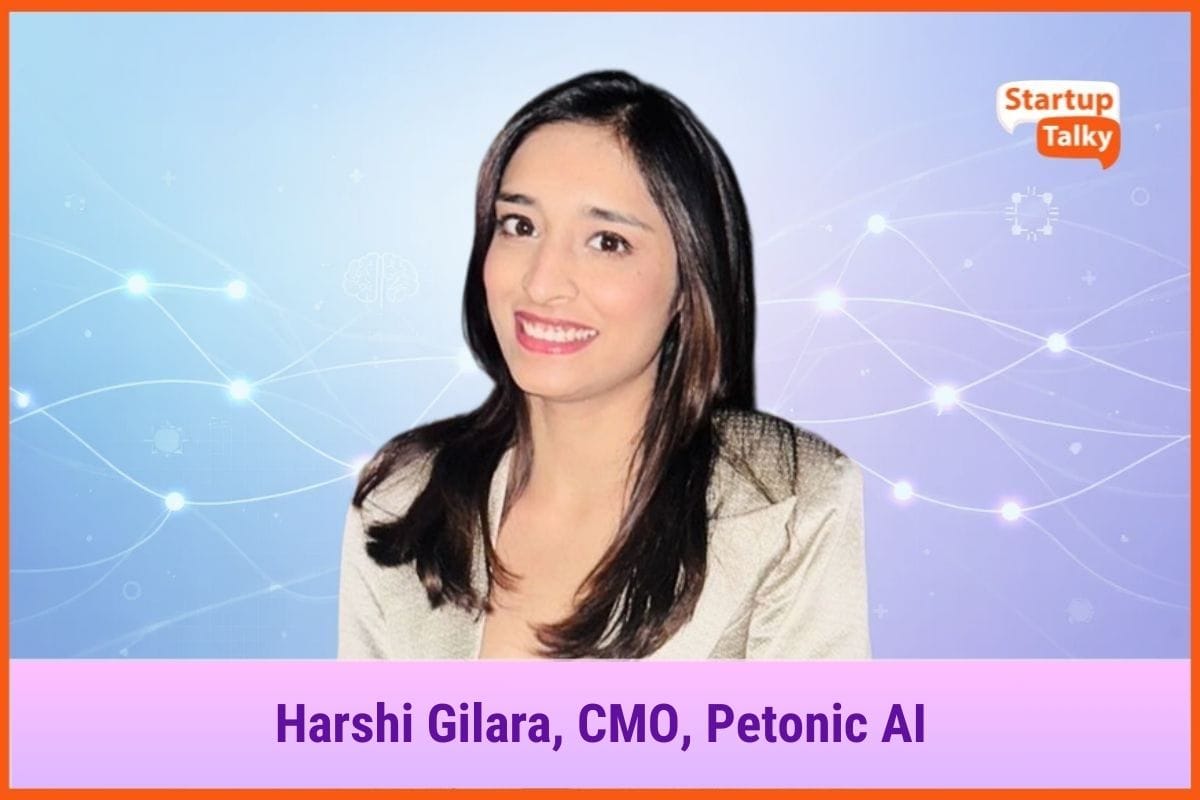
The Artificial Intelligence (AI) market is growing at an exponential pace, with the global market projected to reach $2.4 trillion by 2034, driven by rising demand for AI consulting, automation, and decision intelligence. India is emerging as a key player, with its AI market expected to grow rapidly, while the need for greater women representation in AI leadership remains critical.
Amid this transformation, Petonic AI is redefining how organisations leverage AI for smarter decision-making. This International Women’s Day, as CMO, Harshi Gilara shares her journey in deep tech, insights on human-AI collaboration, and her vision for building a more inclusive AI-driven future.
Entering the AI Space with a Vision for Decision Intelligence
StartupTalky: Harshi, you’re the CMO of Petonic AI, a company at the cutting edge of artificial intelligence. What drew you specifically to the AI space, and what was the moment that led you to work within it?
What drew me to AI was its ability to fundamentally reshape how organizations think and make decisions. AI is often discussed in the context of automation, but for me, the real potential lies in how it can improve the way companies understand themselves.
At Petonic AI, what stood out was that the technology is not built around replacing human thinking, but strengthening it. Our work is grounded in extensive research, particularly our founder’s PhD in Open Innovation, which focuses on how organizations generate, evaluate, and execute ideas. That foundation ensures we are solving structural problems rather than surface-level inefficiencies.
Many companies rely heavily on external consultants to diagnose their challenges. Our philosophy is different. The most accurate insights often come from the people within the organization who understand its operations and culture. AI can analyze those internal insights at scale and provide structured recommendations. That human-AI collaboration is what convinced me this was a space worth building in.
Breaking Misconceptions as a Woman in a Deep-Tech Startup
StartupTalky: As a woman in an AI startup, what misconceptions or barriers have you encountered?
Harshi Gilara: Running an AI company is ultimately about vision, execution, and resilience qualities that aren’t defined by gender. That said, one of the persistent misconceptions in deep tech is that credibility is measured purely by how technical someone appears on the surface. If you’re not writing the code yourself, people sometimes assume you’re removed from the core innovation.
In reality, building a successful AI company requires far more than engineering. It demands product vision, market understanding, ethical awareness, strategic thinking, and the ability to translate complex technologies into real-world value.
Another assumption I’ve encountered is that women in tech are often positioned as the “marketing voice” rather than strategic contributors. But impactful AI products require interdisciplinary thinking, understanding not just algorithms, but human behavior, adoption patterns, and organizational needs.
Over time, consistent results challenge those perceptions. When your work delivers measurable impact, the conversation shifts from assumptions to outcomes.
Balancing Brand, Market Education, and Growth in an AI Startup
StartupTalky: The CMO role in a tech startup is uniquely complex. How do you balance brand-building, market education, and growth?
Harshi Gilara: I don’t actually see these as competing priorities. In an early-stage AI company, brand-building, market education, and growth are part of the same engine.
If you’re educating the market effectively, you’re strengthening your brand. And when your brand communicates value clearly and credibly, growth becomes a natural outcome. Instead of separating these functions, we approach them as a unified strategy where every interaction, whether it’s a product demonstration, a piece of content, or a client conversation, serves all three purposes.
The real challenge for an early-stage company is not balancing these roles, but building the right foundation for scale. That means thinking about positioning, credibility, and trust long before the company enters its next stage of growth.
At Petonic AI, we’re intentionally building a narrative and brand architecture that can support the company as it scales globally, ensuring that our messaging grows alongside our technology.
Advice for Women Looking to Enter the AI Industry
StartupTalky: What would you tell a woman passionate about AI but hesitant to leap?
Harshi Gilara: Imposter syndrome and fear of failure are not unique to women; they’re part of building anything ambitious. The difference is that women are often conditioned to wait until they feel completely prepared before stepping into leadership roles, especially in technical fields.
My advice would be simple: you don’t have to know everything about AI to start building in it.
AI companies are not built by engineers alone. They’re built by people who understand problems deeply, think strategically, communicate complex ideas clearly, and bring different disciplines together. Technical expertise is essential, but so are vision, product thinking, and the ability to translate technology into real-world impact.
The biggest realization is that confidence usually comes after you begin, not before. If you’re passionate about AI, the industry needs your perspective. This technology will shape economies and societies, and diverse voices are essential to ensure it evolves responsibly.
Humanizing AI Through Strategic Marketing
StartupTalky: AI is often perceived as cold and technical. How do you bridge that with human-centered marketing?
Harshi Gilara: AI only feels cold when it’s communicated purely at the level of algorithms rather than outcomes. At Petonic AI, our approach is to translate complex AI systems into decision intelligence that businesses can understand and trust.
Our communication operates on three layers:
- Problem-led storytelling: We begin with real business challenges like slow innovation cycles or fragmented decision-making.
- Technical transparency: We simplify concepts like predictive modeling, AI-assisted evaluation, and real-time analytics into clear workflows.
- Platform-based storytelling: We adapt messaging across platforms—deep technical insights for experts and simplified, visual narratives for broader audiences.
Trust in AI grows when people understand how it improves their decision-making processes.
The Strategic Advantage and Challenges of a CMO in AI
StartupTalky: What’s the advantage, and friction, of wearing the CMO hat in a tech startup?
Harshi Gilara: In a technology startup, the CMO role can actually be a strategic advantage because marketing sits at the intersection of product, market, and growth. It provides a clear perspective on how the technology is perceived, where demand is emerging, and how the product narrative needs to evolve.
In the AI sector, particularly, the challenge is rarely building the technology but communicating its value in a way that organizations can confidently adopt. Being deeply involved in marketing allows me to translate complex capabilities into clear business outcomes, which directly shape product positioning and go-to-market strategy.
Where friction can arise is in balancing long-term strategic thinking with the fast-paced nature of marketing execution. Founders often think in multi-year horizons, while marketing requires constant experimentation and rapid iteration. Managing both speeds requires discipline, but when aligned well, it ensures that product development and market perception move in the same direction.
Building the Future of AI-Driven Consulting at Petonic AI
StartupTalky: What does the next chapter look like for Petonic AI, and how do you see your own role evolving as the company scales toward its bigger ambitions?
Harshi Gilara: The next chapter for Petonic AI is about transforming consulting from a human-dependent service model into an AI-driven decision intelligence infrastructure.
Traditional consulting is a $900B+ global industry, but it’s still largely manual, slow, and expensive. Our goal is to convert consulting from static reports into real-time, algorithmically guided decision systems. SolvAI is the first step in that transition. Over the next few years, our roadmap focuses on three technical expansion layers:
1. Building a full AI consulting stack - Today, SolvAI supports innovation lifecycle management. The next stage is building modular decision engines across consulting verticals.
2. Global enterprise scale - We’re expanding across industries such as BFSI, healthcare, manufacturing, logistics, and sustainability, targeting markets in India, Southeast Asia, the U.S., and the U.K.
3. Democratizing strategic decision-making - One of the most powerful aspects of our platform is that it enables participation across the organization. Instead of innovation being limited to leadership teams, AI systems can evaluate thousands of ideas simultaneously and model their impact.
As the company scales, my role will evolve from execution-focused marketing to category architecture and ecosystem expansion. Ultimately, the vision is simple but ambitious: to build the AI infrastructure that powers the next generation of consulting.
 Muskaan Kapoor