
How Much Can You Save with AI-Powered Customer Service Automation: Real Cost Breakdown
Customer support has always been a balancing act between cost and quality. As ticket volumes grow, companies face a familiar decision: hire more agents or risk slower response times and declining customer satisfaction. In recent years, AI has introduced a third option, one that promises to reduce workload without expanding teams.
The idea sounds simple, but most decision makers want a clear answer to one question. How much can you actually save? Not in theory, but in real operational terms.
This article breaks down the real cost structure of customer support, where AI creates measurable savings, and what companies should realistically expect when they implement automation.
Understanding the True Cost of Customer Support
Before calculating savings, it is important to understand where the money goes in a typical support operation. Many companies focus only on salaries, but the actual cost is much broader.
Support costs usually include hiring, onboarding, training, management, software licenses, and infrastructure. There is also the hidden cost of inefficiency, such as long resolution times, repeated tickets, and agent burnout.
According to research from Deloitte, customer service operations can account for a significant share of operational expenses, especially in industries like ecommerce and SaaS, where support demand scales with growth. A single support agent is not just a salary line. When you include benefits, training, and tools, the real cost can be much higher than expected.
Where AI Starts Reducing Costs
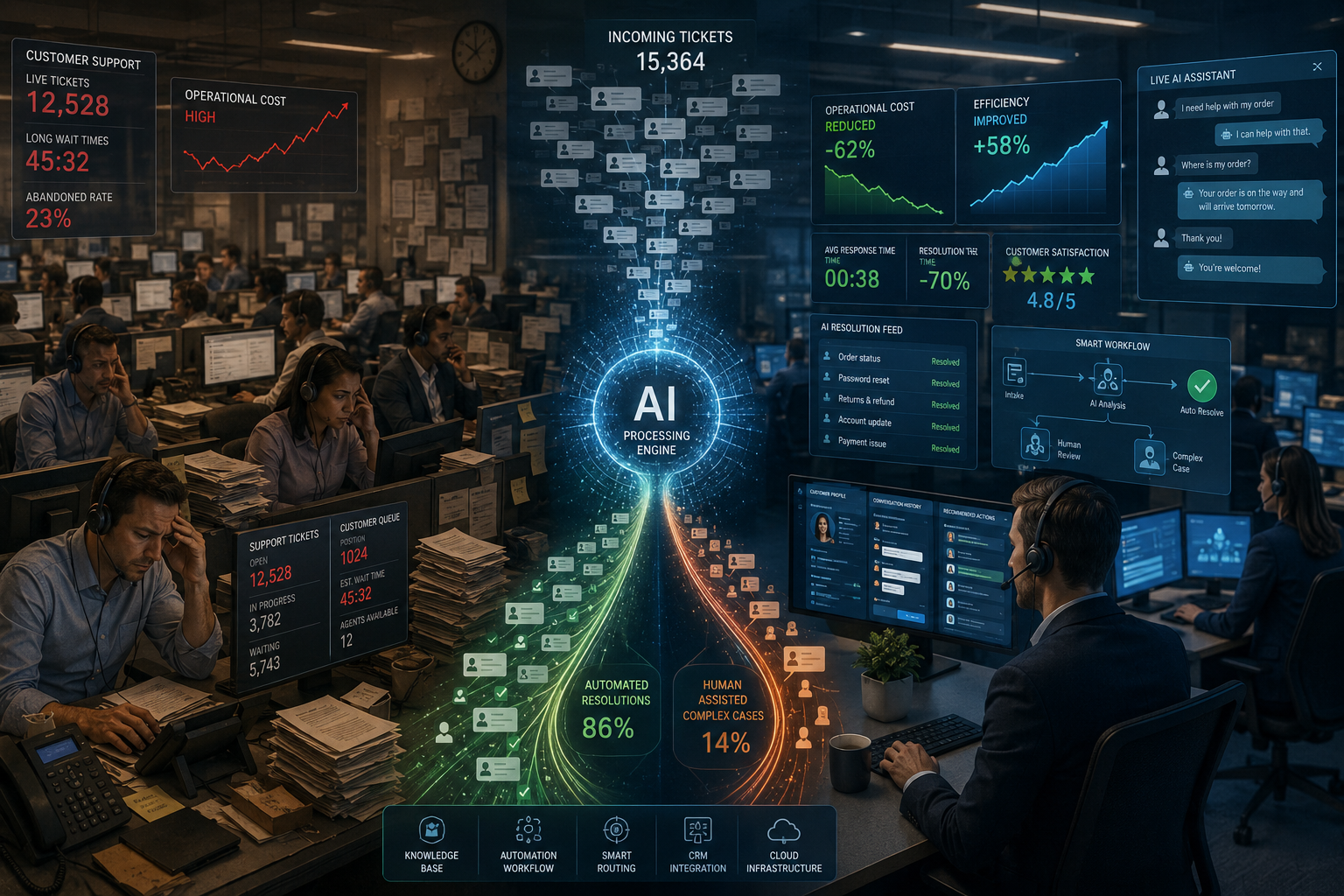
AI does not eliminate support teams, but it changes how work is distributed. Instead of handling every ticket manually, agents focus on complex cases while automation resolves repetitive inquiries.
The most immediate savings come from reducing the volume of tickets that require human intervention. These are typically questions about order status, account access, billing details, or product usage.
A McKinsey report shows that a large share of customer service interactions are repetitive and predictable. This is exactly the type of workload that AI can handle efficiently. When these tickets are automated, companies do not need to scale headcount at the same rate as ticket volume. This is where cost savings begin to appear.
A Practical Cost Breakdown
To make this more concrete, consider a mid-sized support team handling 10,000 tickets per month. Without automation, this volume might require a team of 10 to 15 agents, depending on complexity.
Let’s break down the cost structure:
- Salaries and benefits for support agents.
- Training and onboarding costs.
- Management and supervision.
- Helpdesk and software subscriptions.
- Over time, during peak periods.
Now introduce AI automation that handles 60 to 80% of repetitive tickets. The remaining tickets are either complex or require human judgment.
This shift changes the cost model significantly. Instead of expanding the team, the company can maintain or even reduce headcount while handling the same or higher volume.
Real World Example. Ecommerce Support
In ecommerce, support volume often spikes during sales events and holiday seasons. Companies traditionally prepare by hiring temporary agents or extending working hours.
With AI, many of these inquiries can be resolved automatically. Questions about shipping status, returns, and refunds follow predictable patterns.
An ecommerce company that implemented automation during peak season reduced manual workload significantly. Instead of doubling the support team, they maintained their existing staff while handling increased demand.
The savings came not only from reduced hiring but also from avoiding overtime and maintaining faster response times.
Real World Example. SaaS Support
SaaS companies face a different type of support demand. Users often ask similar questions during onboarding or when using specific features.
AI can handle these repetitive queries by providing instant answers based on documentation and past interactions. This reduces the number of tickets that reach human agents.
A SaaS company that introduced automation saw a reduction in ticket backlog and improved response speed. Instead of hiring additional agents to support growth, they scaled with the same team.
This allowed them to allocate resources to product development and customer success instead of expanding support operations.
Hidden Savings That Are Often Overlooked
Cost savings from AI are not limited to salaries. Several indirect benefits contribute to overall efficiency.
- Reduced onboarding time for new agents.
- Lower agent turnover due to reduced repetitive workload.
- Faster resolution times lead to higher customer satisfaction.
- Fewer escalations caused by delayed responses.
- Improved consistency in communication.
These factors have a cumulative impact on business performance. For example, faster responses can improve customer retention, which directly affects revenue.
Comparing AI Costs vs Human Costs
AI is not free. Companies need to invest in implementation, integration, and ongoing optimization. However, the cost structure is fundamentally different from human labor.
Human costs scale linearly with ticket volume. More tickets require more agents. AI costs, on the other hand, scale more efficiently. Once the system is in place, it can handle additional volume without proportional cost increases.
This creates a key advantage for growing companies. Instead of constantly hiring, they can rely on automation to absorb demand.
The Importance of Accuracy
Cost savings depend heavily on how accurate the AI system is. If the system produces incorrect responses, it can increase workload instead of reducing it.
This is why data quality and training are critical. AI must be grounded in reliable information such as knowledge base articles, past tickets, and internal documentation.
Companies that invest in structured data see better results and higher automation rates. Those who skip this step often struggle to achieve meaningful savings.
When Savings Do Not Materialize
Not every implementation leads to immediate cost reduction. There are scenarios where companies fail to see expected results.
Common reasons include poor data quality, lack of integration with existing systems, and unrealistic expectations about full automation.
For example, a company that automates without defining escalation paths may create customer frustration. This leads to more follow-up tickets and increased workload for agents. Savings come from proper implementation, not just the technology itself.
A Realistic Savings Timeline
Cost reduction does not happen overnight. Most companies see gradual improvements as the system is optimized.
In the first phase, AI assists agents by generating responses and summarizing tickets. This improves efficiency but does not immediately reduce headcount.
In the second phase, automation handles a growing share of inquiries. This is where companies start to see measurable savings.
Over time, as the system learns and improves, the impact becomes more significant. Companies can handle higher volumes without increasing costs.
How to Maximize Cost Savings
To achieve meaningful savings, companies need a structured approach. The following steps are critical:
- Identify repetitive ticket categories.
- Clean and organize knowledge base content.
- Start with agent assist before full automation.
- Define clear escalation rules.
- Integrate AI with existing systems.
- Continuously monitor and improve performance.
These steps ensure that automation delivers real value instead of adding complexity.
Beyond Costs. Strategic Impact
While cost reduction is important, the impact of AI goes beyond savings. It changes how support teams operate and how businesses interact with customers.
Faster responses improve customer experience. Consistent answers reduce confusion. Agents can focus on meaningful interactions instead of repetitive tasks.
This creates a more efficient and scalable support system that supports business growth.
For companies looking to implement this effectively, solutions like the CoSupport's AI customer support platform provide a structured way to automate repetitive inquiries, integrate with existing workflows, and maintain control over accuracy and escalation. This approach allows businesses to reduce operational costs while improving overall service quality.
Final Thoughts
AI-powered customer service automation offers a clear opportunity to reduce costs, but only when implemented correctly. The savings come from handling repetitive work efficiently, improving response times, and reducing the need for constant hiring.
Companies that approach automation strategically can scale support operations without losing control over quality or customer experience. Those who rush implementation or ignore key factors may struggle to see results.
The real value of AI is not just in saving money. It is in building a support system that grows with the business, adapts to customer needs, and delivers consistent performance over time.