ByteAsk Raises $1 Mn Led by Y Combinator for C++ AI Agents
ByteAsk has raised $1 million from Y Combinator and Entrepreneur First to build AI coding agents for C and C++ in defence, trading, automotive and semiconductors. On the two programmes' published standard terms, roughly $375,000 of the round came from angels.
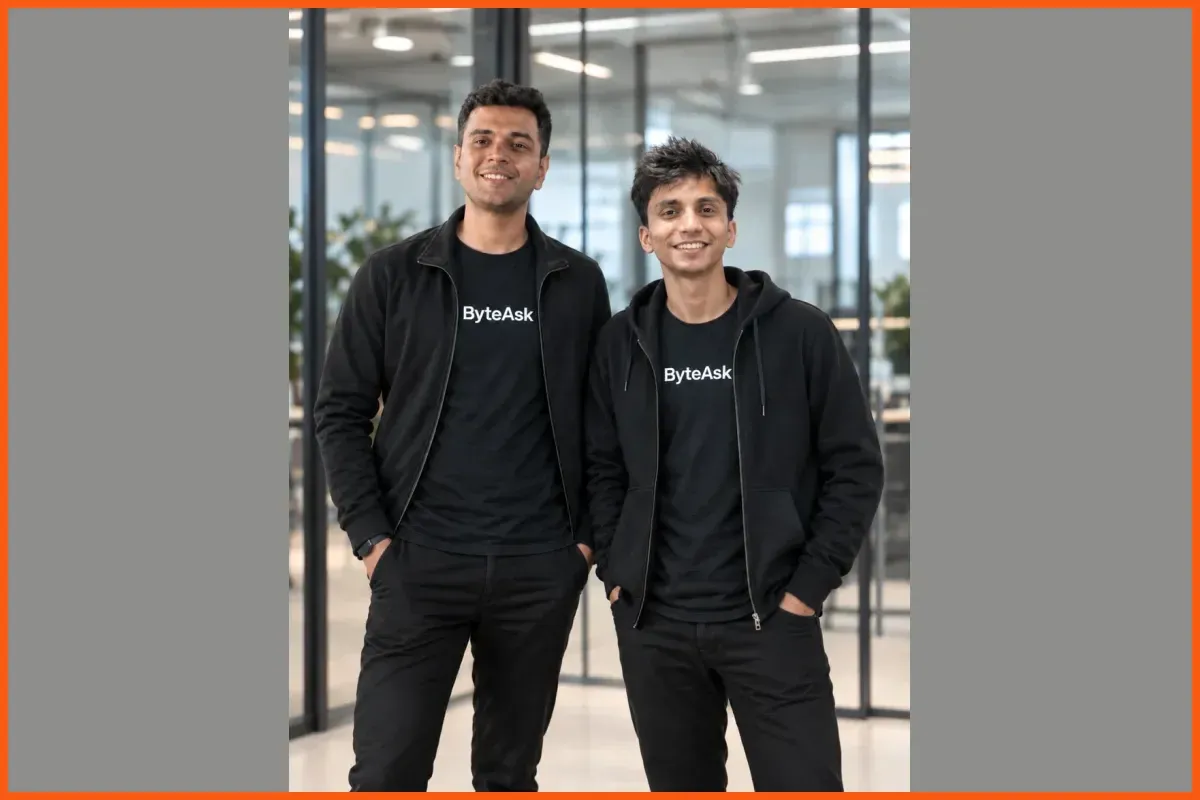
ByteAsk, a San Francisco company building AI coding agents for C and C++, has raised $1 million in pre-seed funding from Y Combinator and Entrepreneur First, alongside angel investors who work at global quantitative trading firms.
Both institutional backers publish standard terms. Y Combinator's is $500,000: $125,000 for a fixed 7% on a post-money SAFE, plus $375,000 on an uncapped SAFE with a most-favoured-nation clause. Entrepreneur First's India programme invests $125,000 for an 8% convertible. On those published terms the two programmes account for $625,000 of the round, which leaves roughly $375,000 coming from individuals. That is an unusually large angel component for a pre-seed, and it tracks with founders who spent their careers inside trading firms, where the people writing those cheques are also the people who would use the product.
The company was founded in June 2026 and sits in Y Combinator's Fall 2026 batch, the cohort that runs October to December in San Francisco. Founders Anirudha Kulkarni and Pratyush Saini say it is one of five India-founded companies in that batch. Operations are split between the US and India.
What the agent actually does
Most AI coding agents propose a change and stop there. ByteAsk runs the change through the toolchain before a developer sees it. It compiles with the project's own flags and build system, runs the test suite, and puts the result through memory and threading sanitizers: AddressSanitizer, UndefinedBehaviorSanitizer, ThreadSanitizer and Valgrind. It attaches to live gdb and lldb sessions, runs clang-tidy and clang-format, and reads compiled output through objdump, nm and readelf.
It works from a terminal or inside an editor, and covers the usual C++ build stack:
- Compilers and build systems: LLVM, GCC, clang, CMake, make, vcpkg, Conan
- Debuggers: gdb, lldb
- Editors: VS Code, Cursor, JetBrains IDEs, Neovim, Emacs, Zed, Windsurf, VSCodium
Two details matter for the customers it is chasing. The agent ships a reference layer that cites the standards these engineers are actually held to, including AUTOSAR, MISRA and the STM32 and x86-64 manuals, rather than paraphrasing them. And it can run entirely on-premises, with a choice of ByteAsk-managed models, the customer's own API keys, or self-hosted models through vLLM, Ollama, llama.cpp or LM Studio, which are not metered. Read-only commands execute on their own; anything that changes state waits for approval. Code and prompts are deleted after processing, and there is a free tier.
Why C and C++ is the hard case
The gap ByteAsk is building against is real but thinly measured. SWE-bench, the benchmark most model releases quote, is built on Python repositories. Multilingual equivalents arrived much later and are far smaller: Multi-SWE-bench carries 1,632 instances across seven languages including C and C++, and SWE-Bench ProMax covers 170 refactoring instances across the same seven. A model can look strong on the headline coding benchmark while almost nobody has measured it on the language running the car.
The technical reason is that C and C++ fail differently from the languages AI coding assistants were trained on. In safety-critical work the language is deliberately narrowed: MISRA C++:2023 and AUTOSAR C++14 ban the constructs that produce undefined or implementation-defined behaviour, precisely because static analysis cannot reason about them. Catching a buffer overrun or a silent lossy conversion needs flow-sensitive analysis across the whole program, not pattern-matching over code that looks similar. In an engine control unit, undefined behaviour is not a style problem. That is the argument for running the compiler and the sanitizers rather than trusting what the model produced, and it is the argument the company is built on.
The bet is that verification, not generation, is the bottleneck.
The company says that on its own benchmark of real firmware engineering tickets, its grounding environment lets a smaller model resolve 89% of tickets against 61% for the best frontier model tested without it. That is an internal benchmark, not an independent one. ByteAsk also says engineers use it roughly six times more intensively per day than a comparable open-source coding agent, and that weekly active users are doubling week on week. It has not disclosed the base.
From legal search to firmware
Kulkarni and Saini met as undergraduates at IIT Delhi and started LawSutra AI in January 2026, building semantic search for Indian legal research, a problem where keyword tools return too much and general chatbots invent citations. Manupatra acquired the company four months later, after testing the search technology on its own legal data. ByteAsk says 97.5% of results were relevant to the query, the best of the AI systems Manupatra tested. "LawSutra's semantic capability stood out for combining strong technology with a clear understanding of how lawyers actually research," said Deepak Kapoor, founder and chief executive of Manupatra. The technology now runs inside Manupatra AI Search. Y Combinator's profile of ByteAsk puts LawSutra's reach at more than 100,000 legal professionals, against the 5,000-plus lawyers who had signed up directly before the sale. That gap between a young company's own funnel and a 25-year-old incumbent's distribution is most of why legal AI tools tend to get bought rather than scaled.
Kulkarni holds a B.Tech and an M.Tech from IIT Delhi and worked on low-latency C++ at Optiver, including on its Delta One trading team, and on markets engineering at Quantbox Research, where he built a Python-to-C++ optimising transpiler that took an execution path from 1.5 seconds to 150 nanoseconds in production. Saini was a senior AI engineer at ThirdAI, working on large-scale training and inference infrastructure, and a founding engineer at Simbian, where he helped build security agents handling more than a million incidents a year.
Where the money goes
The round funds engineering and research hiring across San Francisco and Bengaluru, GPU compute and training data, and the on-premises security and privacy work that defence and trading customers insist on. ByteAsk plans to start with large firms in high-frequency trading, automotive and embedded systems before widening out, and intends to release a language model post-trained specifically for C++ within six to eight months.
That last ambition puts it in the category investors now call a neolab, a company shaped like a research lab rather than a product business. It is an expensive category to sit in. The Information reported roughly $2.5 billion committed or under discussion across five neolabs in a little over a month. ByteAsk is entering it on $1 million, which is either the discipline that comes from starting with customers who will pay for verified output, or a very thin runway for post-training a language model. The six-to-eight-month timeline will settle which.