Cabinet Greenlights INR 1.27 Lakh Crore Semicon Mission 2.0 for India’s Semiconductor Growth
The Union Cabinet has granted INR 1.27 lakh crore for India Semiconductor Mission (Semicon) 2.0 for bolstering the country’s semiconductor design and production ecosystem. Announced by IT Minister Ashwini Vaishnaw, the initiative intends to attract INR 4 lakh crore investments.
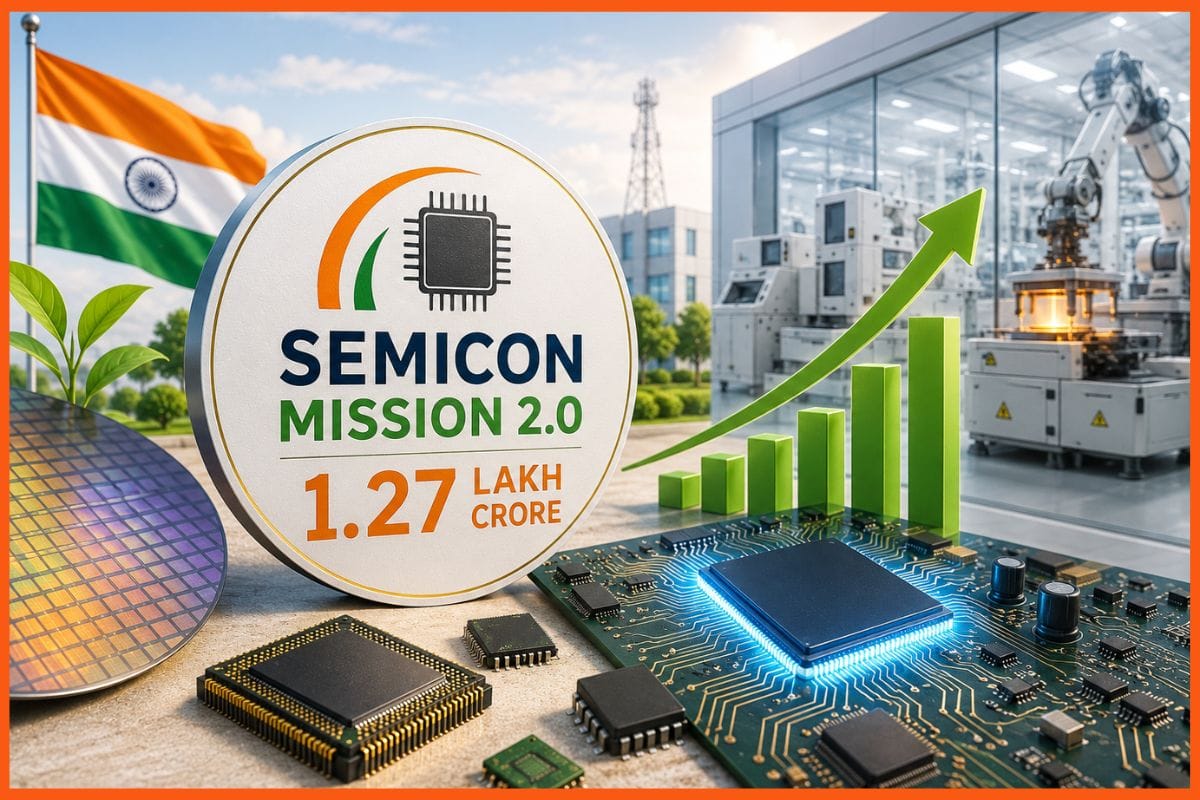
According to IT Minister Ashwini Vaishnaw, the Union Cabinet approved a budget of 1.27 lakh crore Indian rupees (INR) for the second India Semiconductor Mission on July 15, 2026. Investments of almost INR 4 lakh crore are anticipated by the government under the new programme. In addition, during the scheme lifetime, semiconductor production will reach INR 2 lakh crore.
In order to advance India's semiconductor design and manufacturing ecosystem, the Union Cabinet, which is headed by Prime Minister Narendra Modi, has given its approval to Semicon 2.0. Mineral and gas providers, who are integral to the chip production process, will also be eligible for incentives under the updated semiconductor programme.
Scheme Covers Entire Value Chain of Semiconductor Ecosystem
According to Vaishnaw, the new plan encompasses the whole ecosystem of semiconductor value chains. Semicon 2.0 would be built upon six pillars, he noted. The design of chips will serve as the initial foundation. Design, development, and production of indigenous chips will be the programme's primary priority, according to the Minister. By the conclusion of this program, India would be able to produce its own chips, according to the minister.
The initial India Semicon Mission had a budget of INR 76,000 crore. Twelve projects totalling about INR 1.64 lakh crore have been greenlit by the government under ISM 1.0. The semiconductor division of Indian technology company Tata Electronics has been the primary investor in the industry. Companies are already planning to increase production capacity in response to the global memory chip shortage, so the new initiative couldn't have arrived at a better moment. In order to satisfy the chip needs of AI devices, the plan anticipates attracting investment from other chip categories.
India Semiconductor Manufacturing Growth Till Now
Twelve semiconductor projects in the Indian states of Gujarat, Assam, Andhra Pradesh, Uttar Pradesh, and Odisha have received government approval since the beginning of the India Semiconductor Mission. These projects have a combined investment of around INR 1.64 lakh crore.
Projects in this category include the Dholera semiconductor production facility of Tata Electronics, the ATMP plant in Assam of Tata Semiconductor Assembly and Test, the Gujarat semiconductor packaging facility of Micron Technology, and other packaging initiatives undertaken by CG Power and the CG Power-Renesas partnership.
Three semiconductor plants have started producing goods for sale thus far. The first was the Sanand, Gujarat-based assembly, testing, marking, and packaging (ATMP) facility owned by Micron Technology, which cost $2.75 billion. On February 28, 2026, the unit was officially opened. At the moment, this plant is making DRAM and NAND flash memory for use in cellphones, servers, and cars. The Sanand OSAT facility of Kaynes Semicon is the second operating unit; commercial production commenced in March 2026. Thirdly, commercial manufacturing has also begun at CG Semi's Outsourced Semiconductor Assembly and Test (OSAT) plant in Sanand, Gujarat.