Centre Considers Mandatory Separate Warehouses for E-commerce Export FDI Compliance
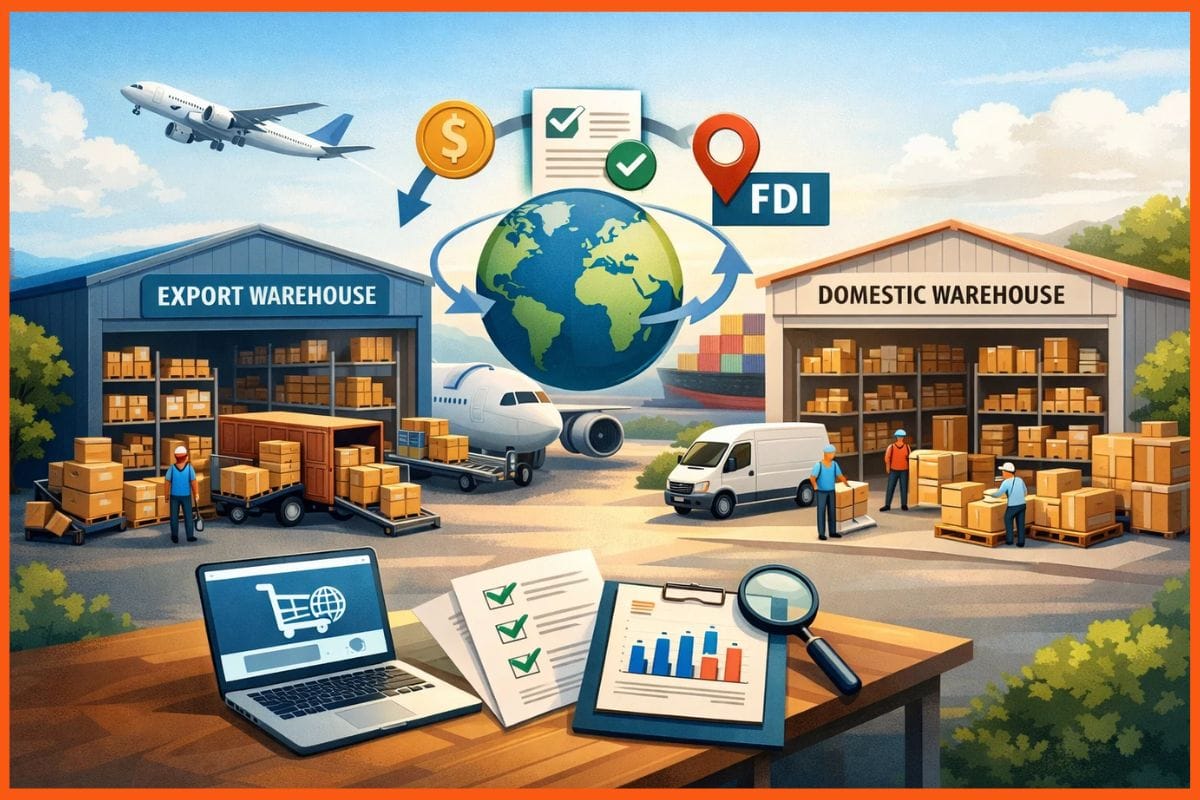
To shield small-scale retailers from competition, the government is considering measures including allowing foreign direct investment (FDI) for online sales but requiring international and local merchandise to be stored in separate facilities. According to a media outlet, the government is considering the possibility of mandating the use of separate warehouses.
The goal of the move is to prevent domestic marketing of export-orientated products. It is proposed that an e-commerce corporation backed by foreign investors establish a wholly owned subsidiary in India in order to buy goods from local vendors and resell them on a global scale.
Why Centre has Taken this Step?
Importantly, investing in an inventory-based e-commerce strategy is now not allowed in India. E-commerce marketplace models are the only ones that can use it. To increase Indian exports, the government has been contemplating opening the door to foreign direct investment in online retail. A letter soliciting feedback on the possibility of foreign direct investment (FDI) in e-commerce models based on inventory, intended only for export, was circulated by the ministry of trade and industry last year.
Amazon has previously asked the Indian government to change its foreign direct investment regulations so that the company could bypass middlemen and purchase goods straight from Indian vendors. By the year 2030, the Indian e-commerce market is predicted to have grown to over $400 billion. Consequently, the industry is highly favoured by investors. In 2025, 206 agreements were closed by e-commerce firms, raising a total of $1.7 billion. According to EY, out of India's total exports, 43% come from the country's more than 6.3 Cr MSMEs. The export value of online goods and services is $4–5 billion, or just 1% of the total export value.
FDI in Ecommerce a New Game Changer
One possible outcome of the decision to enable FDI in e-commerce exports is that corporations will increase their procurement from MSMEs. Profits for micro, small, and medium-sized enterprises (MSMEs) and India's exports will all rise as a result. Additionally, MSMEs might alleviate some of their regulatory requirements by doing business with FDI-funded enterprises.
The government has made significant efforts in recent years to assist micro, small, and medium-sized enterprises (MSMEs) in their efforts to create jobs and establish India as a leading manufacturing hub on the international stage. Finance Minister Nirmala Sitharaman announced in her 2026–27 budget speech that the Centre will establish a special fund for SMEs, with a target of creating "future champions", with a dedicated budget of INR 10,000 Cr. To further assist MSMEs and allow them access to risk financing, the government intends to add INR 2,000 Cr to the Self-Reliant India (SRI) Fund, which was established in 2021.
|
Quick Shots |
|
•GOI considers mandatory separate
warehouses for e-commerce export FDI compliance •Aim: Protect small retailers and prevent
domestic sale of export-only goods •Proposal includes separating local and
export inventory storage •FDI-backed firms may need to set up wholly
owned subsidiaries in India |