CHINI KUM Closes ₹1.64 Crore Pre-Seed for Zero-Sugar Drinks
CHINI KUM has closed its pre-seed at ₹1.64 crore, entirely from individual angels, for a zero-sugar prebiotic drink. It is competing in the category PepsiCo validated by paying $1.95 billion for Poppi.
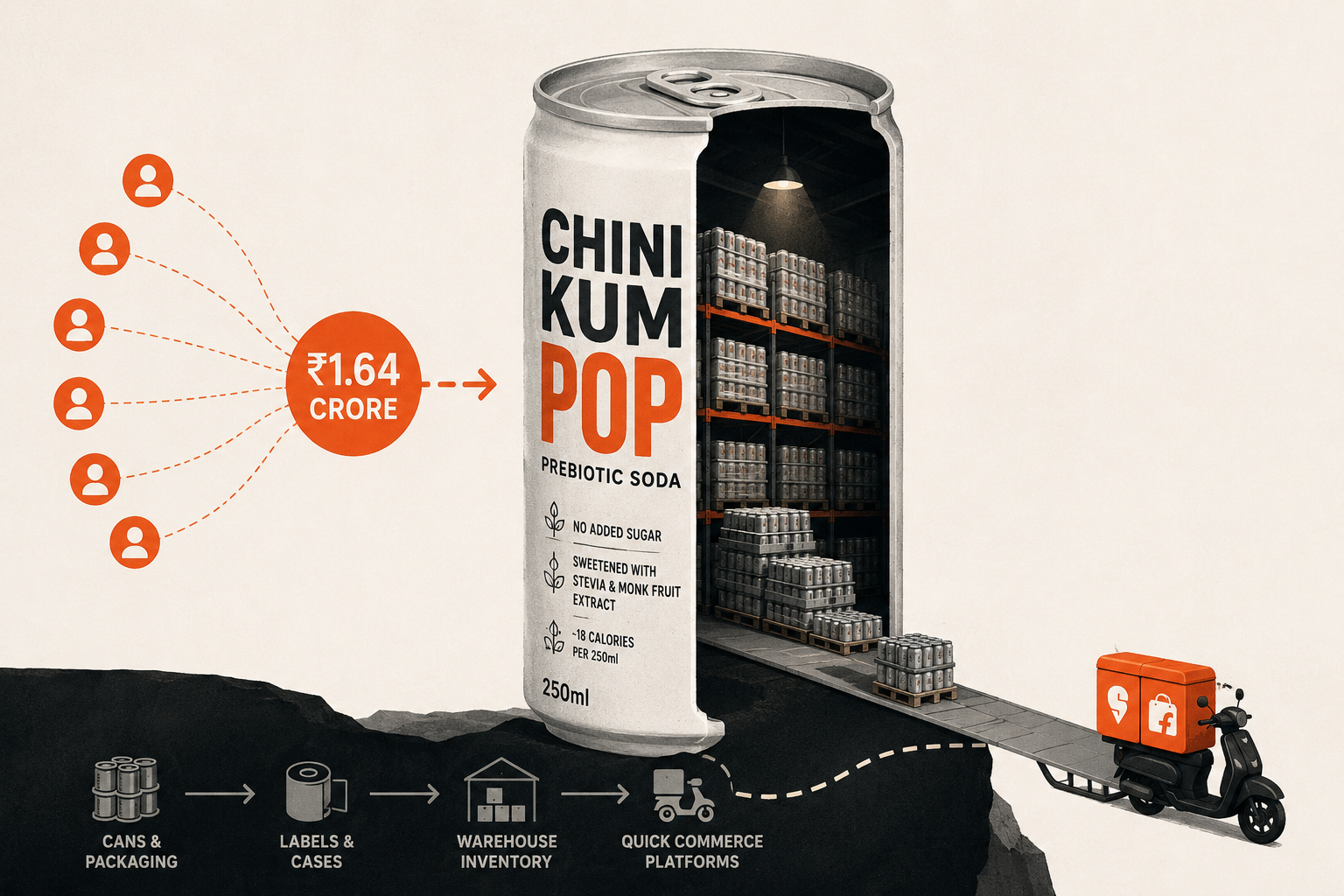
A 250ml can of CHINI KUM POP carries about 18 calories and no added sugar. The sweetness comes from stevia and monk fruit extract, and the fibre in it is the prebiotic that gives the category its name.
On 29 August 2026 the Noida brand closed its pre-seed round at ₹1.64 crore. Founder Priyank Jain announced it on LinkedIn, having opened the round in January.
"Happy to share that our pre-seed round, announced earlier this January, got closed at a total raise of ₹1.64 Cr!"
The money came entirely from angels, seven of them, among them Deepika Agarwal, Swati Singhal and Aditya Babbar. No fund took part. The company is about a year old and was valued at roughly ₹9.4 crore earlier this year.
CHINI KUM sells a carbonated line it calls POP and a still range, in flavours including lemon and mango, through Swiggy Instamart, Flipkart Minutes and its own site. It puts the calorie saving against a conventional soft drink at about 85%.
Where ₹1.64 crore goes in a canned drinks business
Almost all of it goes into inventory before any of it comes back. CHINI KUM does not own a plant, so a production run is paid for up front, and so are the cans, the labels and the outer cases. That stock ships into a warehouse and sits there until it sells, with the platform settling afterwards on its own terms. A software company at this funding level is paying salaries and cloud bills, and can slow both down in a bad month. A canned drinks brand at this funding level has already turned most of its round into aluminium sitting in somebody else's dark store, and it cannot un-buy it. That is why D2C brands raise more often, and in smaller pieces, than software companies do.
The shelf is an app now
Instamart and Flipkart Minutes put a one-year-old brand in front of buyers in several cities with no distributor and no listing negotiation. Ten years ago that took a sales team and a few years. The catch is that the same quick commerce platforms charge for visibility, control the search ranking that decides whether anyone finds a new drink, and can drop a slow SKU without ceremony. The shelf is easier to reach and harder to hold.
Why investors are looking at fizzy drinks with no sugar
In May 2025 PepsiCo completed the purchase of Poppi, an American prebiotic soda brand, for $1.95 billion. That deal showed a drink defined mostly by what it leaves out could be worth nearly $2 billion to an incumbent, and it is the reason angels in India are now willing to fund a can of flavoured fibre.
The incumbents here have noticed too. ITC has been extending its range into sugar-free territory, so the shelf CHINI KUM competes on already carries zero-sugar options from companies with national distribution, alongside a growing set of smaller beverage startups.
The number that decides the next round
Whether someone who tries a mango CHINI KUM orders a second one.
Stevia and monk fruit are the honest difficulty here. They let the brand avoid the artificial sweeteners it is positioned against, and they carry an aftertaste that some people never get used to. No amount of packaging or shelf placement fixes that. Repeat purchase is the only number a fund will care about when this brand comes back for a bigger round, and ₹1.64 crore is roughly what it costs to find out.
Common questions
What is in CHINI KUM's drinks?
The drinks contain no added sugar and are sweetened with stevia and monk fruit extract, with fructo-oligosaccharide as the prebiotic fibre. A 250ml serving carries roughly 18 calories.
How much has CHINI KUM raised?
Its pre-seed round closed at ₹1.64 crore, opened in January 2026 and closed in August 2026, entirely from angel investors.
Where can you buy CHINI KUM?
The brand sells through Swiggy Instamart, Flipkart Minutes and its own website, drinkchinikum.com.
Round size and the quote come from Priyank Jain's public LinkedIn post of 29 August 2026. Product details come from the company's website. Company age, valuation and investor names come from Tracxn, retrieved 29 August 2026. The PepsiCo figure comes from PepsiCo's own announcement.